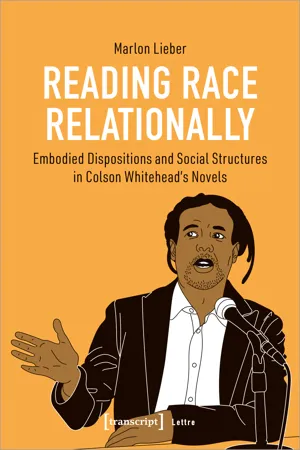
What does it mean to write African American literature after the end of legalized segregation? In this study of Colson Whitehead's first six novels, Marlon Lieber argues that this question has permeated the Pulitzer Prize-winning author's writing since his 1999 debut The Intuitionist . Drawing on Pierre Bourdieu's relational sociology and Marxist critical theory, Lieber shows that Whitehead's oeuvre articulates the tension between the persistent presence of racism and transformations in the United States' class structure, which reveals new modes of abjection. At the same time, Whitehead imagines forms of writing that strive to transcend the histories of domination objectified in social structures and embodied in the form of habitus.
eBook - PDF
Reading Race Relationally
Embodied Dispositions and Social Structures in Colson Whitehead's Novels
- 271 pages
- English
- PDF
- Available on iOS & Android
eBook - PDF
Reading Race Relationally
Embodied Dispositions and Social Structures in Colson Whitehead's Novels
About this book
Information
Topic
LiteraturSubtopic
Nordamerikanische GeschichteTable of contents
- Cover
- Contents
- Acknowledgments
- Introduction: Reading | Race | Relationally
- 1. Reading the Past, Writing the Future: The Intuitionist
- 2. Ab/uses of History: John Henry Days and Apex Hides the Hurt
- 3. (Post‐Black) Bildungsroman or Novel of (Black Bourgeois) Manners? Sag Harbor
- 4. Money, Abstraction, Cultural Production: John Henry Days and Apex Hides the Hurt Revisited
- 5. The Masterless Ocean: Zone One
- Conclusion: To Escape the Fundamental Principles of Your Existence
- Works Cited
Trusted by 375,005 students
Access to over 1.5 million titles for a fair monthly price.
Study more efficiently using our study tools.
Frequently asked questions
Yes, you can cancel anytime from the Subscription tab in your account settings on the Perlego website. Your subscription will stay active until the end of your current billing period. Learn how to cancel your subscription
No, books cannot be downloaded as external files, such as PDFs, for use outside of Perlego. However, you can download books within the Perlego app for offline reading on mobile or tablet. Learn how to download books offline
Perlego offers two plans: Essential and Complete
- Essential is ideal for learners and professionals who enjoy exploring a wide range of subjects. Access the Essential Library with 800,000+ trusted titles and best-sellers across business, personal growth, and the humanities. Includes unlimited reading time and Standard Read Aloud voice.
- Complete: Perfect for advanced learners and researchers needing full, unrestricted access. Unlock 1.5M+ books across hundreds of subjects, including academic and specialized titles. The Complete Plan also includes advanced features like Premium Read Aloud and Research Assistant.
We are an online textbook subscription service, where you can get access to an entire online library for less than the price of a single book per month. With over 1.5 million books across 990+ topics, we’ve got you covered! Learn about our mission
Look out for the read-aloud symbol on your next book to see if you can listen to it. The read-aloud tool reads text aloud for you, highlighting the text as it is being read. You can pause it, speed it up and slow it down. Learn more about Read Aloud
Yes! You can use the Perlego app on both iOS and Android devices to read anytime, anywhere — even offline. Perfect for commutes or when you’re on the go.
Please note we cannot support devices running on iOS 13 and Android 7 or earlier. Learn more about using the app
Please note we cannot support devices running on iOS 13 and Android 7 or earlier. Learn more about using the app
Yes, you can access Reading Race Relationally by Marlon Lieber in PDF and/or ePUB format, as well as other popular books in Literatur & Nordamerikanische Geschichte. We have over 1.5 million books available in our catalogue for you to explore.