It is an often ignored but fundamental fact that in the Ottoman world, as in most empires, there were 'first-class' and 'second class' subjects. Among the townspeople, peasants and nomads subject to the sultans, who might be Muslims or non-Muslims, adult Muslim males were first-class subjects and all others, including Muslim boys and women, were of the second class. As for the female members of the elite, while less privileged than the males, in some respects their life chances might be better than those of ordinary women. Even so, they shared the risks of pregnancy, childbirth and epidemic diseases with townswomen of the subject class and to a certain extent, with village women as well. Thus, the study of Ottoman women is indispensable for understanding Ottoman society in general.
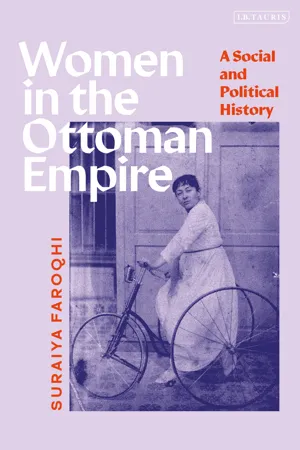
In this book, the agency of women from a diverse range of class, religious, ethnic, and geographic backgrounds is, for the first time, woven into the social and political history of the Ottoman Empire, from the early-modern period to its dissolution in 1918. Suraiya Faroqhi charts the history of elite and non-elite women in thematic chapters concentrating on urban women, family life, work, slavery, education and survival in times of war. In the process the book introduces readers to the key sources, primary and secondary, necessary to reconstruct and understand the ways that females navigated social, legal and economic constraints, through the central prisms of family relations, work and charity. The first introductory social history of women in the Ottoman Empire, and including a timeline and extended further reading section, this book will be essential reading for scholars and students of Ottoman history and the history of women in the Middle East.
- 328 pages
- English
- ePUB (mobile friendly)
- Available on iOS & Android
eBook - ePub
About this book
Trusted by 375,005 students
Access to over 1.5 million titles for a fair monthly price.
Study more efficiently using our study tools.
Information
Table of contents
- Cover
- Half-Title Page
- Title Page
- Epigraph
- Contents
- List of figures
- Preface and acknowledgements
- A note on spelling and transliteration
- Maps of the Ottoman empire
- Timeline
- Introduction
- Prologue: a conspectus of Ottoman history as relevant to women
- 1 How women fitted into Ottoman history
- Part I 1500s–1700
- 2 The legal framework of family life
- 3 Dependent on work, investments and charity
- 4 Exceptionally talented, exceptionally active: women of distinction
- Part II 1700–1870s
- 5 Ottoman diversity: female agency and survival in Ottoman Syria and Egypt
- 6 Ottoman diversity: coping with relatives, the state and dependent capitalism
- Part III 1870–1918
- 7 Female teachers, journalists and actors: education as a source of survival skills
- 8 Before 1912: surviving through family, work, and charity – and occasionally turning to crime
- 9 In profound distress: struggling to survive the disintegration of the empire (1912–18)
- Conclusion
- Suggestions for further reading
- Glossary
- Notes
- Bibliography
- Index
- Copyright
Frequently asked questions
Yes, you can cancel anytime from the Subscription tab in your account settings on the Perlego website. Your subscription will stay active until the end of your current billing period. Learn how to cancel your subscription
No, books cannot be downloaded as external files, such as PDFs, for use outside of Perlego. However, you can download books within the Perlego app for offline reading on mobile or tablet. Learn how to download books offline
Perlego offers two plans: Essential and Complete
- Essential is ideal for learners and professionals who enjoy exploring a wide range of subjects. Access the Essential Library with 800,000+ trusted titles and best-sellers across business, personal growth, and the humanities. Includes unlimited reading time and Standard Read Aloud voice.
- Complete: Perfect for advanced learners and researchers needing full, unrestricted access. Unlock 1.5M+ books across hundreds of subjects, including academic and specialized titles. The Complete Plan also includes advanced features like Premium Read Aloud and Research Assistant.
We are an online textbook subscription service, where you can get access to an entire online library for less than the price of a single book per month. With over 1.5 million books across 990+ topics, we’ve got you covered! Learn about our mission
Look out for the read-aloud symbol on your next book to see if you can listen to it. The read-aloud tool reads text aloud for you, highlighting the text as it is being read. You can pause it, speed it up and slow it down. Learn more about Read Aloud
Yes! You can use the Perlego app on both iOS and Android devices to read anytime, anywhere — even offline. Perfect for commutes or when you’re on the go.
Please note we cannot support devices running on iOS 13 and Android 7 or earlier. Learn more about using the app
Please note we cannot support devices running on iOS 13 and Android 7 or earlier. Learn more about using the app
Yes, you can access Women in the Ottoman Empire by Suraiya Faroqhi in PDF and/or ePUB format, as well as other popular books in History & Middle Eastern History. We have over 1.5 million books available in our catalogue for you to explore.