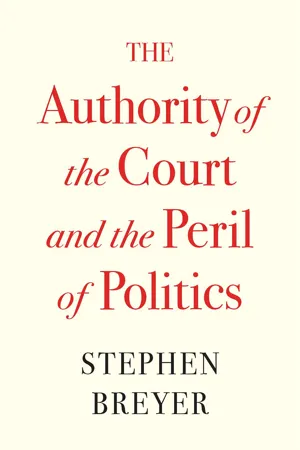
A sitting justice reflects upon the authority of the Supreme Court—how that authority was gained and how measures to restructure the Court could undermine both the Court and the constitutional system of checks and balances that depends on it.
A growing chorus of officials and commentators argues that the Supreme Court has become too political. On this view the confirmation process is just an exercise in partisan agenda-setting, and the jurists are no more than "politicians in robes"—their ostensibly neutral judicial philosophies mere camouflage for conservative or liberal convictions.
Stephen Breyer, drawing upon his experience as a Supreme Court justice, sounds a cautionary note. Mindful of the Court's history, he suggests that the judiciary's hard-won authority could be marred by reforms premised on the assumption of ideological bias. Having, as Hamilton observed, "no influence over either the sword or the purse," the Court earned its authority by making decisions that have, over time, increased the public's trust. If public trust is now in decline, one part of the solution is to promote better understandings of how the judiciary actually works: how judges adhere to their oaths and how they try to avoid considerations of politics and popularity.
Breyer warns that political intervention could itself further erode public trust. Without the public's trust, the Court would no longer be able to act as a check on the other branches of government or as a guarantor of the rule of law, risking serious harm to our constitutional system.
- 101 pages
- English
- ePUB (mobile friendly)
- Available on iOS & Android
eBook - ePub
The Authority of the Court and the Peril of Politics
About this book
Information
Table of contents
- Cover
- Also by Stephen Breyer
- Title Page
- Copyright
- Dedication
- Contents
- Preface
- Author’s Note
- I. The Court’s Power: In General
- II. The Court as a Check
- III. The Check and the Future
- Acknowledgments
Trusted by 375,005 students
Access to over 1.5 million titles for a fair monthly price.
Study more efficiently using our study tools.
Frequently asked questions
Yes, you can cancel anytime from the Subscription tab in your account settings on the Perlego website. Your subscription will stay active until the end of your current billing period. Learn how to cancel your subscription
No, books cannot be downloaded as external files, such as PDFs, for use outside of Perlego. However, you can download books within the Perlego app for offline reading on mobile or tablet. Learn how to download books offline
Perlego offers two plans: Essential and Complete
- Essential is ideal for learners and professionals who enjoy exploring a wide range of subjects. Access the Essential Library with 800,000+ trusted titles and best-sellers across business, personal growth, and the humanities. Includes unlimited reading time and Standard Read Aloud voice.
- Complete: Perfect for advanced learners and researchers needing full, unrestricted access. Unlock 1.5M+ books across hundreds of subjects, including academic and specialized titles. The Complete Plan also includes advanced features like Premium Read Aloud and Research Assistant.
We are an online textbook subscription service, where you can get access to an entire online library for less than the price of a single book per month. With over 1.5 million books across 990+ topics, we’ve got you covered! Learn about our mission
Look out for the read-aloud symbol on your next book to see if you can listen to it. The read-aloud tool reads text aloud for you, highlighting the text as it is being read. You can pause it, speed it up and slow it down. Learn more about Read Aloud
Yes! You can use the Perlego app on both iOS and Android devices to read anytime, anywhere — even offline. Perfect for commutes or when you’re on the go.
Please note we cannot support devices running on iOS 13 and Android 7 or earlier. Learn more about using the app
Please note we cannot support devices running on iOS 13 and Android 7 or earlier. Learn more about using the app
Yes, you can access The Authority of the Court and the Peril of Politics by Stephen Breyer in PDF and/or ePUB format, as well as other popular books in Law & North American History. We have over 1.5 million books available in our catalogue for you to explore.