"Provocative and engaging…The array of urgent questions and crises facing our democracy makes one miss Richard Rorty's voice: insistent, relentlessly questioning, and dedicated to the proposition that we can't afford to let our democracy fail."
—Chris Lehmann, New Republic
"Richard Rorty was the most iconoclastic and dramatic philosopher of the last half-century. In this final book, his unique literary style, singular intellectual zest, and demythologizing defiance of official philosophy are on full display."
—Cornel West
"Coherent, often brilliant, and it presents a clear and timely case for political pragmatism."
—Jonathan Rée, Prospect
"Today, there are few philosophers left whose thoughts are inspired by a unifying vision; there are even fewer who can articulate such a view in terms of such a ravishing flow of provocative, but sharp and differentiated, arguments."
—Jürgen Habermas
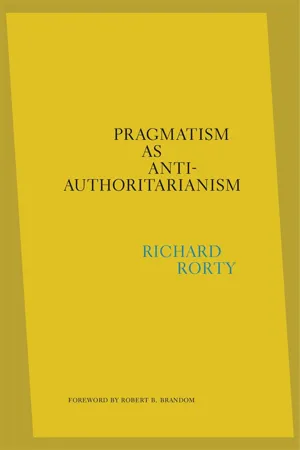
Richard Rorty's final masterwork offers his culminating thoughts on the influential version of pragmatism he began to articulate decades ago in his groundbreaking Philosophy and the Mirror of Nature. He identifies anti-authoritarianism as the principal impulse and virtue of pragmatism. Anti-authoritarianism, in this view, means acknowledging that our cultural inheritance is always open to revision because no authority exists to ascertain the truth, once and for all. If we cannot rely on the unshakable certainties of God or nature, then all we have left to go on—and argue with—are the opinions and ideas of our fellow humans. The test of these ideas, Rorty suggests, is relatively simple: Do they work? Do they produce the peace, freedom, and happiness we desire? To achieve this enlightened pragmatism is not easy, though. Pragmatism demands trust. It demands that we think and care about what others think and care about, and that we account for their doubts of and objections to our own beliefs.
No book offers a more accessible account of pragmatism, just as no philosopher has more eloquently challenged the hidebound traditions arrayed against the goals of social justice.
- 273 pages
- English
- PDF
- Available on iOS & Android
eBook - PDF
Pragmatism as Anti-Authoritarianism
About this book
Information
Topic
PhilosophySubtopic
Epistemology in PhilosophyTable of contents
- Cover
- Title Page
- Copyright
- Contents
- Foreword: Achieving the Enlightenment by Robert B. Brandom
- Preface
- 1. Pragmatism and Religion
- 2. Pragmatism as Romantic Polytheism
- 3 & 4. Universality and Truth
- 5. Pan-Relationalism
- 6. Against Depth
- 7. Ethics without Universal Obligations
- 8. Justice as a Larger Loyalty
- 9. Is There Anything Worth Saving in Empiricism?
- 10. McDowell’s Version of Empiricism
- Epilogue by Eduardo Mendieta
- Notes
- Index
Trusted by 375,005 students
Access to over 1.5 million titles for a fair monthly price.
Study more efficiently using our study tools.
Frequently asked questions
Yes, you can cancel anytime from the Subscription tab in your account settings on the Perlego website. Your subscription will stay active until the end of your current billing period. Learn how to cancel your subscription
No, books cannot be downloaded as external files, such as PDFs, for use outside of Perlego. However, you can download books within the Perlego app for offline reading on mobile or tablet. Learn how to download books offline
Perlego offers two plans: Essential and Complete
- Essential is ideal for learners and professionals who enjoy exploring a wide range of subjects. Access the Essential Library with 800,000+ trusted titles and best-sellers across business, personal growth, and the humanities. Includes unlimited reading time and Standard Read Aloud voice.
- Complete: Perfect for advanced learners and researchers needing full, unrestricted access. Unlock 1.5M+ books across hundreds of subjects, including academic and specialized titles. The Complete Plan also includes advanced features like Premium Read Aloud and Research Assistant.
We are an online textbook subscription service, where you can get access to an entire online library for less than the price of a single book per month. With over 1.5 million books across 990+ topics, we’ve got you covered! Learn about our mission
Look out for the read-aloud symbol on your next book to see if you can listen to it. The read-aloud tool reads text aloud for you, highlighting the text as it is being read. You can pause it, speed it up and slow it down. Learn more about Read Aloud
Yes! You can use the Perlego app on both iOS and Android devices to read anytime, anywhere — even offline. Perfect for commutes or when you’re on the go.
Please note we cannot support devices running on iOS 13 and Android 7 or earlier. Learn more about using the app
Please note we cannot support devices running on iOS 13 and Android 7 or earlier. Learn more about using the app
Yes, you can access Pragmatism as Anti-Authoritarianism by Richard Rorty, Eduardo Mendieta in PDF and/or ePUB format, as well as other popular books in Philosophy & Epistemology in Philosophy. We have over 1.5 million books available in our catalogue for you to explore.