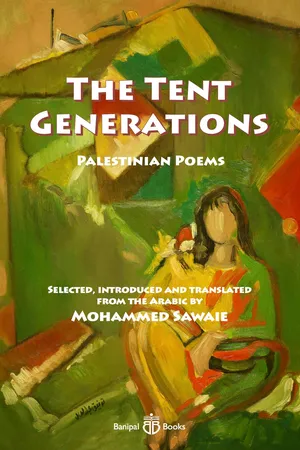
From the Introduction by Mohammed Sawaie:
The Palestinian poets included in The Tent Generations, Palestinian Poems represent different age groups and backgrounds, yet they all express a strong sense of "Palestinian-ness". They include Israeli citizens, the offspring of those who remained in Palestine after 1948. They also include poets who lived or continue to live in the West Bank and Gaza, areas that are still occupied, or controlled by Israelis as of this writing. Finally, they include poets born in Palestine, but whose families were expelled, or migrated to neighboring Arab countries as a result of the Arab-Israeli wars of the Nakba in 1948, and then of 1967 and 1973.
The educational backgrounds of the poets represented here vary. Salem Jubran, Samih al-Qasim, Tawfiq Zayyad, and Marwan Makhoul, for example, were products of the Israeli educational system. Others attended institutions of learning in various Arab countries. Fadwa Tuqan received little formal education in her city of Nablus; she, however, acquired instruction in language, support in writing poetry, and encouragement to publish her poems from her brother, the well-known poet Ibrahim Tuqan, mentioned previously.
All these poems are written in fusha Arabic, Modern Standard Arabic, the codified literary, written language shared by educated speakers of Arabic in their various respective regions. Palestinian folkloric poetry, referred to as al-Shi'r al-Sha'bi or Shi'r al-'Ammiyya, is not included in this work. Folk poetry, richly expressed orally in the Palestinian dialect, 'Ammiyya, embraces a variety of themes (national pride, panegyric, love, generosity toward guests/strangers, and so on), including the political themes expressed in the poems in this work. There is a rising interest in collecting and preserving this folkloric poetry, and several anthologies of oral poetry as well as studies have recently appeared.
The 1948 Nakba, the wars of 1967 and 1973, and their subsequent tragic impact find expression in the work of Palestinian poets. Some of the authors in this collection had firsthand experience of the loss of home, and the up-rootedness from and destruction of their villages and cities. Others acquired knowledge of such experiences, the tragedy that befell Palestinians, through stories told by grandparents or parents, stories of hardship and deprivation transmitted from one generation to another. Thus, poets express in vocabulary specific to the Palestinian experience of the dispossession of homeland, the forced expulsion, the pain of living in the miserable conditions of refugee camps in the diaspora.