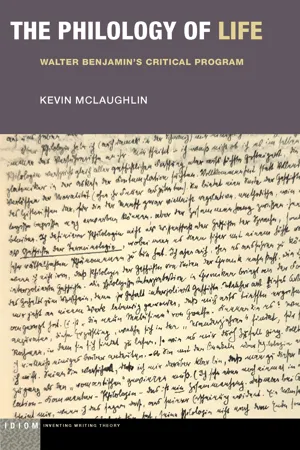
The Philology of Life retraces the outlines of the philological project developed by Walter Benjamin in his early essays on Hölderlin, the Romantics, and Goethe. This philological program, McLaughlin shows, provides the methodological key to Benjamin's work as a whole.
According to Benjamin, German literary history in the period roughly following the first World War was part of a wider "crisis of historical experience"—a life crisis to which Lebensphilosophie (philosophy of life) had instructively but insufficiently responded. Benjamin's literary critical struggle during these years consisted in developing a philology of literary historical experience and of life that is rooted in an encounter with a written image.
The fundamental importance of this "philological" method in Benjamin's work seems not to have been recognized by his contemporary readers, including Theodor Adorno who considered the approach to be lacking in dialectical rigor. This facet of Benjamin's work was also elided in the postwar publications of his writings, both in German and English. In recent decades, the publication of a wider range of Benjamin's writings has made it possible to retrace the outlines of a distinctive philological project that starts to develop in his early literary criticism and that extends into the late studies of Baudelaire and Paris. By bringing this innovative method to light this study proposes "the philology of life" as the key to the critical program of one of the most influential intellectual figures in the humanities.
- 213 pages
- English
- PDF
- Available on iOS & Android
eBook - PDF
About this book
Information
Publisher
Fordham University PressYear
2023Print ISBN
9781531501693
9781531501686
Edition
1eBook ISBN
9781531501716
Table of contents
- Cover
- Title Page
- Copyright
- Dedication
- Contents
- Note on Abbreviations
- Introduction: The Philology of Life
- 1. “Two Poems by Friedrich Hölderlin"
- 2. The Concept of Criticism in German Romanticism
- 3. “Goethe’s Elective Affinities"
- Coda: The Afterlife of Philology
- Acknowledgments
- Appendix: Sources for Benjamin’s “Goethe’s Elective Affinities” (1924–25)
- Notes
- Bibliography
- Index
- About the Author
- Series
Trusted by 375,005 students
Access to over 1.5 million titles for a fair monthly price.
Study more efficiently using our study tools.
Frequently asked questions
Yes, you can cancel anytime from the Subscription tab in your account settings on the Perlego website. Your subscription will stay active until the end of your current billing period. Learn how to cancel your subscription
No, books cannot be downloaded as external files, such as PDFs, for use outside of Perlego. However, you can download books within the Perlego app for offline reading on mobile or tablet. Learn how to download books offline
Perlego offers two plans: Essential and Complete
- Essential is ideal for learners and professionals who enjoy exploring a wide range of subjects. Access the Essential Library with 800,000+ trusted titles and best-sellers across business, personal growth, and the humanities. Includes unlimited reading time and Standard Read Aloud voice.
- Complete: Perfect for advanced learners and researchers needing full, unrestricted access. Unlock 1.5M+ books across hundreds of subjects, including academic and specialized titles. The Complete Plan also includes advanced features like Premium Read Aloud and Research Assistant.
We are an online textbook subscription service, where you can get access to an entire online library for less than the price of a single book per month. With over 1.5 million books across 990+ topics, we’ve got you covered! Learn about our mission
Look out for the read-aloud symbol on your next book to see if you can listen to it. The read-aloud tool reads text aloud for you, highlighting the text as it is being read. You can pause it, speed it up and slow it down. Learn more about Read Aloud
Yes! You can use the Perlego app on both iOS and Android devices to read anytime, anywhere — even offline. Perfect for commutes or when you’re on the go.
Please note we cannot support devices running on iOS 13 and Android 7 or earlier. Learn more about using the app
Please note we cannot support devices running on iOS 13 and Android 7 or earlier. Learn more about using the app
Yes, you can access The Philology of Life by Kevin McLaughlin in PDF and/or ePUB format, as well as other popular books in Literature & Literary Criticism Theory. We have over 1.5 million books available in our catalogue for you to explore.