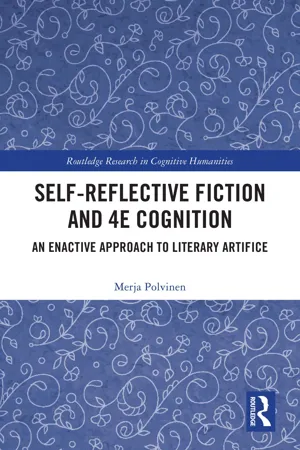
Self-Reflective Fiction and 4E Cognition
eBook - ePub

Self-Reflective Fiction and 4E Cognition

An Enactive Approach to Literary Artifice

  1. 208 pages
  2. English
  3. ePUB (mobile friendly)
  4. Available on iOS & Android
eBook - ePub

Self-Reflective Fiction and 4E Cognition

An Enactive Approach to Literary Artifice

About this book

This book brings together the study of self-reflective fiction and the contemporary 4E theories of cognition in order to challenge existing cognitive-theoretical models and approaches to literary phenomena.

Polvinen presents reflective attention on artifice as an integral part of engagement with fictional narratives, rather than as an external viewpoint that would obscure immersive experiences. The detailed analyses included are both of traditionally metafictional texts by John Barth, A.S. Byatt, Dave Eggers, and Ali Smith, as well as of speculative fictions by Ted Chiang, China Miéville, Christopher Priest, and Catherynne M. Valente. Each of the chapters focuses on a specific issue of fictional cognition: on metaphorical representation, spatiality, temporality, and fictionality. As a whole, the book argues that by combining a literary and theoretically complex view of artifice with the enactive paradigm of perception and imagination, practitioners of cognitive literary studies can further sharpen their own conceptual and terminological apparatus and continue to generate fruitful hermeneutic circulation around the study of the imagination in both the sciences and the humanities.

This book will appeal to students and scholars interested in cognitive approaches to literary studies, speculative fiction, metafiction, and narrative studies.

Frequently asked questions

Yes, you can cancel anytime from the Subscription tab in your account settings on the Perlego website. Your subscription will stay active until the end of your current billing period. Learn how to cancel your subscription.
No, books cannot be downloaded as external files, such as PDFs, for use outside of Perlego. However, you can download books within the Perlego app for offline reading on mobile or tablet. Learn more here.
Perlego offers two plans: Essential and Complete
  • Essential is ideal for learners and professionals who enjoy exploring a wide range of subjects. Access the Essential Library with 800,000+ trusted titles and best-sellers across business, personal growth, and the humanities. Includes unlimited reading time and Standard Read Aloud voice.
  • Complete: Perfect for advanced learners and researchers needing full, unrestricted access. Unlock 1.4M+ books across hundreds of subjects, including academic and specialized titles. The Complete Plan also includes advanced features like Premium Read Aloud and Research Assistant.
Both plans are available with monthly, semester, or annual billing cycles.
We are an online textbook subscription service, where you can get access to an entire online library for less than the price of a single book per month. With over 1 million books across 1000+ topics, we’ve got you covered! Learn more here.
Look out for the read-aloud symbol on your next book to see if you can listen to it. The read-aloud tool reads text aloud for you, highlighting the text as it is being read. You can pause it, speed it up and slow it down. Learn more here.
Yes! You can use the Perlego app on both iOS or Android devices to read anytime, anywhere — even offline. Perfect for commutes or when you’re on the go.
Please note we cannot support devices running on iOS 13 and Android 7 or earlier. Learn more about using the app.
Yes, you can access Self-Reflective Fiction and 4E Cognition by Merja Polvinen in PDF and/or ePUB format, as well as other popular books in Languages & Linguistics & Linguistics. We have over one million books available in our catalogue for you to explore.

Table of contents

  1. Cover
  2. Half Title
  3. Series Page
  4. Title Page
  5. Copyright Page
  6. Table of Contents
  7. Acknowledgements
  8. 1 Introduction: An Enactive Approach to Self-Reflective Fiction
  9. 2 The Metaphorical Seeing-As
  10. 3 The Artificial Spatiality of Literary Environments
  11. 4 Temporality and Embodied Knowledge
  12. 5 Fictionality as Artifice
  13. References
  14. Index