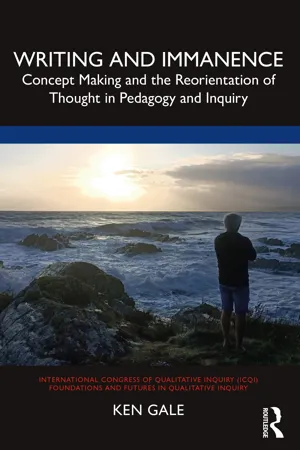
Writing and Immanence
eBook - ePub

Writing and Immanence

Concept Making and the Reorientation of Thought in Pedagogy and Inquiry

  1. 232 pages
  2. English
  3. ePUB (mobile friendly)
  4. Available on iOS & Android
eBook - ePub

Writing and Immanence

Concept Making and the Reorientation of Thought in Pedagogy and Inquiry

About this book

Writing and Immanence is a book that is attentive to the unabatingly potent, sometimes agonistic, forces at play in the continuing unfoldings of crises of representation. As immanent doing, the writing in the book writes to destabilise the orthodoxies, conventions and unquestioned givens of writing in the academy and, in so doing, is troubled by the ontogenetic uncertainties of its own writing coming into being.

In the always active processualism of presencing, the fragility of word and concept creation animates, what Meillassoux has described as 'the absolute necessity of the contingency of everything'. In working to avoid the formational and structural linearities of a series of numbered consecutive chapters, the book is constructed in and around the movements of the always actualising capaciousness of Acts. In offering engagements with education research and pedagogy and always sensitive to the dynamics of multiplicity, each Act emanates from and feeds into other en(Act)ments in the unfolding emergence of the book. Hence, in agencement, the book offers multiple points of entry and departure.

Deleuze has said that a creator is 'someone who creates their own impossibilities, and thereby creates possibilities…it's by banging your head on the wall that you find a way through.' Therefore, the writing of this book writes to the writing, pedagogic and qualitative research practices of those in education and the humanities who are writing to the creation of such impossibilities.

Frequently asked questions

Yes, you can cancel anytime from the Subscription tab in your account settings on the Perlego website. Your subscription will stay active until the end of your current billing period. Learn how to cancel your subscription.
No, books cannot be downloaded as external files, such as PDFs, for use outside of Perlego. However, you can download books within the Perlego app for offline reading on mobile or tablet. Learn more here.
Perlego offers two plans: Essential and Complete
  • Essential is ideal for learners and professionals who enjoy exploring a wide range of subjects. Access the Essential Library with 800,000+ trusted titles and best-sellers across business, personal growth, and the humanities. Includes unlimited reading time and Standard Read Aloud voice.
  • Complete: Perfect for advanced learners and researchers needing full, unrestricted access. Unlock 1.4M+ books across hundreds of subjects, including academic and specialized titles. The Complete Plan also includes advanced features like Premium Read Aloud and Research Assistant.
Both plans are available with monthly, semester, or annual billing cycles.
We are an online textbook subscription service, where you can get access to an entire online library for less than the price of a single book per month. With over 1 million books across 1000+ topics, we’ve got you covered! Learn more here.
Look out for the read-aloud symbol on your next book to see if you can listen to it. The read-aloud tool reads text aloud for you, highlighting the text as it is being read. You can pause it, speed it up and slow it down. Learn more here.
Yes! You can use the Perlego app on both iOS or Android devices to read anytime, anywhere — even offline. Perfect for commutes or when you’re on the go.
Please note we cannot support devices running on iOS 13 and Android 7 or earlier. Learn more about using the app.
Yes, you can access Writing and Immanence by Ken Gale in PDF and/or ePUB format, as well as other popular books in Psychology & Social Science Research & Methodology. We have over one million books available in our catalogue for you to explore.

Information

Table of contents

  1. Cover Page
  2. Half Title page
  3. Series Page
  4. Title Page
  5. Copyright Page
  6. Contents
  7. Foreword
  8. Acknowledgements
  9. A prelude?
  10. An act of introduction? Introducing? Middling? Book beginnings?
  11. Acts of embodiment: Bodies/bodying/(em)bodying …
  12. Acts of process over substance
  13. Acts of affective presencing
  14. Acts of returning to the rhizome
  15. Acts with and of posthuman empiricisms
  16. Acts of resistance to the urge to transparency
  17. Acts of diary, notebook and journal making
  18. Writing acts as immanent doing
  19. The final act?: How can becomings conclude?
  20. References
  21. Index