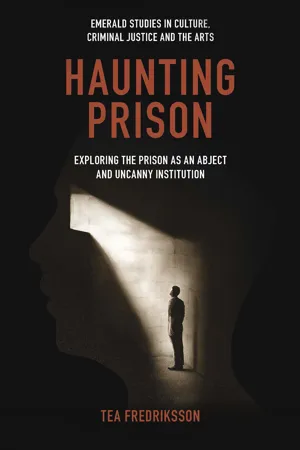
Haunting Prison
eBook - ePub

Haunting Prison

Exploring the Prison as an Abject and Uncanny Institution

  1. 248 pages
  2. English
  3. ePUB (mobile friendly)
  4. Available on iOS & Android
eBook - ePub

Haunting Prison

Exploring the Prison as an Abject and Uncanny Institution

About this book

Through a study of ten commercially published prison autobiographies, Haunting Prison: Exploring the Prison as an Abject and Uncanny Institution unveils how prison is narrativized and socially represented as an abject and uncanny institution, shedding new light on what prison is and does in Western carceral imaginations.

Unveiling the layers of editing that position prison autobiographies between fact and fiction, Tea Fredriksson delves into how true crime's claims to factuality coexist with the genre's inescapable horror iconography. In a thematic analysis of how autobiographical prison stories make prison 'come alive' on the page as a site of abject horror and eerie unsettlement, Haunting Prison: Exploring the Prison as an Abject and Uncanny Institution explores how prison functions as a storied institution, both as a physical site of subterranean horrors and in terms of the many-layered stories told about prison and the bodies within it. Showcasing how prison expresses and distills the normative social anxieties of the global North-West and linking othering processes and unsettling likenesses as common narrational themes, Fredriksson reveals how prison is both an abject other to and a haunting, uncanny double of the outside world.

A refreshing take on the study of true crime data, Haunting Prison: Exploring the Prison as an Abject and Uncanny Institution is appealing reading for scholars interested in qualitative research methods for studying crime, punishment and victimhood in popular culture.

This series has been renamed to "Emerald Studies in Culture, Crime, Criminal Justice and the Arts" effective for 2025 publications onward.

Frequently asked questions

Yes, you can cancel anytime from the Subscription tab in your account settings on the Perlego website. Your subscription will stay active until the end of your current billing period. Learn how to cancel your subscription.
No, books cannot be downloaded as external files, such as PDFs, for use outside of Perlego. However, you can download books within the Perlego app for offline reading on mobile or tablet. Learn more here.
Perlego offers two plans: Essential and Complete
  • Essential is ideal for learners and professionals who enjoy exploring a wide range of subjects. Access the Essential Library with 800,000+ trusted titles and best-sellers across business, personal growth, and the humanities. Includes unlimited reading time and Standard Read Aloud voice.
  • Complete: Perfect for advanced learners and researchers needing full, unrestricted access. Unlock 1.4M+ books across hundreds of subjects, including academic and specialized titles. The Complete Plan also includes advanced features like Premium Read Aloud and Research Assistant.
Both plans are available with monthly, semester, or annual billing cycles.
We are an online textbook subscription service, where you can get access to an entire online library for less than the price of a single book per month. With over 1 million books across 1000+ topics, we’ve got you covered! Learn more here.
Look out for the read-aloud symbol on your next book to see if you can listen to it. The read-aloud tool reads text aloud for you, highlighting the text as it is being read. You can pause it, speed it up and slow it down. Learn more here.
Yes! You can use the Perlego app on both iOS or Android devices to read anytime, anywhere — even offline. Perfect for commutes or when you’re on the go.
Please note we cannot support devices running on iOS 13 and Android 7 or earlier. Learn more about using the app.
Yes, you can access Haunting Prison by Tea Fredriksson in PDF and/or ePUB format, as well as other popular books in Social Sciences & Criminology. We have over one million books available in our catalogue for you to explore.

Table of contents

  1. Cover
  2. Title
  3. Chapter 1. Prison Imag(inari)es
  4. Chapter 2. Prison as an Abject (M)other
  5. Chapter 3. Subjective Abjection
  6. Chapter 4. The Haunting Prison
  7. Chapter 5. A Prison Chronotope
  8. Chapter 6. Prisons of Stone and Story
  9. Bibliography
  10. Index