- English
- ePUB (mobile friendly)
- Available on iOS & Android
eBook - ePub
About this book
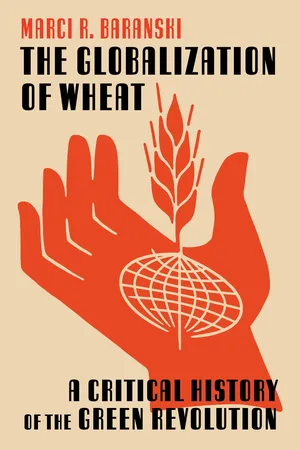
In The Globalization of Wheat, Marci R. Baranski explores Norman Borlaug's complicated legacy as godfather of the Green Revolution. Winner of the Nobel Peace Prize in 1970 for his role in fighting global hunger, Borlaug, an American agricultural scientist and plant breeder who worked for the Rockefeller Foundation, left a legacy that divides opinions even today. His high-yielding dwarf wheat varieties, known as miracle seeds, effectively doubled and tripled crop yields across the globe, from Kenya to India and Argentina to Mexico due to their wide adaptation. But these modern seeds also required expensive chemical fertilizers and irrigation, both of which were only available to wealthier farmers. Baranski argues that Borlaug's new technologies ultimately privileged wealthier farmers, despite assurances to politicians that these new crops would thrive in diverse geographies and benefit all farmers. As large-scale monocultures replaced traditional farming practices, these changes were codified into the Indian wheat research system, thus limiting attention to traditional practices and marginal environments. In the shadow of this legacy, and in the face of accelerating climate change, Baranski brings new light to Borlaug's role in a controversial concept in agricultural science.
Information
Subtopic
Environmental ScienceIndex
HistoryTable of contents
- Cover Page
- Title Page
- Copyright Page
- Dedication
- Contents
- Acknowledgments
- Introduction
- Chapter 1. Narratives around Wide Adaptation in International Wheat Research, 1960–1970: Norman E. Borlaug, Charles F. Krull, and Keith W. Finlay
- Chapter 2. Proper Agronomy: The Indian Context of a New Plant Breeding Ideal, 1960–1970
- Chapter 3. Indian Wheat Research after the Green Revolution
- Chapter 4. The Persistence of Wide Adaptation in India
- Chapter 5. Challenges to Wide Adaptation in International Agricultural Research: Wheat in North Africa and the Middle East and Maize in Mexico
- Conclusion. The Legacy of Wide Adaptation in International Agricultural Development
- Research Methods
- Notes
- Bibliography
- Index
Trusted by 375,005 students
Access to over 1.5 million titles for a fair monthly price.
Study more efficiently using our study tools.
Frequently asked questions
Yes, you can cancel anytime from the Subscription tab in your account settings on the Perlego website. Your subscription will stay active until the end of your current billing period. Learn how to cancel your subscription
No, books cannot be downloaded as external files, such as PDFs, for use outside of Perlego. However, you can download books within the Perlego app for offline reading on mobile or tablet. Learn how to download books offline
Perlego offers two plans: Essential and Complete
- Essential is ideal for learners and professionals who enjoy exploring a wide range of subjects. Access the Essential Library with 800,000+ trusted titles and best-sellers across business, personal growth, and the humanities. Includes unlimited reading time and Standard Read Aloud voice.
- Complete: Perfect for advanced learners and researchers needing full, unrestricted access. Unlock 1.5M+ books across hundreds of subjects, including academic and specialized titles. The Complete Plan also includes advanced features like Premium Read Aloud and Research Assistant.
We are an online textbook subscription service, where you can get access to an entire online library for less than the price of a single book per month. With over 1.5 million books across 990+ topics, we’ve got you covered! Learn about our mission
Look out for the read-aloud symbol on your next book to see if you can listen to it. The read-aloud tool reads text aloud for you, highlighting the text as it is being read. You can pause it, speed it up and slow it down. Learn more about Read Aloud
Yes! You can use the Perlego app on both iOS and Android devices to read anytime, anywhere — even offline. Perfect for commutes or when you’re on the go.
Please note we cannot support devices running on iOS 13 and Android 7 or earlier. Learn more about using the app
Please note we cannot support devices running on iOS 13 and Android 7 or earlier. Learn more about using the app
Yes, you can access The Globalization of Wheat by Marci Baranski in PDF and/or ePUB format, as well as other popular books in History & Environmental Science. We have over 1.5 million books available in our catalogue for you to explore.