The French Revolution swept away the Old Regime along with many of its ideas about epistemology, history, society, and politics. In the intellectual ferment that followed, debates about religion figured prominently as diverse thinkers grappled with the philosophical and civil status of religion in a post-revolutionary age.
Arthur McCalla demonstrates the central place of religion in the intellectual life of post-revolutionary France in Religion and the Post-revolutionary Mind. Certain questions – What is the nature of religion? Does society rest on religious foundations? What ought to be the place of religion in society? – drew sustained attention from across the political spectrum. Idéologues viewed religion as error and sought to eradicate it through the promotion of secular values. Catholic Traditionalists understood religion as a body of revealed truths of supernatural origin that ought to be authoritative in all aspects of life. Liberals sought to replace Christian orthodoxy with a new public faith consonant with liberal values. But these blocs were not monolithic, and McCalla reveals the complexities of each one, as well as the dialogues and rivalries among them. The categories established by the concepts of religion these thinkers constructed continue to shape debates over liberationist critiques, liberal pluralism, laïcité, and political theology.
The place of religion in civil society is again a matter of urgent debate. Religion and the Post-revolutionary Mind provides essential historical context for thinking about the status of religion in the contemporary world.
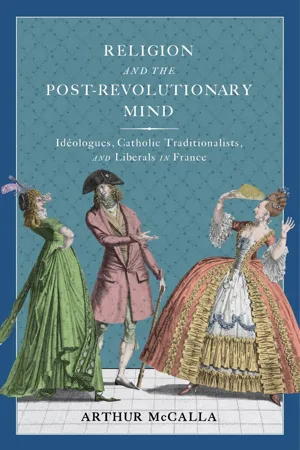
eBook - ePub
Religion and the Post-revolutionary Mind
Idéologues, Catholic Traditionalists, and Liberals in France
- English
- ePUB (mobile friendly)
- Available on iOS & Android
eBook - ePub
Religion and the Post-revolutionary Mind
Idéologues, Catholic Traditionalists, and Liberals in France
About this book
Information
Table of contents
- Cover
- Copyright
- Contents
- Acknowledgments
- Dramatis Personae
- Introduction
- PART ONE A Liberationist Critique: The Idéologues
- 1 The Idéologues’ Science of Ideas
- 2 The Idéologues’ Critique of Religion
- 3 From Critique of Religion to Religious Policy
- PART TWO Sociological Traditionalism: Louis de Bonald
- 4 Bonald’s Science of Society
- 5 Bonald’s History of Religions
- 6 Bonald and Restoration Policy
- PART THREE Theological Traditionalism: Félicité de Lamennais and the Mennaisians
- 7 Lamennais’s Theological Traditionalism
- 8 The Mennaisian Science of Religions
- 9 Mennaisian Political Theology
- PART FOUR Statist Liberalism: Doctrinaires and Globistes
- 10 Rational Spiritualism
- 11 The Philosophical Status of Religion
- 12 The Civil Status of Religion
- PART FIVE Pluralist Liberalism: Benjamin Constant
- 13 Benjamin Constant and De la religion
- 14 Constant’s History of Religions
- 15 Liberal Pluralism’s Religion
- PART SIX Orientalist Traditionalism: Ferdinand d’Eckstein
- 16 Eckstein’s Traditionalism
- 17 An Orientalist History of Religions
- 18 Eckstein’s Political Theology
- Conclusion
- Bibliography
- Index
Trusted by 375,005 students
Access to over 1.5 million titles for a fair monthly price.
Study more efficiently using our study tools.
Frequently asked questions
Yes, you can cancel anytime from the Subscription tab in your account settings on the Perlego website. Your subscription will stay active until the end of your current billing period. Learn how to cancel your subscription
No, books cannot be downloaded as external files, such as PDFs, for use outside of Perlego. However, you can download books within the Perlego app for offline reading on mobile or tablet. Learn how to download books offline
Perlego offers two plans: Essential and Complete
- Essential is ideal for learners and professionals who enjoy exploring a wide range of subjects. Access the Essential Library with 800,000+ trusted titles and best-sellers across business, personal growth, and the humanities. Includes unlimited reading time and Standard Read Aloud voice.
- Complete: Perfect for advanced learners and researchers needing full, unrestricted access. Unlock 1.5M+ books across hundreds of subjects, including academic and specialized titles. The Complete Plan also includes advanced features like Premium Read Aloud and Research Assistant.
We are an online textbook subscription service, where you can get access to an entire online library for less than the price of a single book per month. With over 1.5 million books across 990+ topics, we’ve got you covered! Learn about our mission
Look out for the read-aloud symbol on your next book to see if you can listen to it. The read-aloud tool reads text aloud for you, highlighting the text as it is being read. You can pause it, speed it up and slow it down. Learn more about Read Aloud
Yes! You can use the Perlego app on both iOS and Android devices to read anytime, anywhere — even offline. Perfect for commutes or when you’re on the go.
Please note we cannot support devices running on iOS 13 and Android 7 or earlier. Learn more about using the app
Please note we cannot support devices running on iOS 13 and Android 7 or earlier. Learn more about using the app
Yes, you can access Religion and the Post-revolutionary Mind by Arthur McCalla in PDF and/or ePUB format, as well as other popular books in History & French History. We have over 1.5 million books available in our catalogue for you to explore.