A bold history of the rise of central banks, showing how institutions designed to steady the ship of global finance have instead become as destabilizing as they are dominant.
While central banks have gained remarkable influence over the past fifty years, promising more stability, global finance has gone from crisis to crisis. How do we explain this development? Drawing on original sources ignored in previous research, The Rise of Central Banks offers a groundbreaking account of the origins and consequences of central banks' increasing clout over economic policy.
Many commentators argue that ideas drove change, indicating a shift in the 1970s from Keynesianism to monetarism, concerned with controlling inflation. Others point to the stagflation crises, which put capitalists and workers at loggerheads. Capitalists won, the story goes, then pushed deregulation and disinflation by redistributing power from elected governments to markets and central banks. Both approaches are helpful, but they share a weakness. Abstracting from the evolving practices of central banking, they provide inaccurate accounts of recent policy changes and fail to explain how we arrived at the current era of easy money and excessive finance.
By comparing developments in the United States, the United Kingdom, Germany, and Switzerland, Leon Wansleben finds that central bankers' own policy innovations were an important ingredient of change. These innovations allowed central bankers to use privileged relationships with expanding financial markets to govern the economy. But by relying on markets, central banks fostered excessive credit growth and cultivated an unsustainable version of capitalism. Through extensive archival work and numerous interviews, Wansleben sheds new light on the agency of bureaucrats and calls upon society and elected leaders to direct these actors' efforts to more progressive goals.
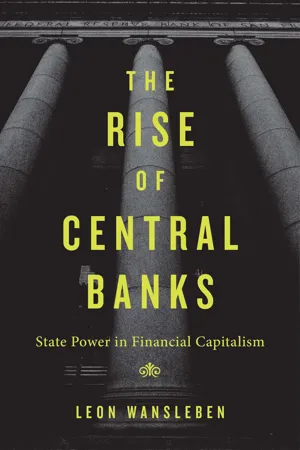
- 328 pages
- English
- ePUB (mobile friendly)
- Available on iOS & Android
eBook - ePub
About this book
Information
Table of contents
- Cover
- Title Page
- Copyright
- Dedication
- Contents
- Preface
- Introduction
- 1. Neoliberalism and the Rise of Central Banks
- 2. Monetarism and the Invention of Monetary Policy
- 3. Hegemonizing Financial Market Expectations
- 4. Money Markets as Infrastructures of Global Finance and Central Banks
- 5. The Organization of Ignorance: How Central Bankers Abandoned Regulation
- 6. Plumbing Financialization in Vain: Central Banking after 2008
- Conclusion
- Appendix
- Notes
- References
- Index
Trusted by 375,005 students
Access to over 1.5 million titles for a fair monthly price.
Study more efficiently using our study tools.
Frequently asked questions
Yes, you can cancel anytime from the Subscription tab in your account settings on the Perlego website. Your subscription will stay active until the end of your current billing period. Learn how to cancel your subscription
No, books cannot be downloaded as external files, such as PDFs, for use outside of Perlego. However, you can download books within the Perlego app for offline reading on mobile or tablet. Learn how to download books offline
Perlego offers two plans: Essential and Complete
- Essential is ideal for learners and professionals who enjoy exploring a wide range of subjects. Access the Essential Library with 800,000+ trusted titles and best-sellers across business, personal growth, and the humanities. Includes unlimited reading time and Standard Read Aloud voice.
- Complete: Perfect for advanced learners and researchers needing full, unrestricted access. Unlock 1.5M+ books across hundreds of subjects, including academic and specialized titles. The Complete Plan also includes advanced features like Premium Read Aloud and Research Assistant.
We are an online textbook subscription service, where you can get access to an entire online library for less than the price of a single book per month. With over 1.5 million books across 990+ topics, we’ve got you covered! Learn about our mission
Look out for the read-aloud symbol on your next book to see if you can listen to it. The read-aloud tool reads text aloud for you, highlighting the text as it is being read. You can pause it, speed it up and slow it down. Learn more about Read Aloud
Yes! You can use the Perlego app on both iOS and Android devices to read anytime, anywhere — even offline. Perfect for commutes or when you’re on the go.
Please note we cannot support devices running on iOS 13 and Android 7 or earlier. Learn more about using the app
Please note we cannot support devices running on iOS 13 and Android 7 or earlier. Learn more about using the app
Yes, you can access The Rise of Central Banks by Leon Wansleben in PDF and/or ePUB format, as well as other popular books in Economics & Business General. We have over 1.5 million books available in our catalogue for you to explore.