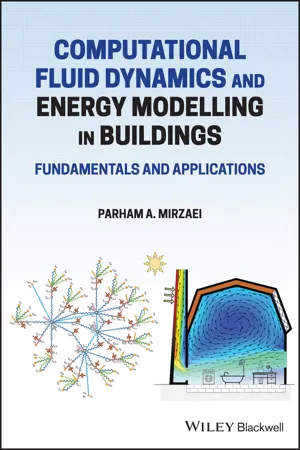
Computational Fluid Dynamics and Energy Modelling in Buildings
eBook - PDF

Computational Fluid Dynamics and Energy Modelling in Buildings

Fundamentals and Applications

  1. English
  2. PDF
  3. Available on iOS & Android
eBook - PDF

Computational Fluid Dynamics and Energy Modelling in Buildings

Fundamentals and Applications

About this book

COMPUTATIONAL FLUID DYNAMICS AND ENERGY MODELLING IN BUILDINGS

A Comprehensive Overview of the Fundamentals of Heat and Mass Transport Simulation and Energy Performance in Buildings

In the first part of Computational Fluid Dynamics and Energy Modelling in Buildings: Fundamentals and Applications, the author explains the fundamentals of fluid mechanics, thermodynamics, and heat transfer, with a specific focus on their application in buildings. This background knowledge sets the scene to further model heat and mass transport in buildings, with explanations of commonly applied simplifications and assumptions.

In the second part, the author elaborates how the fundamentals explained in part 1 can be used to model energy flow in buildings, which is the basis of all commercial and educational building energy simulation tools. An innovative illustrative nodal network concept is introduced to help readers comprehend the basics of conservation laws in buildings. The application of numerical techniques to form dynamic simulation tools are then introduced. In general, understanding these techniques will help readers to identify and justify their choices when working with building energy simulation tools, rather than using default settings.

Detailed airflow information in buildings cannot be obtained in building energy simulation techniques. Therefore, part three is focused on introducing computational fluid dynamics (CFD) as a detailed modelling technique for airflow in buildings. This part starts with an introduction to the fundamentals of the finite volume method used to solve the governing fluid equations and the related challenges and considerations are discussed. The last chapter of this part covers the solutions to some practical problems of airflow within and around buildings.

The key aspect of Computational Fluid Dynamics and Energy Modelling in Buildings: Fundamentals and Applications is that it is tailored for audiences without extensive past experience of numerical methods. Undergraduate or graduate students in architecture, urban planning, geography, architectural engineering, and other engineering fields, along with building performance and simulation professionals, can use this book to gain additional clarity on the topics of building energy simulation and computational fluid dynamics.

Frequently asked questions

Yes, you can cancel anytime from the Subscription tab in your account settings on the Perlego website. Your subscription will stay active until the end of your current billing period. Learn how to cancel your subscription.
At the moment all of our mobile-responsive ePub books are available to download via the app. Most of our PDFs are also available to download and we're working on making the final remaining ones downloadable now. Learn more here.
Perlego offers two plans: Essential and Complete
  • Essential is ideal for learners and professionals who enjoy exploring a wide range of subjects. Access the Essential Library with 800,000+ trusted titles and best-sellers across business, personal growth, and the humanities. Includes unlimited reading time and Standard Read Aloud voice.
  • Complete: Perfect for advanced learners and researchers needing full, unrestricted access. Unlock 1.4M+ books across hundreds of subjects, including academic and specialized titles. The Complete Plan also includes advanced features like Premium Read Aloud and Research Assistant.
Both plans are available with monthly, semester, or annual billing cycles.
We are an online textbook subscription service, where you can get access to an entire online library for less than the price of a single book per month. With over 1 million books across 1000+ topics, we’ve got you covered! Learn more here.
Look out for the read-aloud symbol on your next book to see if you can listen to it. The read-aloud tool reads text aloud for you, highlighting the text as it is being read. You can pause it, speed it up and slow it down. Learn more here.
Yes! You can use the Perlego app on both iOS or Android devices to read anytime, anywhere — even offline. Perfect for commutes or when you’re on the go.
Please note we cannot support devices running on iOS 13 and Android 7 or earlier. Learn more about using the app.
Yes, you can access Computational Fluid Dynamics and Energy Modelling in Buildings by Parham A. Mirzaei in PDF and/or ePUB format, as well as other popular books in Technology & Engineering & Construction & Architectural Engineering. We have over one million books available in our catalogue for you to explore.

Table of contents

  1. Cover
  2. Title Page
  3. Copyright Page
  4. Contents
  5. Preface
  6. Chapter 1 An Overview of Heat and Mass Transport in Buildings
  7. Chapter 2 An Overview on Fundamentals of Fluid Mechanics in Buildings
  8. Chapter 3 Applications of Fluid Mechanics in Buildings
  9. Chapter 4 An Overview on Fundamentals of Thermodynamics in Buildings
  10. Chapter 5 Applications of Thermodynamics in Buildings
  11. Chapter 6 An Overview on Fundamentals of Heat Transfer in Buildings
  12. Chapter 7 Applications of Heat Transfer in Buildings
  13. Chapter 8 Fundamental of Energy Modelling in Buildings
  14. Chapter 9 Dynamic Energy Modelling in Buildings
  15. Chapter 10 Fundamental of Computational Fluid Dynamics – A Finite Volume Approach
  16. Chapter 11 Solvers and Solution Analysis
  17. Chapter 12 Application of CFD in Buildings and Built Environment
  18. Index
  19. EULA