This volume offers a broad exploration of the cultural history of democracy in the Renaissance. The Renaissance has rarely been considered an important moment in the history of democracy. Nonetheless, as this volume shows, this period may be seen as a "democratic laboratory" in many, often unexpected, ways. The classicizing cultural movement known as humanism, which spread throughout Europe and beyond in this period, had the effect of vastly enhancing knowledge of the classical democratic and republican traditions. Greek history and philosophy, including the story of Athenian democracy, became fully known in the West for the first time in the postclassical world. Partly as a result of this, the period from 1400 to 1650 witnessed rich and historically important debates on some of the enduring political issues at the heart of democratic culture: issues of sovereignty, of liberty, of citizenship, of the common good, of the place of religion in government.
At the same time, the introduction of printing, and the emergence of a flourishing, proto-journalistic news culture, laid the basis for something that recognizably anticipates the modern "public sphere." The expansion of transnational and transcontinental exchange, in what has been called the "age of encounters," gave a new urgency to discussions of religious and ethnic diversity. Gender, too, was a matter of intense debate in this period, as was, specifically, the question of women's relation to political agency and power.
This volume explores these developments in ten chapters devoted to the notions of sovereignty, liberty, and the "common good"; the relation of state and household; religion and political obligation; gender and citizenship; ethnicity, diversity, and nationalism; democratic crises and civil resistance; international relations; and the development of news culture. It makes a pressing case for a fresh understanding of modern democracy's deep roots.
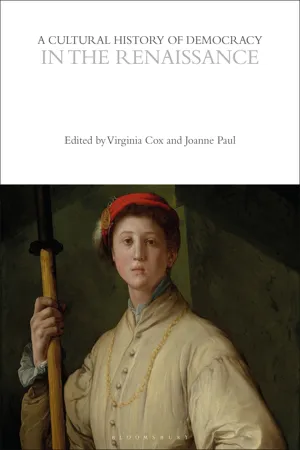
eBook - ePub
A Cultural History of Democracy in the Renaissance
- 288 pages
- English
- ePUB (mobile friendly)
- Available on iOS & Android
eBook - ePub
A Cultural History of Democracy in the Renaissance
About this book
Information
Table of contents
- Cover
- Halftitle Page
- Title Page
- Contents
- List of Illustrations
- General Editor’s Preface
- Introduction
- 1 Sovereignty
- 2 Liberty and the Rule of Law
- 3 The Common Good
- 4 Economic and Social Democracy
- 5 Religion and the Principles of Political Obligation
- 6 Citizenship and Gender
- 7 Human Diversity and Democracy in the Renaissance
- 8 Democratic Crises, Revolutions, and Civil Resistance
- 9 International Relations
- 10 Beyond the Polis
- Notes
- References
- Notes on Contributors
- Index
- Imprint
Trusted by 375,005 students
Access to over 1.5 million titles for a fair monthly price.
Study more efficiently using our study tools.
Frequently asked questions
Yes, you can cancel anytime from the Subscription tab in your account settings on the Perlego website. Your subscription will stay active until the end of your current billing period. Learn how to cancel your subscription
No, books cannot be downloaded as external files, such as PDFs, for use outside of Perlego. However, you can download books within the Perlego app for offline reading on mobile or tablet. Learn how to download books offline
Perlego offers two plans: Essential and Complete
- Essential is ideal for learners and professionals who enjoy exploring a wide range of subjects. Access the Essential Library with 800,000+ trusted titles and best-sellers across business, personal growth, and the humanities. Includes unlimited reading time and Standard Read Aloud voice.
- Complete: Perfect for advanced learners and researchers needing full, unrestricted access. Unlock 1.5M+ books across hundreds of subjects, including academic and specialized titles. The Complete Plan also includes advanced features like Premium Read Aloud and Research Assistant.
We are an online textbook subscription service, where you can get access to an entire online library for less than the price of a single book per month. With over 1.5 million books across 990+ topics, we’ve got you covered! Learn about our mission
Look out for the read-aloud symbol on your next book to see if you can listen to it. The read-aloud tool reads text aloud for you, highlighting the text as it is being read. You can pause it, speed it up and slow it down. Learn more about Read Aloud
Yes! You can use the Perlego app on both iOS and Android devices to read anytime, anywhere — even offline. Perfect for commutes or when you’re on the go.
Please note we cannot support devices running on iOS 13 and Android 7 or earlier. Learn more about using the app
Please note we cannot support devices running on iOS 13 and Android 7 or earlier. Learn more about using the app
Yes, you can access A Cultural History of Democracy in the Renaissance by Virginia Cox, Joanne Paul, Virginia Cox,Joanne Paul, Eugenio Biagini in PDF and/or ePUB format, as well as other popular books in History & European Renaissance History. We have over 1.5 million books available in our catalogue for you to explore.