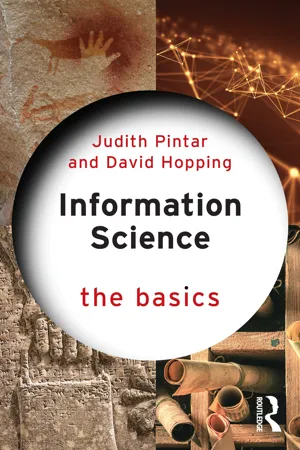
Information Science
eBook - ePub

Information Science

The Basics

  1. 252 pages
  2. English
  3. ePUB (mobile friendly)
  4. Available on iOS & Android
eBook - ePub

Information Science

The Basics

About this book

Information Science: The Basics provides an accessible introduction to the multifaceted field of Information Science (IS).

Inviting readers to explore a modern field of study with deep historical foundations, the book begins by considering the complexities of the term "information" and the information life cycle from classification to preservation. Each chapter examines a different area within IS, surveying its history, technologies, and practices with a critical eye. This interdisciplinary field incorporates a wide range of approaches which it shares with humanities, social science, and technology fields. What makes IS unique is its emphasis on the connections between information, technology, and society. The need to share information more effectively in response to social, environmental, and biomedical challenges has never been so urgent; the volume discusses the risks as well as benefits that come with the emerging technologies that make it possible. The book also explores how IS, with its long-standing commitment to intellectual freedom and digital inclusion, and its keen attention to the protection of privacy, data ethics, and algorithmic transparency, can contribute to the creation of a more open and equitable society.

Information Science: The Basics is essential reading for anyone who wishes to know more about information and the impact it has on our world. It will be particularly useful for anyone intending to study IS at the undergraduate level or considering a shift to a career in the information professions.

Frequently asked questions

Yes, you can cancel anytime from the Subscription tab in your account settings on the Perlego website. Your subscription will stay active until the end of your current billing period. Learn how to cancel your subscription.
At the moment all of our mobile-responsive ePub books are available to download via the app. Most of our PDFs are also available to download and we're working on making the final remaining ones downloadable now. Learn more here.
Perlego offers two plans: Essential and Complete
  • Essential is ideal for learners and professionals who enjoy exploring a wide range of subjects. Access the Essential Library with 800,000+ trusted titles and best-sellers across business, personal growth, and the humanities. Includes unlimited reading time and Standard Read Aloud voice.
  • Complete: Perfect for advanced learners and researchers needing full, unrestricted access. Unlock 1.4M+ books across hundreds of subjects, including academic and specialized titles. The Complete Plan also includes advanced features like Premium Read Aloud and Research Assistant.
Both plans are available with monthly, semester, or annual billing cycles.
We are an online textbook subscription service, where you can get access to an entire online library for less than the price of a single book per month. With over 1 million books across 1000+ topics, we’ve got you covered! Learn more here.
Look out for the read-aloud symbol on your next book to see if you can listen to it. The read-aloud tool reads text aloud for you, highlighting the text as it is being read. You can pause it, speed it up and slow it down. Learn more here.
Yes! You can use the Perlego app on both iOS or Android devices to read anytime, anywhere — even offline. Perfect for commutes or when you’re on the go.
Please note we cannot support devices running on iOS 13 and Android 7 or earlier. Learn more about using the app.
Yes, you can access Information Science by Judith Pintar,David Hopping in PDF and/or ePUB format, as well as other popular books in Languages & Linguistics & Library & Information Science. We have over one million books available in our catalogue for you to explore.

Table of contents

  1. Cover
  2. Half-Title
  3. Series
  4. Title
  5. Copyright
  6. Contents
  7. Preface
  8. Introduction
  9. 1 Collecting Information
  10. 2 Classifying Information
  11. 3 Organizing Information
  12. 4 Retrieving Information
  13. 5 Utilizing Information
  14. 6 Governing Information
  15. 7 Studying Information
  16. 8 Designing Information
  17. 9 Preserving Information
  18. 10 Imagining Information
  19. Bibliography
  20. Index