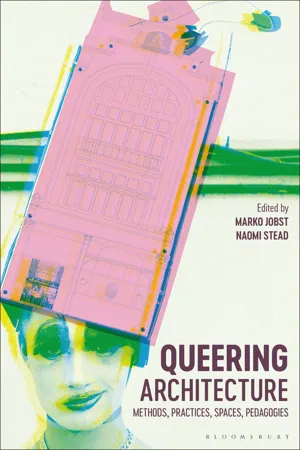
Featuring contributions from a range of significant voices in the field, this volume renews the conversation around what it means to speak of the 'queer' in the context of architecture, and offers a fresh take on the methodological and epistemological challenges this poses to the discipline of architectural theory.
Architecture as a discipline, a profession and an applied practice is always subordinate to its own conceptual framework, which is one of orderliness. It refers to buildings, but also to infrastructures of thought and knowledge, to conventions and taxonomies, to structures of governance, hierarchies of power and systems of administration. How, then, can one look at queering architectural discourse when the very term 'queer', celebrated for its elusive nature, resists and attacks such order?
Divided into four subsections, the essays in this anthology each pursue a distinct line of inquiry – methods, practices, spaces and pedagogies – in order to help particularize the proposed queering of architecture. They demonstrate the paradoxical nature of the endeavour from a diverse range of perspectives – from questions of mapping queer theory in architecture; to issues of queer architectural archives, or lack thereof; to non-Western challenges to the very term queer, and the queering of basic assumptions across affiliated disciplines.
Queering Architecture not only provides a bold challenge to the normative methods employed in architectural discourse but also addresses how establishing 'queer' methodologies is a paradox in itself.
- 296 pages
- English
- ePUB (mobile friendly)
- Available on iOS & Android
eBook - ePub
About this book
Information
Table of contents
- Cover
- Half-Title
- Title
- Contents
- List of Figures
- Introduction
- I Methods
- II Practices
- III Spaces
- IV Pedagogies
- Index
- Copyright
Trusted by 375,005 students
Access to over 1.5 million titles for a fair monthly price.
Study more efficiently using our study tools.
Frequently asked questions
Yes, you can cancel anytime from the Subscription tab in your account settings on the Perlego website. Your subscription will stay active until the end of your current billing period. Learn how to cancel your subscription
No, books cannot be downloaded as external files, such as PDFs, for use outside of Perlego. However, you can download books within the Perlego app for offline reading on mobile or tablet. Learn how to download books offline
Perlego offers two plans: Essential and Complete
- Essential is ideal for learners and professionals who enjoy exploring a wide range of subjects. Access the Essential Library with 800,000+ trusted titles and best-sellers across business, personal growth, and the humanities. Includes unlimited reading time and Standard Read Aloud voice.
- Complete: Perfect for advanced learners and researchers needing full, unrestricted access. Unlock 1.5M+ books across hundreds of subjects, including academic and specialized titles. The Complete Plan also includes advanced features like Premium Read Aloud and Research Assistant.
We are an online textbook subscription service, where you can get access to an entire online library for less than the price of a single book per month. With over 1.5 million books across 990+ topics, we’ve got you covered! Learn about our mission
Look out for the read-aloud symbol on your next book to see if you can listen to it. The read-aloud tool reads text aloud for you, highlighting the text as it is being read. You can pause it, speed it up and slow it down. Learn more about Read Aloud
Yes! You can use the Perlego app on both iOS and Android devices to read anytime, anywhere — even offline. Perfect for commutes or when you’re on the go.
Please note we cannot support devices running on iOS 13 and Android 7 or earlier. Learn more about using the app
Please note we cannot support devices running on iOS 13 and Android 7 or earlier. Learn more about using the app
Yes, you can access Queering Architecture by Marko Jobst,Naomi Stead in PDF and/or ePUB format, as well as other popular books in Architecture & Architecture Criticism. We have over 1.5 million books available in our catalogue for you to explore.