- 120 pages
- English
- ePUB (mobile friendly)
- Available on iOS & Android
eBook - ePub
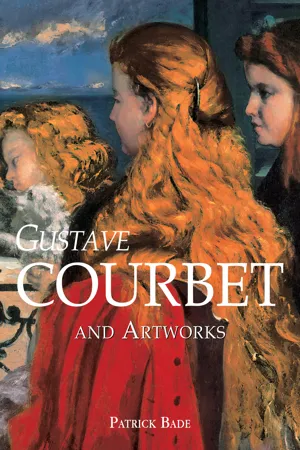
Gustave Courbet and artworks
About this book
Ornans, Courbet's birthplace, is near the beautiful valley of the Doubs River, and it was here as a boy, and later as a man, that he absorbed the love of landscape.
He was by nature a revolutionary, a man born to oppose existing order and to assert his independence; he had that quality of bluster and brutality which makes the revolutionary count in art as well as in politics. In both directions his spirit of revolt manifested itself. He went to Paris to study art, yet he did not attach himself to the studio of any of the prominent masters. Already in his country home he had had a little instruction in painting, and preferred to study the masterpieces of the Louvre. At first his pictures were not sufficiently distinctive to arouse any opposition, and were admitted to the Salon. Then followed the Funeral at Ornans, which the critics violently assailed: "A masquerade funeral, six metres long, in which there is more to laugh at than to weep over." Indeed, the real offence of Courbet's pictures was that they represented live flesh and blood. They depicted men and women as they really are and realistically doing the business in which they are engaged. His figures were not men and women deprived of personality and idealised into a type, posed in positions that will decorate the canvas. He advocated painting things as they are, and proclaimed that la vérité vraie must be the aim of the artist. So at the Universal Exposition of 1855 he withdrew his pictures from the exhibition grounds and set them in a wooden booth, just outside the entrance. Over the booth he posted a sign with large lettering. It read, simply: "Courbet – Realist." Like every revolutionary, he was an extremist. He ignored the fact that to every artist the truth of nature appears under a different guise according to his way of seeing and experiencing. Instead, he adhered to the notion that art is only a copying of nature and not a matter also of selection and arrangement. In his contempt for prettiness Courbet often chose subjects which may fairly be called ugly. But that he also had a sense of beauty may be seen in his landscapes. That sense, mingled with his capacity for deep emotion, appears in his marines – these last being his most impressive work. Moreover, in all his works, whether attractive or not to the observer, he proved himself a powerful painter, painting in a broad, free manner, with a fine feeling for colour, and with a firmness of pigment that made all his representations very real and stirring.
Information
Topic
ArtSubtopic
Artist MonographsTable of contents
- Biography
- Portrait of a Young Woman
- White Bull and Blond Heifer
- Study for The Young Ladies of the Village
- The Young Ladies of the Village
- The Wrestlers
- The Bathers
- The Sleeping Spinner
- Portrait of Alfred Bruyas
- The Homecoming
- The Encounter or Bonjour Monsieur Courbet
- The Spanish Lady
- The Grain Sifters
- The Painter's Studio: A Real Allegory Summing up Seven Years of my Artistic and Moral Life
- Le Château d’Ornans
- Mother Grégoire
- The Quarry
- Study for one of the Young Ladies on the Banks of the Seine
- Young Ladies on the Banks of the Seine
- Portrait of Mathilde Cuoq
- The Bridge at Ambressum
- The Hunting Lunch
- The Lady of Frankfurt
- Portrait of Madame Brayer
- The German Hunter
- The Diligence in the Snow
- Flowers
- Portrait of a Lady with a Parrot
- The Springtime Rut or Battle of the Stags
- Large Oak Trees by the waterside, Port-Berteau
- The Woods of Rochemont. The Round Dance of the Children
- The Trellis
- Study for the Return of the Conference
- Portrait of Gabrielle Borreau
- The Charente at Port-Berteau
- Still-life - Flowers
- Portrait of Laure Borreau
- View of Saintes
- The Source of the Loue
- Reflexion or Meditation
- The Bridge
- The Source of the Loue
- The Cave de la Loue
- The Oak Tree of Flagey, also called Oak Tree of Vercingetorix
- The Gour de Conche
- Crumbling Rocks
- The Sarrazine Cave
- The Lock of the Loue
- Three English Girls at the Window
- The Somnambulist
- The Girl with the Seagulls, Trouville
- The Beach at Trouville at Low Tide
- The Covered Stream or The Stream of the Black Well
- Portrait of the Countess Palma Karoly
- Fantastic View of Amorphous Rocks
- Portrait of Pierre-Joseph Proudhon and his Children
- Fishing Boat
- Woman with a Parrot
- Marine
- Deer Reserve at Plaisir-Fontaine
- The Poor Village Lady, Ornans
- The Ruse
- Origin of the World
- Jo, the Beautiful Irish Girl
- The Awakening
- Sleep
- Hunters in the Snow
- Killing the Deer or Scene of a Hunt in the Snow
- Hunter on horseback
- Almsgiving from a Beggar in Ornans
- The Three Bathers
- Landscape with Snow
- The Woman in the Waves
- The Source
- Portrait of Pierre Dupont
- Beach in Normandy
- The Rock of Hautepierre
- The Black Well
- The Cliff of Étretat after the Storm
- The Wave
- The Wave
- The Stormy Sea
- Still Life with Apples and Pomegranate
- Still-life - Fruits
- Still Life - Apples
- Three Trouts from the Loue
- The Sea
- The Blue Source
- Self-Portrait at Sainte-Pélagie
- The Bridge of Fleurier
- Portrait of Régis Courbet
- The Vintager of Montreux
- Chillon Castle
- Sunset on Lake Leman
- View of Lake Léman with a Cloudy Sky
- The Old Mill
- Panorama of the Alps, La Dent du Midi
Trusted by 375,005 students
Access to over 1.5 million titles for a fair monthly price.
Study more efficiently using our study tools.
Frequently asked questions
Yes, you can cancel anytime from the Subscription tab in your account settings on the Perlego website. Your subscription will stay active until the end of your current billing period. Learn how to cancel your subscription
No, books cannot be downloaded as external files, such as PDFs, for use outside of Perlego. However, you can download books within the Perlego app for offline reading on mobile or tablet. Learn how to download books offline
Perlego offers two plans: Essential and Complete
- Essential is ideal for learners and professionals who enjoy exploring a wide range of subjects. Access the Essential Library with 800,000+ trusted titles and best-sellers across business, personal growth, and the humanities. Includes unlimited reading time and Standard Read Aloud voice.
- Complete: Perfect for advanced learners and researchers needing full, unrestricted access. Unlock 1.5M+ books across hundreds of subjects, including academic and specialized titles. The Complete Plan also includes advanced features like Premium Read Aloud and Research Assistant.
We are an online textbook subscription service, where you can get access to an entire online library for less than the price of a single book per month. With over 1.5 million books across 990+ topics, we’ve got you covered! Learn about our mission
Look out for the read-aloud symbol on your next book to see if you can listen to it. The read-aloud tool reads text aloud for you, highlighting the text as it is being read. You can pause it, speed it up and slow it down. Learn more about Read Aloud
Yes! You can use the Perlego app on both iOS and Android devices to read anytime, anywhere — even offline. Perfect for commutes or when you’re on the go.
Please note we cannot support devices running on iOS 13 and Android 7 or earlier. Learn more about using the app
Please note we cannot support devices running on iOS 13 and Android 7 or earlier. Learn more about using the app
Yes, you can access Gustave Courbet and artworks by Patrick Bade in PDF and/or ePUB format, as well as other popular books in Art & Artist Monographs. We have over 1.5 million books available in our catalogue for you to explore.