- 113 pages
- English
- ePUB (mobile friendly)
- Available on iOS & Android
eBook - ePub
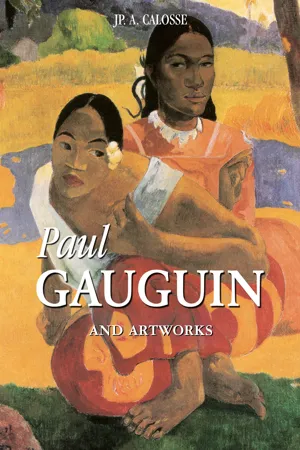
Paul Gauguin and artworks
About this book
Paul Gauguin was first a sailor, then a successful stockbroker in Paris. In 1874 he began to paint at weekends as a Sunday painter. Nine years later, after a stock-market crash, he felt confident of his ability to earn a living for his family by painting and he resigned his position and took up the painter's brush full time. Following the lead of Cézanne, Gauguin painted still-lifes from the very beginning of his artistic career. He even owned a still-life by Cézanne, which is shown in Gauguin's painting Portrait of Marie Lagadu. The year 1891 was crucial for Gauguin. In that year he left France for Tahiti, where he stayed till 1893. This stay in Tahiti determined his future life and career, for in 1895, after a sojourn in France, he returned there for good. In Tahiti, Gauguin discovered primitive art, with its flat forms and violent colours, belonging to an untamed nature. With absolute sincerity, he transferred them onto his canvas. His paintings from then on reflected this style: a radical simplification of drawing; brilliant, pure, bright colours; an ornamental type composition; and a deliberate flatness of planes. Gauguin termed this style "synthetic symbolism".
Information
Topic
ArtSubtopic
Artist MonographsTable of contents
- Biography
- Garden at Vaugirard
- The Four Breton Girls
- Young Breton Bathers
- Head of a Tahitian Woman
- Te tiare farani (Flowers of France)
- Les Parau Parau (Conversation)
- Te raau rahi (The Big Tree)
- Path in Papeete (A Tahitian Street)
- La Orana Maria (Ave Maria)
- Young Tahitian Man (Young Man with a Flower)
- The Rest
- Evil’s Word (Eve)
- Parau Na Te Varua Ino (Evil’s Words)
- Arearea (Happiness)
- Fatata te moua (At the Foot of the Mountain) or The Big Tree
- Vaïraumati tei oa (Her Name is Vaïraumati)
- Ta matete (The Market)
- Aha oe feii? (What? Are You Jealous?)
- Matamoe (Landscape with Peacocks)
- E haera oe i hia? (Where Are You Going?)
- Nafea faa ipoipo? (When Will You Marry?)
- Manao Tupapau (The Soul of the Dead Ones is Awake)
- Fatata te miti (On the Seashore)
- Otahi (Alone)
- Aïta tamari vahine Judith te parari (Annah the Javanese)
- Hina tefatou (The Moon and the Earth)
- Tahitian Pastoral Scene
- Merabi metua no Tehama (Teha’amana Has Many Parents)
- Eu haere ia oe (Where Are You Going?) Or Woman Holding a Fruit
- Self-Portrait with a Hat
- Te Alua (The God)
- Maruru (Satisfied)
- Nava nava fenua (Delicious Earth)
- Te faruru (Making Love)
- Mahana no varua ino (The Day of the Bad Spirit)
- Manao Tupapau (Watched by the Spirits of the Dead)
- Self-Portrait with a Palette
- The Cellist (Portrait of Upaupa Schneklud)
- Mahana no Atua (Day of the God)
- Breton Peasant Women
- Nave nave moe (Sweet Dreams) or Sacred Spring
- The Holy Night
- The Mill in Pont-Aven
- Portrait of Jeanne Goupil
- Teapot and Fruits
- Scene from Tahitian Life
- Nave nave mahana (Delicious Day)
- Te arii Vahine (The King’s Wife)
- Te tamari no atua (Nativity)
- Bé bé (The Nativity)
- Te vaa (The Canoe) Or A Tahitian Family
- Buddha
- Eiaha ohipa (Tahitians in a Room)
- Noa Noa, Sitting Tahitian
- Noa Noa
- Vaïrumati
- Bathers
- Te rerio (The Dream)
- Man Picking Fruits
- Tarari maruru (Landscape with Two Goats)
- Where Do We Come From? What Are We? Where Are We Going?
- Human Miseries
- Rave te hiti aamu (The Idol)
- Faa iheihe (Preparations for a Feast)
- Te Tiai na Oe Ite Rata (Are You Waiting for a Letter?)
- Two Tahitian Women
- Women on the Seashore (Maternity)
- Ruperupe (Gathering Fruit)
- The Great Buddha
- Three Tahitian Women against a Yellow Background
- Te avae no Maria (The Month of Mary) Or Woman Carrying Flowers
- Horse on the Road
- Still Life with Grapefruits
- Sunflowers
- The Ford (The Flight)
- Rider
- Barbaric Tales
- Woman with a Fan
Trusted by 375,005 students
Access to over 1.5 million titles for a fair monthly price.
Study more efficiently using our study tools.
Frequently asked questions
Yes, you can cancel anytime from the Subscription tab in your account settings on the Perlego website. Your subscription will stay active until the end of your current billing period. Learn how to cancel your subscription
No, books cannot be downloaded as external files, such as PDFs, for use outside of Perlego. However, you can download books within the Perlego app for offline reading on mobile or tablet. Learn how to download books offline
Perlego offers two plans: Essential and Complete
- Essential is ideal for learners and professionals who enjoy exploring a wide range of subjects. Access the Essential Library with 800,000+ trusted titles and best-sellers across business, personal growth, and the humanities. Includes unlimited reading time and Standard Read Aloud voice.
- Complete: Perfect for advanced learners and researchers needing full, unrestricted access. Unlock 1.5M+ books across hundreds of subjects, including academic and specialized titles. The Complete Plan also includes advanced features like Premium Read Aloud and Research Assistant.
We are an online textbook subscription service, where you can get access to an entire online library for less than the price of a single book per month. With over 1.5 million books across 990+ topics, we’ve got you covered! Learn about our mission
Look out for the read-aloud symbol on your next book to see if you can listen to it. The read-aloud tool reads text aloud for you, highlighting the text as it is being read. You can pause it, speed it up and slow it down. Learn more about Read Aloud
Yes! You can use the Perlego app on both iOS and Android devices to read anytime, anywhere — even offline. Perfect for commutes or when you’re on the go.
Please note we cannot support devices running on iOS 13 and Android 7 or earlier. Learn more about using the app
Please note we cannot support devices running on iOS 13 and Android 7 or earlier. Learn more about using the app
Yes, you can access Paul Gauguin and artworks by Jp. A. Calosse in PDF and/or ePUB format, as well as other popular books in Art & Artist Monographs. We have over 1.5 million books available in our catalogue for you to explore.