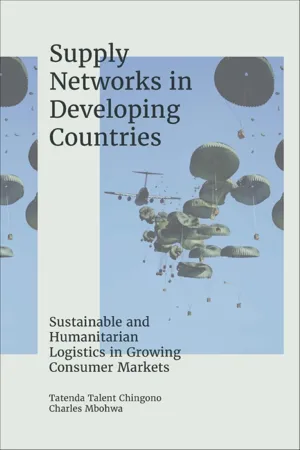
Supply Networks in Developing Countries
Sustainable and Humanitarian Logistics in Growing Consumer Markets
- 220 pages
- English
- ePUB (mobile friendly)
- Available on iOS & Android
Supply Networks in Developing Countries
Sustainable and Humanitarian Logistics in Growing Consumer Markets
About this book
Contributing to research, knowledge, and discourse on humanitarian logistics and supply chains in Africa, Supply Networks in Developing Countries introduces a unique perspective on the developing world, and how their supply networks can be enhanced and optimized.
The authors highlight the 4th Industrial Revolution, information technology, reverse logistics, supply chain modelling and block-chains, and how these can be the key to strengthening humanitarian logistics in developing countries. It discusses humanitarian supply chain management issues in relation to the increasing numbers of disasters and the complexity and magnitude of global emergency relief operations.
By exploring the roles and responsibilities of major stakeholders including donors, relief agencies, NGOs, governments, academia and cooperate business, this book provides the skills and knowledge needed to manage supply chains in both unpredictable and dire environments.
Frequently asked questions
- Essential is ideal for learners and professionals who enjoy exploring a wide range of subjects. Access the Essential Library with 800,000+ trusted titles and best-sellers across business, personal growth, and the humanities. Includes unlimited reading time and Standard Read Aloud voice.
- Complete: Perfect for advanced learners and researchers needing full, unrestricted access. Unlock 1.4M+ books across hundreds of subjects, including academic and specialized titles. The Complete Plan also includes advanced features like Premium Read Aloud and Research Assistant.
Please note we cannot support devices running on iOS 13 and Android 7 or earlier. Learn more about using the app.
Information
Table of contents
- Cover
- Title
- Chapter 1. Humanitarian Logistics, Identifying and Reacting to Disasters
- Chapter 2. Frameworks Supporting Humanitarian Logistics
- Chapter 3. Disasters in Selected Emerging Economies
- Chapter 4. Supply Chain Channels and Network Design
- Chapter 5. Supply Chain Systems and Disaster Management
- Chapter 6. Modelling Humanitarian Supply Chains
- Chapter 7. Strategies and Opportunities for Reverse Logistics
- Chapter 8. Information Technology in Humanitarian Logistics
- Chapter 9. Humanitarian Logistics in the Industry 4.0
- Chapter 10. Humanitarian Logistics: The Way Forward
- Index