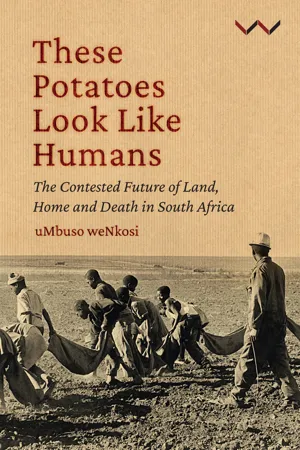
These Potatoes Look Like Humans offers a unique understanding of the intersection between land, labour, dispossession and violence experienced by Black South Africans from the apartheid period to the present. In this ground-breaking book, Mbuso Nkosi criticises the historical framing of this debate within narrow materialist and legalistic arguments. His assertion is that, for most Black South Africans, the meaning of land cannot be separated from one's spiritual and ancestral connection to it, and this results in him seeing the dispossession of land in South Africa with a perspective not yet explored. Nkosi takes as his starting point the historic 1959 potato boycott in South Africa, which came about as a result of startling rumours that potatoes dug out of the soil from the farms in the Bethal district of Mpumalanga were in fact human heads. Journalists such as Ruth First and Henry Nxumalo went to Bethal to uncover these stories and revealed horrific accounts of abuse and routine killings of farmworkers by white Afrikaners. The workers were disenfranchised Black people who were forced to work on these farms for alleged 'crimes' against National Party state laws, such as the failure to carry passbooks. In reading this violence from the perspectives of both the Black worker and the white farmer, Nkosi deploys the device of the eye to look at his research subjects and make sense of how the past informs the present. His argument is that the violence against Black farmworkers was not only on the exploitation of cheap labour, but also an anxiety white farmers felt about their settler-colonial appropriation of land. This anxiety, Nkosi argues, is pervasive in current heated public debates on the land question and calls for 'land expropriation without compensation'. Furthermore, the dispossession of Black people from their land cannot be overcome until there is a recognition of the dead and restless spirits of the land, and a spiritual return to home for Black people's ancestors. Until such time, the cycles of violence will persist. This book will be of interest to academics and scholars working in the area of land and workers' struggles but also to the general reader who wants to gain a deeper understanding of redress and social justice on multiple levels.
eBook - PDF
These Potatoes Look Like Humans
The contested future of land, home and death in South Africa
- 188 pages
- English
- PDF
- Available on iOS & Android
eBook - PDF
These Potatoes Look Like Humans
The contested future of land, home and death in South Africa
About this book
Information
Table of contents
- Cover
- Half-title
- Title
- Copyright
- Dedication
- Contents
- List of illustrations
- Acknowledgements
- Prologue: Emazambaneni: The land of terror
- Chapter 1. The spectre of the human potato
- Chapter 2. Whose eyes are looking at history?
- Chapter 3. Bethal, the house of God
- Chapter 4. Violence: The white farmers’ fears erupt
- Chapter 5. These eyes are looking for a home
- Chapter 6. Bethal today
- Chapter 7. Our eschatological future
- Notes
- Bibliography
- Index
Trusted by 375,005 students
Access to over 1.5 million titles for a fair monthly price.
Study more efficiently using our study tools.
Frequently asked questions
Yes, you can cancel anytime from the Subscription tab in your account settings on the Perlego website. Your subscription will stay active until the end of your current billing period. Learn how to cancel your subscription
No, books cannot be downloaded as external files, such as PDFs, for use outside of Perlego. However, you can download books within the Perlego app for offline reading on mobile or tablet. Learn how to download books offline
Perlego offers two plans: Essential and Complete
- Essential is ideal for learners and professionals who enjoy exploring a wide range of subjects. Access the Essential Library with 800,000+ trusted titles and best-sellers across business, personal growth, and the humanities. Includes unlimited reading time and Standard Read Aloud voice.
- Complete: Perfect for advanced learners and researchers needing full, unrestricted access. Unlock 1.5M+ books across hundreds of subjects, including academic and specialized titles. The Complete Plan also includes advanced features like Premium Read Aloud and Research Assistant.
We are an online textbook subscription service, where you can get access to an entire online library for less than the price of a single book per month. With over 1.5 million books across 990+ topics, we’ve got you covered! Learn about our mission
Look out for the read-aloud symbol on your next book to see if you can listen to it. The read-aloud tool reads text aloud for you, highlighting the text as it is being read. You can pause it, speed it up and slow it down. Learn more about Read Aloud
Yes! You can use the Perlego app on both iOS and Android devices to read anytime, anywhere — even offline. Perfect for commutes or when you’re on the go.
Please note we cannot support devices running on iOS 13 and Android 7 or earlier. Learn more about using the app
Please note we cannot support devices running on iOS 13 and Android 7 or earlier. Learn more about using the app
Yes, you can access These Potatoes Look Like Humans by Mbuso Nkosi in PDF and/or ePUB format, as well as other popular books in Politics & International Relations & African History. We have over 1.5 million books available in our catalogue for you to explore.