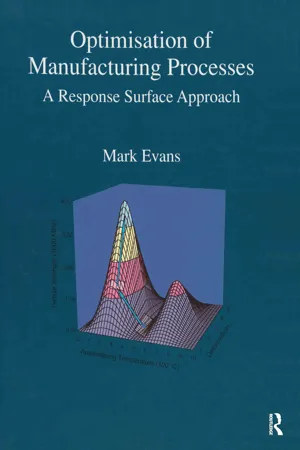
Many engineering companies around the world are currently undergoing a quality control and improvement revolution that originally started in Japan many decades ago and this book provides a brief overview of this revolution. Robust design is a central component of the modern approach to quality improvement and is a phrase used to describe any engineering activity whose objective is to develop high quality products (and processes) at low cost. A key characteristic of robust design is the use of statistically planned (designed) experiments to identify those process variables that determine product quality. Robust design was developed in Japan by G. Taguchi in the early 1950s and its widespread use throughout Japanese industry is one of the main reasons why the country has emerged as a major producer of relatively cheap high quality products, especially in the automobile, home electronics and microprocessing sectors. Despite its early success in Japan, robust design remained virtually untried in the United States and Europe until the early 1980s. However, the realisation that quality is a vital ingredient required for success in today's highly global and competitive markets has since prompted Western companies to embrace the robust design concept. This book explores the planning, implementation and analysis of experiments designed both to improve existing manufacturing process and to create newer and better processes and products.
- 333 pages
- English
- PDF
- Available on iOS & Android
eBook - PDF
About this book
Information
Table of contents
- Cover
- Half Title
- Title
- Copyright
- Contents
- Preface
- I. CONCEPTS METHODS AND CASE STUDIES
- II. LINEAR EXPERIMENTAL DESIGNS
- III. OPTIMISATION OF LINEAR PROCESSES
- IV. NON LINEAR EXPERIMENTAL DESIGNS
- V. OPTIMISATION OF NON LINEAR PROCESSES
- REFERENCES
- INDEX
Trusted by 375,005 students
Access to over 1.5 million titles for a fair monthly price.
Study more efficiently using our study tools.
Frequently asked questions
Yes, you can cancel anytime from the Subscription tab in your account settings on the Perlego website. Your subscription will stay active until the end of your current billing period. Learn how to cancel your subscription
No, books cannot be downloaded as external files, such as PDFs, for use outside of Perlego. However, you can download books within the Perlego app for offline reading on mobile or tablet. Learn how to download books offline
Perlego offers two plans: Essential and Complete
- Essential is ideal for learners and professionals who enjoy exploring a wide range of subjects. Access the Essential Library with 800,000+ trusted titles and best-sellers across business, personal growth, and the humanities. Includes unlimited reading time and Standard Read Aloud voice.
- Complete: Perfect for advanced learners and researchers needing full, unrestricted access. Unlock 1.5M+ books across hundreds of subjects, including academic and specialized titles. The Complete Plan also includes advanced features like Premium Read Aloud and Research Assistant.
We are an online textbook subscription service, where you can get access to an entire online library for less than the price of a single book per month. With over 1.5 million books across 990+ topics, we’ve got you covered! Learn about our mission
Look out for the read-aloud symbol on your next book to see if you can listen to it. The read-aloud tool reads text aloud for you, highlighting the text as it is being read. You can pause it, speed it up and slow it down. Learn more about Read Aloud
Yes! You can use the Perlego app on both iOS and Android devices to read anytime, anywhere — even offline. Perfect for commutes or when you’re on the go.
Please note we cannot support devices running on iOS 13 and Android 7 or earlier. Learn more about using the app
Please note we cannot support devices running on iOS 13 and Android 7 or earlier. Learn more about using the app
Yes, you can access Optimisation of Manufacturing Processes by Mark Evans in PDF and/or ePUB format, as well as other popular books in Technology & Engineering & Civil Engineering. We have over 1.5 million books available in our catalogue for you to explore.