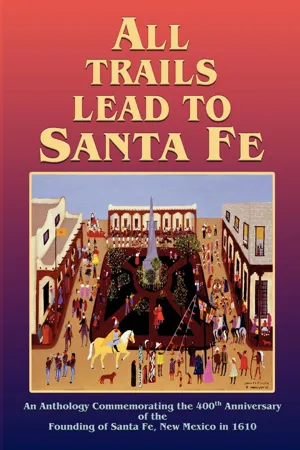
Santa Fe, as a tourist destination and an international art market with its attraction of devotees to opera, flamenco, good food and romanticized cultures, is also a city of deep historical drama. Like its seemingly "adobe style-only" architecture, all one has to do is turn the corner and discover a miniature Alhambra, a Romanesque Cathedral, or a French-inspired chapel next to one of the oldest adobe chapels in the United States to realize its long historical diversity. This fusion of architectural styles is a mirror of its people, cultures and history. From its early origins, Native American presence in the area through the archaeological record is undeniable and has proved to be a force to be reckoned with as well as reconciled. It was, however, the desire of European arrivals, Spaniards, already mixed in Spain and Mexico, to create a new life, a new environment, different architecture, different government, culture and spiritual life that set the foundations for the creation of "La Villa de Santa Fe." Indeed, Santa Fe remained Spanish from its earliest Spanish presence of 1607 until 1821. But history is not just the time between dates but the human drama that creates the "City Different." The Mexican Period of 1821-1848, American occupation and the following Territorial Period into Statehood are no less defining and, in fact, are as traumatic for some citizens as the first European contact. This tapestry was all held together by the common belief that Santa Fe was different and after centuries of coexistence a city with its cultures, tolerance and beauty was worth preserving. Indeed, the existence and awareness of this oldest of North American capitals was to attract the famous as well as infamous: poets, writers, painters, philosophers, scientists and the sickly whose prayers were answered in the thin dry air of the city situated at the base of the Sangre de Cristos at 7, 000 foot elevation. We hope readers will enjoy "All Trails Lead to Santa Fe" and in its pages discover facts not revealed before, or, in the sense of true adventure, enlighten and encourage the reader to continue the search for the evolution of "La Villa de Santa Fe."
- English
- ePUB (mobile friendly)
- Available on iOS & Android
eBook - ePub
About this book
Information
Subtopic
North American HistoryIndex
HistoryTable of contents
- Cover
- Title Page
- Copyright Page
- Contents
- Foreword
- Preface
- Introduction
- Listen
- 1 Down at the Shell-bead Water
- 2 A City Different Than We Thought, Land Grants in Early Santa Fe, 1598–1900
- 3 The Viceroy’s Order Founding the Villa of Santa Fe, A Reconsideration, 1605–1610
- 4 Thirty-eight Adobe Houses, The Villa de Santa Fe in the Seventeenth Century, 1608–1610
- 5 The History of the Santa Fe Plaza, 1610–1720
- 6 A Window to the Past, The San Miguel and La Conquistadora Chapels and Their Builders, 1610–1776
- 7 Barrio de Analco, Its Roots in Mexico and Role in Early Colonial Santa Fe, 1610–1780
- 8 In Her Own Voice, Doña Teresa Aguilera y Rocha and Intrigue in the Palace of the Governors, 1659–1662
- 9 On Establishing a Presidio at Santa Fe, 1678–1693
- 10 Vargas at the Gate, The Spanish Restoration of Santa Fe, 1692–1696
- 11 The Pastures of the Royal Horse Herd of the Santa Fe Presidio, 1692–1740
- 12 It Happened in Old Santa Fe, The Death of Governor Albino Pérez, 1835–1837
- 13 “She Was Our Mother,” New Mexico’s Change of National Sovereignty and Juan Bautista Vigil y Alarid, The Last Mexican Governor of New Mexico
- 14 They Came From the East, Importing Homicide, Violence and Misconceptions of Soft Justice into Early Santa Fe, New Mexico, 1847–1853 / Michael J. Alarid
- 15 King Maker in the Back Room, Editor Max Frost and Hardball Politics in the Late-Territorial Period, 1876–1909
- 16 Progressive Santa Fe, 1880–1912
- 17 The Cure at the End of the Trail, Seeking Health While Transforming a Town, 1880–1940
- 18 Santa Fe in World War II, 1940–1947
- 19 Alcaldes and Mayors of Santa Fe, 1613–2008
- Contributors
- About the 400th Anniversary of Santa Fe
- The 400th Anniversary of Santa Fe Book Committee
- Notes
- Index
Trusted by 375,005 students
Access to over 1.5 million titles for a fair monthly price.
Study more efficiently using our study tools.
Frequently asked questions
Yes, you can cancel anytime from the Subscription tab in your account settings on the Perlego website. Your subscription will stay active until the end of your current billing period. Learn how to cancel your subscription
No, books cannot be downloaded as external files, such as PDFs, for use outside of Perlego. However, you can download books within the Perlego app for offline reading on mobile or tablet. Learn how to download books offline
Perlego offers two plans: Essential and Complete
- Essential is ideal for learners and professionals who enjoy exploring a wide range of subjects. Access the Essential Library with 800,000+ trusted titles and best-sellers across business, personal growth, and the humanities. Includes unlimited reading time and Standard Read Aloud voice.
- Complete: Perfect for advanced learners and researchers needing full, unrestricted access. Unlock 1.5M+ books across hundreds of subjects, including academic and specialized titles. The Complete Plan also includes advanced features like Premium Read Aloud and Research Assistant.
We are an online textbook subscription service, where you can get access to an entire online library for less than the price of a single book per month. With over 1.5 million books across 990+ topics, we’ve got you covered! Learn about our mission
Look out for the read-aloud symbol on your next book to see if you can listen to it. The read-aloud tool reads text aloud for you, highlighting the text as it is being read. You can pause it, speed it up and slow it down. Learn more about Read Aloud
Yes! You can use the Perlego app on both iOS and Android devices to read anytime, anywhere — even offline. Perfect for commutes or when you’re on the go.
Please note we cannot support devices running on iOS 13 and Android 7 or earlier. Learn more about using the app
Please note we cannot support devices running on iOS 13 and Android 7 or earlier. Learn more about using the app
Yes, you can access All Trails Lead to Santa Fe (Softcover) by in PDF and/or ePUB format, as well as other popular books in History & North American History. We have over 1.5 million books available in our catalogue for you to explore.