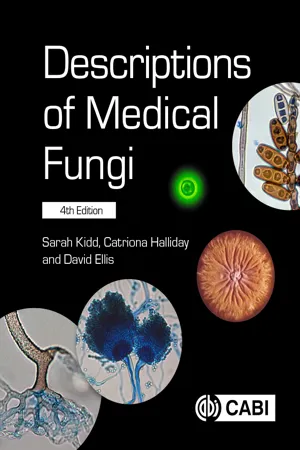
The 4th edition of this book provides laboratory staff and clinicians with a quick benchtop reference on the identification and antifungal susceptibility of human and animal fungal infections. It contains descriptions of all the major medical fungal pathogens, 179 species from 109 genera. This updated edition includes new and revised descriptions and he authors have reconciled current morphological descriptions and name changes with more recent genetic data. The most common fungal species are described, including members of the yeasts, mucoromycetes, conidial moulds, dimorphic pathogens, and dermatophytes. The book features: updates to taxonomy and fungal names.more than 350 colour photographs. antifungal susceptibility profiles, including for new drugs where available.methods of identification including molecular and/or MALDI-ToF mass spectroscopy.This handy reference is essential for laboratory staff and clinicians dealing with the identification and management of human and animal fungal infections, researchers in medical microbiology and mycology laboratories.
- 344 pages
- English
- ePUB (mobile friendly)
- Available on iOS & Android
eBook - ePub
Descriptions of Medical Fungi
About this book
Information
Table of contents
- Cover
- Title Page
- Copyright
- Contents
- Preface
- 1. Acremonium
- 2. Acrophialophora fusispora
- 3. Alternaria
- 4. Aphanoascus fulvescens
- 5. Apiotrichum
- 6. Apophysomyces complex
- 7. Arthroderma
- 8. Arthrographis kalrae
- 9. Aspergillus
- 10. Aureobasidium pullulans
- 11. Basidiobolus ranarum
- 12. Beauveria bassiana
- 13. Bipolaris
- 14. Blastomyces
- 15. Candida
- 16. Chaetomium
- 17. Chrysosporium
- 18. Cladophialophora
- 19. Cladosporium
- 20. Clavispora lusitaniae (syn. Candida lusitaniae)
- 21. Coccidioides immitis/posadasii
- 22. Colletotrichum coccodes
- 23. Conidiobolus coronatus
- 24. Coniochaeta hoffmannii (syn. Lecythophora hoffmannii; Phialophora hoffmannii)
- 25. Cryptococcus
- 26. Cunninghamella bertholletiae
- 27. Curvularia
- 28. Cutaneotrichosporon
- 29. Cyberlindnera fabianii (syn. Candida fabianii)
- 30. Cylindrocarpon
- 31. Debaryomyces hansenii (syn. Candida famata)
- 32. Diutina
- 33. Drechslera
- 34. Emergomyces
- 35. Epicoccum nigrum
- 36. Epidermophyton floccosum
- 37. Exophiala
- 38. Exserohilum
- 39. Fonsecaea complex
- 40. Fusarium
- 41. Geotrichum candidum (syn. Dipodascus geotrichum, Galactomyces candidus)
- 42. Gliocladium
- 43. Graphium
- 44. Histoplasma capsulatum complex
- 45. Hortaea werneckii
- 46. Kluyveromyces marxianus (syn. Candida kefyr; Candida pseudotropicalis)
- 47. Lasiodiplodia theobromae (syn. Botryodiplodia theobromae)
- 48. Lichtheimia corymbifera (syn. Mycocladus corymbifera; Absidia corymbifera)
- 49. Lodderomyces elongisporus
- 50. Lomentospora prolificans (syn. Scedosporium prolificans)
- 51. Lophophyton gallinae (syn. Microsporum gallinae)
- 52. Madurella complex
- 53. Magnusiomyces
- 54. Malassezia
- 55. Malbranchea pulchella
- 56. Marquandomyces marquandii (syn. Paecilomyces marquandii)
- 57. Meyerozyma guilliermondii (syn. Candida guilliermondii)
- 58. Microsphaeropsis arundinis
- 59. Microsporum
- 60. Mortierella wolfii
- 61. Mucor
- 62. Myrmecridium schulzeri (syn. Ramichloridium schulzeri)
- 63. Naganishia albida (syn. Cryptococcus albidus)
- 64. Nannizzia
- 65. Neoscytalidium dimidiatum (syn. Hendersonula toruloidea)
- 66. Ochroconis
- 67. Onychocola canadensis
- 68. Paecilomyces variotii
- 69. Papiliotrema laurentii (syn. Cryptococcus laurentii)
- 70. Paracoccidioides brasiliensis/lutzii
- 71. Paraphyton cookei (syn. Microsporum cookei)
- 72. Penicillium
- 73. Phaeoacremonium parasiticum (syn. Phialophora parasiticum)
- 74. Phialophora verrucosa
- 75. Phoma
- 76. Pichia
- 77. Pleurostoma richardsiae (syn. Pleurostomophora richardsiae; Phialophora richardsiae)
- 78. Pneumocystis jirovecii
- 79. Prototheca
- 80. Pseudopithomyces chartarum (syn. Pithomyces chartarum)
- 81. Purpureocillium lilacinum (syn. Paecilomyces lilacinus)
- 82. Quambalaria cyanescens (syn. Sporothrix cyanescens)
- 83. Rhinocladiella
- 84. Rhizomucor
- 85. Rhizopus
- 86. Rhodotorula
- 87. Saccharomyces cerevisiae
- 88. Saksenaea vasiformis complex
- 89. Sarocladium
- 90. Scedosporium
- 91. Schizophyllum commune
- 92. Scopulariopsis
- 93. Sepedonium
- 94. Sporothrix schenckii complex
- 95. Stemphylium
- 96. Syncephalastrum racemosum
- 97. Talaromyces marneffei (syn. Penicillium marneffei)
- 98. Torulaspora delbrueckii (syn. Candida colliculosa)
- 99. Trematosphaeria grisea (syn. Madurella grisea)
- 100. Trichoderma
- 101. Trichophyton
- 102. Trichosporon
- 103. Trichothecium roseum
- 104. Ulocladium
- 105. Veronaea botryosa
- 106. Verruconis gallopava (syn. Ochroconis gallopava)
- 107. Verticillium
- 108. Wickerhamomyces anomalus (syn. Candida pelliculosa)
- 109. Yarrowia lipolytica (syn. Candida lipolytica)
- 110. Microscopy stains and techniques
- 111. Specialised culture media
- Glossary
- References
- Index
- Back Cover
Trusted by 375,005 students
Access to over 1.5 million titles for a fair monthly price.
Study more efficiently using our study tools.
Frequently asked questions
Yes, you can cancel anytime from the Subscription tab in your account settings on the Perlego website. Your subscription will stay active until the end of your current billing period. Learn how to cancel your subscription
No, books cannot be downloaded as external files, such as PDFs, for use outside of Perlego. However, you can download books within the Perlego app for offline reading on mobile or tablet. Learn how to download books offline
Perlego offers two plans: Essential and Complete
- Essential is ideal for learners and professionals who enjoy exploring a wide range of subjects. Access the Essential Library with 800,000+ trusted titles and best-sellers across business, personal growth, and the humanities. Includes unlimited reading time and Standard Read Aloud voice.
- Complete: Perfect for advanced learners and researchers needing full, unrestricted access. Unlock 1.5M+ books across hundreds of subjects, including academic and specialized titles. The Complete Plan also includes advanced features like Premium Read Aloud and Research Assistant.
We are an online textbook subscription service, where you can get access to an entire online library for less than the price of a single book per month. With over 1.5 million books across 990+ topics, we’ve got you covered! Learn about our mission
Look out for the read-aloud symbol on your next book to see if you can listen to it. The read-aloud tool reads text aloud for you, highlighting the text as it is being read. You can pause it, speed it up and slow it down. Learn more about Read Aloud
Yes! You can use the Perlego app on both iOS and Android devices to read anytime, anywhere — even offline. Perfect for commutes or when you’re on the go.
Please note we cannot support devices running on iOS 13 and Android 7 or earlier. Learn more about using the app
Please note we cannot support devices running on iOS 13 and Android 7 or earlier. Learn more about using the app
Yes, you can access Descriptions of Medical Fungi by Sarah Kidd,Catriona Halliday,David Ellis in PDF and/or ePUB format, as well as other popular books in Scienze biologiche & Microbiologia medica e parassitologia. We have over 1.5 million books available in our catalogue for you to explore.