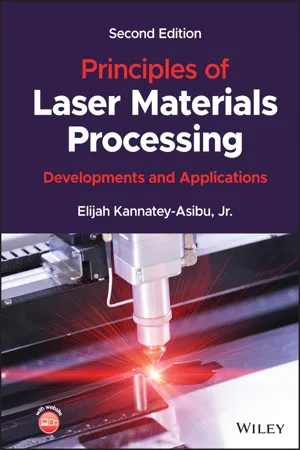
Authoritative resource providing state-of-the-art coverage in the field of laser materials processing, supported with supplementary learning materials
Principles of Laser Materials Processing goes over the most recent advancements and applications in laser materials processing, with the second edition providing a welcome update to the successful first edition through updated content on the important fields within laser materials processing. The text includes solved example problems and problem sets suitable for the readers' further understanding of the technology explained.
Split into three parts, the text first introduces basic concepts of lasers, including the characteristics of lasers and the design of their components, to aid readers in their initial understanding of the technology. The text then reviews the engineering concepts that are needed to analyze the different processes. Finally, it delves into the background of laser materials and provides a state-of-the-art compilation of material in the major application areas, such as laser cutting and drilling, welding, surface modification, and forming, among many others. It also presents information on laser safety to prepare the reader for working in the industry sector and provide practicing engineers the updates needed to work safely and effectively.
In Principles of Laser Materials Processing, readers can expect to find specific information on:
- Laser generation principles, including basic atomic structure, atomic transitions, population distribution, absorption, and spontaneous emission
- Optical resonators, including standing waves in a rectangular cavity, planar resonators, beam modes, line selection, confocal resonators, and concentric resonators
- Laser pumping, including optical pumping, arc/flash lamp pumping, energy distribution in the active medium, and electrical pumping
- Broadening mechanisms, including line-shape functions, homogeneous broadening such as natural and collision, and inhomogeneous broadening
Principles of Laser Materials Processing is highly suitable for senior undergraduate and graduate students studying laser processing, and non-traditional manufacturing processes; it is also aimed at researchers to provide additional information to be used in research projects that are to be undertaken within the technology field.