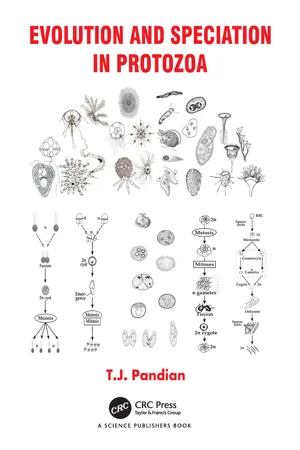
The polyphyletic Protozoa have explored the possibility of performing almost all metazoan functions with a few subcellular organelles. Their unicellularity and structural simplicity have (i) limited diversity to 32,950 species, (ii) restricted spatial distribution to aquatic habitats (94%, against 15% in Metazoa), (iii) demonstrated the ubiquitous dominance of clonality, (iv) reduced sexualization in 50% species, (v) facilitated the use of vegetative gametes in 40% species and (vi) secondary loss of sex in 10% species. With the fastest multiplication rates, i.e. once every 6-60 hours, they occur in high densities of 105-106 cell/ml. Their diverse and complicated life cycles are described in 30 types. Being risky, the cycle involves two hosts in < 2,000 parasitic species and injective transmission mode by sanguivorous insects and ticks in < 300 species. Their radial symmetry has accelerated diversity more than in radially symmetric less speciose Porifera (8,553 species), Cnidaria (10,856) and Echinodermata (7,000). In them, diversity is decelerated in the following descending order: symmetry > clonality > hermaphroditism > motility. Motility ranges from 2-3 ?m for Rhizopoda to 400-2,000 ?m for Ciliophora. Not surprisingly, 6,800 species of arcellinids, filosians and formainifers are testated or shelled. Within 1,229 sessile species, the peritrichid and suctorian ciliates are better adapted to coloniality. Unlike those of many Metazoa, the protozoan cyst is a dynamic stage, in which clonal or sexual reproduction occurs. Over 81% protozoans encyst, as it ensures (i) 90% survival during unfavorable conditions (against 15 in 12% non-encysted protozoans), (ii) genome transfer through generations, (iii) dispersal into new habitats and (iv) transmission to new hosts. Their mean body size ranges from 2 ?m to 2 mm – a range over 1,000-times – only 8% aquatic metazoans cover a similar size range. In comparison to 77% macrophagy in Metazoa, only 46% protozoans are macrophagous predators. Within motile microphagy, protozoans filter 3-2 times smaller food particle at 50% cheaper clearance cost. This efficiency has expanded microphagy to 15% in protozoans, against 3% in Metazoa. Hence, their turnover rate in trophic dynamics is twice faster than that of metazoans. Foraminifers serve as ecological sensitive indicators in petroleum exploration and rise in sea level. For the first time, incidences of clonality and meiosis as well as symbiosis and parasitism have been shown to hint at the origin and evolution of different protozoan taxonomic groups during the geological past.
- 180 pages
- English
- ePUB (mobile friendly)
- Available on iOS & Android
eBook - ePub
Evolution and Speciation in Protozoa
About this book
Information
Table of contents
- Cover Page
- Title Page
- Copyright Page
- Preface
- Acknowledgements
- Contents
- Preamble
- 1. General Introduction
- 2. Spatial Distribution
- 3. Acquisition of Nutrients and Food
- 4. Commensals—Symbionts–Parasites
- 5. Sexual Reproduction
- 6. Clonal Multiplication—Regeneration
- 7. Gametogenesis
- 8. Induction and Morphogenesis
- 9. Diversity: Symmetry-Sexuality-Motility
- 10. Past: Emergence of Protozoa
- 11. Present: Conservation and Dormancy
- 12. Future: Climate Change
- 13. References
- Author Index
- Species Index
- Subject Index
- Author’s Biography
Trusted by 375,005 students
Access to over 1.5 million titles for a fair monthly price.
Study more efficiently using our study tools.
Frequently asked questions
Yes, you can cancel anytime from the Subscription tab in your account settings on the Perlego website. Your subscription will stay active until the end of your current billing period. Learn how to cancel your subscription
No, books cannot be downloaded as external files, such as PDFs, for use outside of Perlego. However, you can download books within the Perlego app for offline reading on mobile or tablet. Learn how to download books offline
Perlego offers two plans: Essential and Complete
- Essential is ideal for learners and professionals who enjoy exploring a wide range of subjects. Access the Essential Library with 800,000+ trusted titles and best-sellers across business, personal growth, and the humanities. Includes unlimited reading time and Standard Read Aloud voice.
- Complete: Perfect for advanced learners and researchers needing full, unrestricted access. Unlock 1.5M+ books across hundreds of subjects, including academic and specialized titles. The Complete Plan also includes advanced features like Premium Read Aloud and Research Assistant.
We are an online textbook subscription service, where you can get access to an entire online library for less than the price of a single book per month. With over 1.5 million books across 990+ topics, we’ve got you covered! Learn about our mission
Look out for the read-aloud symbol on your next book to see if you can listen to it. The read-aloud tool reads text aloud for you, highlighting the text as it is being read. You can pause it, speed it up and slow it down. Learn more about Read Aloud
Yes! You can use the Perlego app on both iOS and Android devices to read anytime, anywhere — even offline. Perfect for commutes or when you’re on the go.
Please note we cannot support devices running on iOS 13 and Android 7 or earlier. Learn more about using the app
Please note we cannot support devices running on iOS 13 and Android 7 or earlier. Learn more about using the app
Yes, you can access Evolution and Speciation in Protozoa by T.J. Pandian in PDF and/or ePUB format, as well as other popular books in Biological Sciences & Medical Theory, Practice & Reference. We have over 1.5 million books available in our catalogue for you to explore.