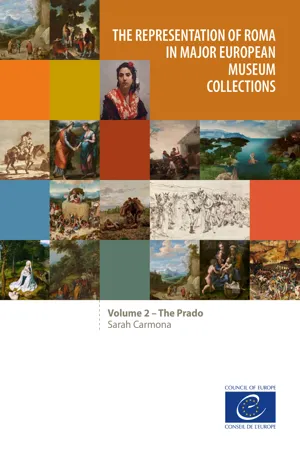
The representation of Roma in major European museum collections
Volume 2: The Prado
- English
- ePUB (mobile friendly)
- Available on iOS & Android
About this book
What do works of art teach us from their period of creation? What do they teach us about human interaction, about social groups?
The Council of Europe is a key player in the fight to respect the rights and equal treatment of Roma and Travellers. As such, it implements various actions aimed at combating discrimination: facilitating the access of Roma and Travellers to public services and justice; giving visibility to their history, culture and languages; and ensuring their participation in the different levels of decision making.
Another aspect of the Council of Europe's work is to improve the wider public's understanding of Roma and their place in Europe. Knowing and understanding Roma and Travellers, their customs, their professions, their history, their migration and the laws affecting them are indispensable elements for interpreting the situation of Roma and Travellers today and understanding the discrimination they face.
This publication focuses on what the works exhibited at the Prado Museum tell us about the place and perception of Roma in Europe from the 15th to the 19th centuries.Students aged 12 to 18, teachers, and any other visitor to the Prado interested in this theme, will find detailed worksheets on 15 paintings representing Roma and Travellers and a booklet to foster reflection on the works and their context, while creating links with our contemporary perception of Roma and Travellers in today's society.
Frequently asked questions
- Essential is ideal for learners and professionals who enjoy exploring a wide range of subjects. Access the Essential Library with 800,000+ trusted titles and best-sellers across business, personal growth, and the humanities. Includes unlimited reading time and Standard Read Aloud voice.
- Complete: Perfect for advanced learners and researchers needing full, unrestricted access. Unlock 1.4M+ books across hundreds of subjects, including academic and specialized titles. The Complete Plan also includes advanced features like Premium Read Aloud and Research Assistant.
Please note we cannot support devices running on iOS 13 and Android 7 or earlier. Learn more about using the app.
Information
Table of contents
- Preface
- The Haywain Triptych (1512-1515)
- Rest on the Flight into Egypt (1518-1520)
- The Temptations of Saint Anthony the Abbot (1520-1524)
- The Holy Family/La Perla (1518)
- The Visitation (1517)
- The Triumph of Death (1562-1563)
- Mule Train and Gypsies in a Forest (1612)
- Landscape with Gypsies (1641-1645)
- Gypsy Family (18th century)
- An Avenue in Andalusia or The Maja and the Cloaked Men (1777)
- The Fight at the Cock Inn (1777)
- Three Gypsies (1840)
- A Gypsy (1871)
- Where do we go now? (Bosnians) (1884)
- The Cattle Market (second half of the 19th century)
- From epistemicide to cultural appropriation
- Conclusion: the justice of the singular versus the totalitarianism of the truth
- The catalogue and photo credits