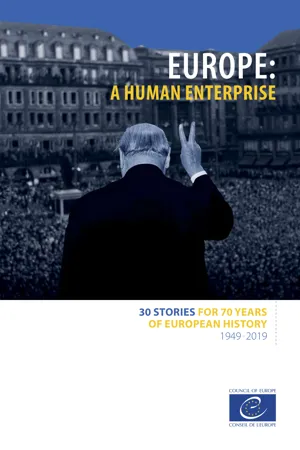
Europe: a human enterprise
eBook - ePub

Europe: a human enterprise

  1. English
  2. ePUB (mobile friendly)
  3. Available on iOS & Android
eBook - ePub

Europe: a human enterprise

About this book

30 stories for 70 years of European history 1949-2019.

Founded in Strasbourg in 1949 to unite a continent ravaged by war, the Council of Europe has built a vast area of democratic security that protects 830 million people in 47 countries, from the United Kingdom to Turkey, from the Russian Federation to Portugal and from Iceland to Switzerland. Its core objective is preserving and promoting human rights, democracy and the rule of law.This book covers 70 years of history, during which Europe has changed profoundly, and – this is something we often forget – changed for the better. Our old continent, which was in ruins after the Second World War, found the energy to rise up out of the ashes. The contributions here go back over the highlights of this common history, from the creation of the European flag to the management of democratic and humanitarian crises, through the enlargement to east European countries after the fall of the Berlin Wall.Written by individuals who have worked for, or closely with, the Organisation, it paints a vivid picture – combining anecdotes with turning points in history – of what the Council of Europe has stood for since 1949, and of the values which it must continue to champion to keep the European ideal alive in people's hearts and minds.The 30 contributions compiled by Denis Huber include accounts by Gabriella Battaini-Dragoni, Maud de Boer-Buquicchio, Gianni Buquicchio, Bruno Haller, Charles Kohler, Catherine Lalumière, Peter Leuprecht, Alexandre Orlov, Guido Raimondi, Catherine Trautmann, Jacques Warin and Hans Winkler.

Preface by Thorbjørn Jagland, Secretary General of the Council of Europe and Gabriella Battaini-Dragoni, Deputy Secretary General of the Council of Europe. Postface by Emmanuel Macron, President of the French Republic.

Frequently asked questions

Yes, you can cancel anytime from the Subscription tab in your account settings on the Perlego website. Your subscription will stay active until the end of your current billing period. Learn how to cancel your subscription.
No, books cannot be downloaded as external files, such as PDFs, for use outside of Perlego. However, you can download books within the Perlego app for offline reading on mobile or tablet. Learn more here.
Perlego offers two plans: Essential and Complete
  • Essential is ideal for learners and professionals who enjoy exploring a wide range of subjects. Access the Essential Library with 800,000+ trusted titles and best-sellers across business, personal growth, and the humanities. Includes unlimited reading time and Standard Read Aloud voice.
  • Complete: Perfect for advanced learners and researchers needing full, unrestricted access. Unlock 1.4M+ books across hundreds of subjects, including academic and specialized titles. The Complete Plan also includes advanced features like Premium Read Aloud and Research Assistant.
Both plans are available with monthly, semester, or annual billing cycles.
We are an online textbook subscription service, where you can get access to an entire online library for less than the price of a single book per month. With over 1 million books across 1000+ topics, we’ve got you covered! Learn more here.
Look out for the read-aloud symbol on your next book to see if you can listen to it. The read-aloud tool reads text aloud for you, highlighting the text as it is being read. You can pause it, speed it up and slow it down. Learn more here.
Yes! You can use the Perlego app on both iOS or Android devices to read anytime, anywhere — even offline. Perfect for commutes or when you’re on the go.
Please note we cannot support devices running on iOS 13 and Android 7 or earlier. Learn more about using the app.
Yes, you can access Europe: a human enterprise by Council of Europe, Denis Huber in PDF and/or ePUB format, as well as other popular books in Politics & International Relations & Human Rights. We have over one million books available in our catalogue for you to explore.

Table of contents

  1. Cover
  2. Title page
  3. Contents
  4. Preface. Stories in history
  5. The beginning. Summer 1949 in Strasbourg
  6. European Convention on Human Rights – November 1950. René Cassin, symbol of the Europe of human rights
  7. Adoption of the European flag – 1955. 12 gold stars on a sky blue background
  8. European Social Charter – 1961. In defence of Cinderella
  9. The Greek crisis – 1967-1969. Fighting a dictatorship in the “homeland of democracy”
  10. Portugal and Spain – 1974-1977. An Iberian dawn
  11. Abolishing the death penalty in Europe
  12. 1984-1985. “Ostpolitik” makes its appearance
  13. 1987-1988. Travels beyond the Iron Curtain
  14. Prohibition of corporal punishment. Take it like a man
  15. Fall of the Berlin Wall – 1989. One November night on the motorway
  16. 1989-2006. Europe, our common home
  17. My road to Damascus
  18. 1990. A memorable tour
  19. 1990. A Venitian story
  20. Strasbourg and Europe. A marriage of head and heart
  21. 1993. An Albanian summer
  22. The Vienna Summit – October 1993. Building a Greater. Europe
  23. Rwanda – 1994-1995. A dress that tells a story
  24. The Strasbourg Summit – October 1997. Reconciling Europe with itself
  25. Bosnia and Herzegovina – 1997. From indifference to difference: a Bosnian story
  26. 1994-1999. From “Mani pulite” to “Caviar-Gate”: the neverending fight against corruption
  27. Kosovo – 1999. Building democracy on a local basis
  28. Azerbaijan – 2001. The prisoners of Gobustan
  29. Chechnya 2000-2003. Heart-to-heart
  30. The Warsaw Summit – May 2005. A new ambition for the European continent
  31. Fighting against violence
  32. Serbia – 2006-2007. Blood and honey
  33. Belarus – 2001-2019. The wheel turning in a vacuum
  34. From Serbia to the Council of Europe. Violence and serenity
  35. Culture, the foundation for a European renaissance
  36. Postface. A human enterprise
  37. Appendices. The 47 member states of the Council of Europe with their accession dates
  38. The Council of Europe in brief
  39. Key dates
  40. The authors
  41. 70 years of history in photographs
  42. Copyright
  43. Table of contents