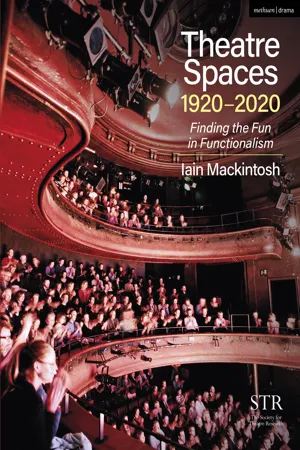
In this lavishly illustrated hands-on account of the creation of new theatre spaces spanning a century, Iain Mackintosh offers a compelling history that is part memoir, part impassioned call to rethink the design of our theatre spaces and the future of live theatre. As the originator of theatre designs as diverse as the Cottesloe in 1977, Glyndebourne in 1994, the Orange Tree Theatre in 1991, the Martha Cohen Theatre in 1985 and the Tina Packer Playhouse in 2001, he discovered why the same show worked in some theatres but not in others.
It is this unique blend of experience that informs this account of many of the best-known theatre spaces in Britain, besides many international examples including the Guthrie Theater, Minneapolis and the Oslo Opera House. Running throughout is a consideration of factors which have shaped design thinking during this time and which demand attention today. After the long theatre closures driven by the Covid-19 pandemic, Mackintosh argues that now is the time to discover the routes travelled over the last century.
Published in partnership with the Society of Theatre Research, the book features a foreword by Sir Richard Eyre, Director of the National Theatre, 1987–1997.
- 272 pages
- English
- ePUB (mobile friendly)
- Available on iOS & Android
eBook - ePub
About this book
Information
Table of contents
- Cover
- Half-Title Page
- Series Page
- Title Page
- Contents
- List of illustrations
- Foreword by Sir Richard Eyre
- An introduction and a summary
- Act I Pre-1920: Setting the scene and some early pioneers
- 1 Theatre is ephemeral while buildings endure. Some necessary background
- 2 Richard Wagner, Adolphe Appia and the spreading of the fan
- Act II 1920–1976: The march of modernism
- 3 The Festival Cambridge, Stratford-upon-Avon and early days of the National
- 4 Guthrie’s thrust stages
- 5 Germany’s building boom and Anglo-American Shakespeare
- 6 The Olivier, the Lyttelton and the Barbican theatres
- Act III 1976–2020: The past informs the present
- 7 The Cottesloe and other courtyards
- 8 Worthy scaffolds: Brook’s empty space and spaces found by others
- 9 Regenerating the old offers an antidote to modernism. Part One: English theatres of the eighteenth and nineteenth centuries
- 10 Regenerating the old offers an antidote to modernism. Part Two: A couple of twentieth-century Scottish theatres reborn – one in Edinburgh and the other in Florida
- 11 New opera houses from Glyndebourne to Dallas. Elsewhere some starchitects upstage the performers
- 12 Learning from the Netherlands, Berlin, Brazil, Australia and from Indian and Chinese cultures
- 13 2010–2020: Some new builds, two renovations – one at Stratford-upon-Avon and one in London – and diversions on in-the-round and the open air
- Act IV 2021: The future
- 14 Unforeseen consequences of seventeenth-century plagues, of the arrival of the talkies and the more recent dangers of the pandemic and of ‘virtual theatre’. Some central themes restated
- Bibliographies
- Acknowledgements
- Theatre index
- Person index
- Copyright
Trusted by 375,005 students
Access to over 1.5 million titles for a fair monthly price.
Study more efficiently using our study tools.
Frequently asked questions
Yes, you can cancel anytime from the Subscription tab in your account settings on the Perlego website. Your subscription will stay active until the end of your current billing period. Learn how to cancel your subscription
No, books cannot be downloaded as external files, such as PDFs, for use outside of Perlego. However, you can download books within the Perlego app for offline reading on mobile or tablet. Learn how to download books offline
Perlego offers two plans: Essential and Complete
- Essential is ideal for learners and professionals who enjoy exploring a wide range of subjects. Access the Essential Library with 800,000+ trusted titles and best-sellers across business, personal growth, and the humanities. Includes unlimited reading time and Standard Read Aloud voice.
- Complete: Perfect for advanced learners and researchers needing full, unrestricted access. Unlock 1.5M+ books across hundreds of subjects, including academic and specialized titles. The Complete Plan also includes advanced features like Premium Read Aloud and Research Assistant.
We are an online textbook subscription service, where you can get access to an entire online library for less than the price of a single book per month. With over 1.5 million books across 990+ topics, we’ve got you covered! Learn about our mission
Look out for the read-aloud symbol on your next book to see if you can listen to it. The read-aloud tool reads text aloud for you, highlighting the text as it is being read. You can pause it, speed it up and slow it down. Learn more about Read Aloud
Yes! You can use the Perlego app on both iOS and Android devices to read anytime, anywhere — even offline. Perfect for commutes or when you’re on the go.
Please note we cannot support devices running on iOS 13 and Android 7 or earlier. Learn more about using the app
Please note we cannot support devices running on iOS 13 and Android 7 or earlier. Learn more about using the app
Yes, you can access Theatre Spaces 1920-2020 by Iain Mackintosh in PDF and/or ePUB format, as well as other popular books in Media & Performing Arts & History of Architecture. We have over 1.5 million books available in our catalogue for you to explore.