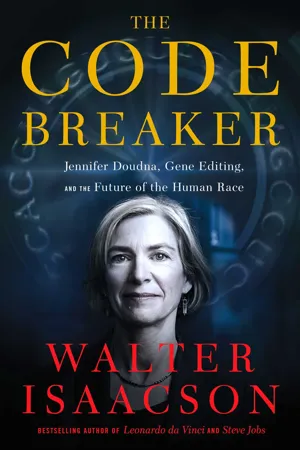
The bestselling author of Leonardo da Vinci and Steve Jobs returns with a gripping account of how the pioneering scientist Jennifer Doudna, along with her colleagues and rivals, launched a revolution that will allow us to cure diseases, fend off viruses, and enhance our children.
In the spring of 2012, the Berkeley biochemist Jennifer Doudna and her collaborators turned a curiosity of nature into an invention that will transform the future of the human race: an easy-to-use tool that can edit DNA. Known as CRISPR, it opened a brave new world of medical miracles and moral questions. It has already been deployed to cure deadly diseases, fight the coronavirus pandemic of 2020, and make inheritable changes in the genes of babies.
The development of CRISPR and the war against coronavirus will hasten our transition to the next great innovation revolution. The past half-century has been an information-technology era, based on the microchip, the computer, and the internet. Now we are entering an even more momentous era, a life-science revolution. Children who study digital coding will be surpassed by those who study the code of life.
Should we use our new evolution-hacking powers to make us less susceptible to viruses and eliminate dreaded disorders? What a wonderful boon that would be! Right? And what about preventing congenital deafness or blindness? Or being very short? Or being depressed? Hmmm…How should we think about that? Should we allow parents, if they can afford it, to enhance the IQ or height or memory or muscles of their kids?
After helping to discover CRISPR, Doudna became a leader in wrestling with these moral and policy issues. Her life story illustrates that the key to innovation is connecting basic science to our everyday lives—moving discoveries from our labs to our bedsides—in ways that respect our moral values. It’s a thrilling detective tale that involves the most profound wonders of nature, from the origins of life to the future of our species.
eBook - ePub
The Code Breaker
Jennifer Doudna, Gene Editing, and the Future of the Human Race
- 560 pages
- English
- ePUB (mobile friendly)
- Available on iOS & Android
eBook - ePub
About this book
Information
Table of contents
- Cover
- Title Page
- Dedication
- Introduction: Into the Breach
- Part One: The Origins of Life
- Part Two: Crispr
- Part Three: Gene Editing
- Part Four: CRISPR in Action
- Part Six: CRISPR Babies
- Part Seven: The Moral Questions
- Part Eight: Dispatches from the Front
- Part Nine: Coronavirus
- Epilogue
- Acknowledgments
- About the Author
- Notes
- Index
- Image Credits
- Copyright
Trusted by 375,005 students
Access to over 1.5 million titles for a fair monthly price.
Study more efficiently using our study tools.
Frequently asked questions
Yes, you can cancel anytime from the Subscription tab in your account settings on the Perlego website. Your subscription will stay active until the end of your current billing period. Learn how to cancel your subscription
No, books cannot be downloaded as external files, such as PDFs, for use outside of Perlego. However, you can download books within the Perlego app for offline reading on mobile or tablet. Learn how to download books offline
Perlego offers two plans: Essential and Complete
- Essential is ideal for learners and professionals who enjoy exploring a wide range of subjects. Access the Essential Library with 800,000+ trusted titles and best-sellers across business, personal growth, and the humanities. Includes unlimited reading time and Standard Read Aloud voice.
- Complete: Perfect for advanced learners and researchers needing full, unrestricted access. Unlock 1.5M+ books across hundreds of subjects, including academic and specialized titles. The Complete Plan also includes advanced features like Premium Read Aloud and Research Assistant.
We are an online textbook subscription service, where you can get access to an entire online library for less than the price of a single book per month. With over 1.5 million books across 990+ topics, we’ve got you covered! Learn about our mission
Look out for the read-aloud symbol on your next book to see if you can listen to it. The read-aloud tool reads text aloud for you, highlighting the text as it is being read. You can pause it, speed it up and slow it down. Learn more about Read Aloud
Yes! You can use the Perlego app on both iOS and Android devices to read anytime, anywhere — even offline. Perfect for commutes or when you’re on the go.
Please note we cannot support devices running on iOS 13 and Android 7 or earlier. Learn more about using the app
Please note we cannot support devices running on iOS 13 and Android 7 or earlier. Learn more about using the app
Yes, you can access The Code Breaker by Walter Isaacson in PDF and/or ePUB format, as well as other popular books in Technology & Engineering & Social Science Biographies. We have over 1.5 million books available in our catalogue for you to explore.