Tracing the origins of modern political thought through three sets of arguments over history, morality, and freedom
In this wide-ranging work, Michael Sonenscher traces the origins of modern political thought and ideologies to a question, raised by Immanuel Kant, about what is involved in comparing individual human lives to the whole of human history. How can we compare them, or understand the results of the comparison? Kant’s question injected a new, future-oriented dimension into existing discussions of prevailing norms, challenging their orientation toward the past. This reversal made Kant’s question a bridge between three successive sets of arguments: between the supporters of the ancients and moderns, the classics and romantics, and the Romans and the Germans. Sonenscher argues that the genealogy of modern political ideologies—from liberalism to nationalism to communism—can be connected to the resulting discussions of time, history, and values, mainly in France but also in Germany, Switzerland, and Britain, in the period straddling the French and Industrial revolutions.
What is the genuinely human content of human history? Everything begins somewhere—democracy with the Greeks, or the idea of a res publica with the Romans—but these local arrangements have become vectors of values that are, apparently, universal. The intellectual upheaval that Sonenscher describes involved a struggle to close the gap, highlighted by Kant, between individual lives and human history. After Kant is an examination of that struggle’s enduring impact on the history and the historiography of political thought.
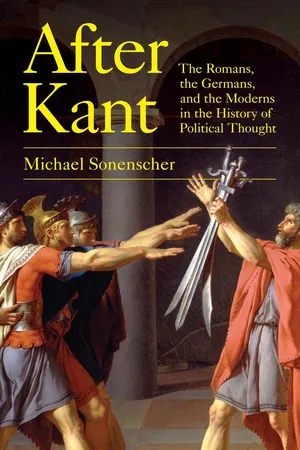
eBook - ePub
After Kant
The Romans, the Germans, and the Moderns in the History of Political Thought
- 572 pages
- English
- ePUB (mobile friendly)
- Available on iOS & Android
eBook - ePub
After Kant
The Romans, the Germans, and the Moderns in the History of Political Thought
About this book
Information
Publisher
Princeton University PressYear
2023Print ISBN
9780691245638
9780691245621
eBook ISBN
9780691245645
Topic
PhilosophySubtopic
Economic HistoryTable of contents
- Cover
- Title Page
- Copyright
- Contents
- Preface
- 1. Introduction
- 2. Palingenesis, History, and Politics
- 3. The Coppet Group and the Liberty of the Moderns
- 4. Germaine de Staël and Modern Politics
- 5. From the Concept of Palingenesis to the Concept of Enlightenment
- 6. The Death of God and the Problem of Autonomy
- 7. The Idea of Autonomy and the Concept of Civil Society
- 8. From Romanticism to Classicism
- 9. The Return of Rome
- 10. Civil Society and the State
- 11. From Autonomy to Democracy
- 12. The Politics of Unsocial Sociability
- Appendix Lord Acton on the Romans, the Germans, and the Moderns
- Bibliography
- Index
Trusted by 375,005 students
Access to over 1.5 million titles for a fair monthly price.
Study more efficiently using our study tools.
Frequently asked questions
Yes, you can cancel anytime from the Subscription tab in your account settings on the Perlego website. Your subscription will stay active until the end of your current billing period. Learn how to cancel your subscription
No, books cannot be downloaded as external files, such as PDFs, for use outside of Perlego. However, you can download books within the Perlego app for offline reading on mobile or tablet. Learn how to download books offline
Perlego offers two plans: Essential and Complete
- Essential is ideal for learners and professionals who enjoy exploring a wide range of subjects. Access the Essential Library with 800,000+ trusted titles and best-sellers across business, personal growth, and the humanities. Includes unlimited reading time and Standard Read Aloud voice.
- Complete: Perfect for advanced learners and researchers needing full, unrestricted access. Unlock 1.5M+ books across hundreds of subjects, including academic and specialized titles. The Complete Plan also includes advanced features like Premium Read Aloud and Research Assistant.
We are an online textbook subscription service, where you can get access to an entire online library for less than the price of a single book per month. With over 1.5 million books across 990+ topics, we’ve got you covered! Learn about our mission
Look out for the read-aloud symbol on your next book to see if you can listen to it. The read-aloud tool reads text aloud for you, highlighting the text as it is being read. You can pause it, speed it up and slow it down. Learn more about Read Aloud
Yes! You can use the Perlego app on both iOS and Android devices to read anytime, anywhere — even offline. Perfect for commutes or when you’re on the go.
Please note we cannot support devices running on iOS 13 and Android 7 or earlier. Learn more about using the app
Please note we cannot support devices running on iOS 13 and Android 7 or earlier. Learn more about using the app
Yes, you can access After Kant by Michael Sonenscher in PDF and/or ePUB format, as well as other popular books in Philosophy & Economic History. We have over 1.5 million books available in our catalogue for you to explore.