An examination of coined money and its significance to rulers, aristocrats and peasants in early medieval Europe
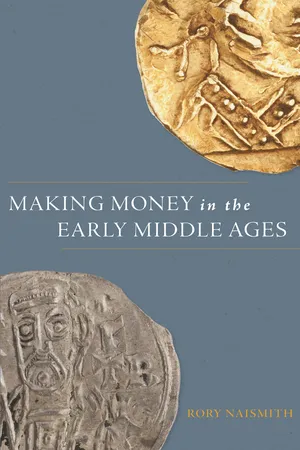
Between the end of the Roman Empire in the fifth century and the economic transformations of the twelfth, coined money in western Europe was scarce and high in value, difficult for the majority of the population to make use of. And yet, as Rory Naismith shows in this illuminating study, coined money was made and used throughout early medieval Europe. It was, he argues, a powerful tool for articulating people’s place in economic and social structures and an important gauge for levels of economic complexity. Working from the premise that using coined money carried special significance when there was less of it around, Naismith uses detailed case studies from the Mediterranean and northern Europe to propose a new reading of early medieval money as a point of contact between economic, social, and institutional history.
Naismith examines structural issues, including the mining and circulation of metal and the use of bullion and other commodities as money, and then offers a chronological account of monetary development, discussing the post-Roman period of gold coinage, the rise of the silver penny in the seventh century and the reconfiguration of elite power in relation to coinage in the tenth and eleventh centuries. In the process, he counters the conventional view of early medieval currency as the domain only of elite gift-givers and intrepid long-distance traders. Even when there were few coins in circulation, Naismith argues, the ways they were used—to give gifts, to pay rents, to spend at markets—have much to tell us.
- 545 pages
- English
- PDF
- Available on iOS & Android
eBook - PDF
Making Money in the Early Middle Ages
About this book
Information
Publisher
Princeton University PressYear
2023Print ISBN
9780691249346
9780691177403
eBook ISBN
9780691249339
Table of contents
- Cover
- Contents
- List of Illustrations
- Preface and Acknowledgements
- Note on Values
- Chapter 1. Introduction
- Part I
- Part II
- Abbreviations
- Bibliography
- Index
Trusted by 375,005 students
Access to over 1.5 million titles for a fair monthly price.
Study more efficiently using our study tools.
Frequently asked questions
Yes, you can cancel anytime from the Subscription tab in your account settings on the Perlego website. Your subscription will stay active until the end of your current billing period. Learn how to cancel your subscription
No, books cannot be downloaded as external files, such as PDFs, for use outside of Perlego. However, you can download books within the Perlego app for offline reading on mobile or tablet. Learn how to download books offline
Perlego offers two plans: Essential and Complete
- Essential is ideal for learners and professionals who enjoy exploring a wide range of subjects. Access the Essential Library with 800,000+ trusted titles and best-sellers across business, personal growth, and the humanities. Includes unlimited reading time and Standard Read Aloud voice.
- Complete: Perfect for advanced learners and researchers needing full, unrestricted access. Unlock 1.5M+ books across hundreds of subjects, including academic and specialized titles. The Complete Plan also includes advanced features like Premium Read Aloud and Research Assistant.
We are an online textbook subscription service, where you can get access to an entire online library for less than the price of a single book per month. With over 1.5 million books across 990+ topics, we’ve got you covered! Learn about our mission
Look out for the read-aloud symbol on your next book to see if you can listen to it. The read-aloud tool reads text aloud for you, highlighting the text as it is being read. You can pause it, speed it up and slow it down. Learn more about Read Aloud
Yes! You can use the Perlego app on both iOS and Android devices to read anytime, anywhere — even offline. Perfect for commutes or when you’re on the go.
Please note we cannot support devices running on iOS 13 and Android 7 or earlier. Learn more about using the app
Please note we cannot support devices running on iOS 13 and Android 7 or earlier. Learn more about using the app
Yes, you can access Making Money in the Early Middle Ages by Rory Naismith in PDF and/or ePUB format, as well as other popular books in History & Economic History. We have over 1.5 million books available in our catalogue for you to explore.