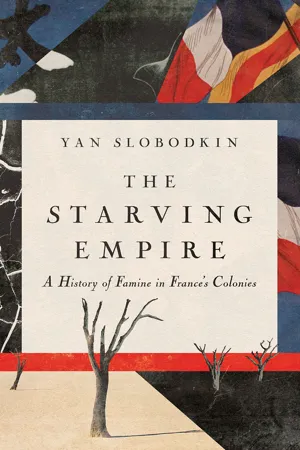
The Starving Empire
eBook - ePub

The Starving Empire

A History of Famine in France's Colonies

  1. 312 pages
  2. English
  3. ePUB (mobile friendly)
  4. Available on iOS & Android
eBook - ePub

The Starving Empire

A History of Famine in France's Colonies

About this book

The Starving Empire traces the history of famine in the modern French Empire, showing that hunger is intensely local and sweepingly global, shaped by regional contexts and the transnational interplay of ideas and policies all at once. By integrating food crises in Algeria, West and Equatorial Africa, and Vietnam into a broader story of imperial and transnational care, Yan Slobodkin reveals how the French colonial state and an emerging international community took increasing responsibility for subsistence, but ultimately failed to fulfill this responsibility.

Europeans once dismissed colonial famines as acts of god, misfortunes of nature, and the inevitable consequences of backward races living in harsh environments. But as Slobodkin recounts, drawing on archival research from four continents, the twentieth century saw transformations in nutrition, scientific racism, and international humanitarianism that profoundly altered ideas of what colonialism could accomplish. A new confidence in the ability to mitigate hunger, coupled with new norms of moral responsibility, marked a turning point in the French Empire's relationship to colonial subjects—and to nature itself.

Increasingly sophisticated understandings of famine as a technical problem subject to state control saddled France with untenable obligations. The Starving Empire not only illustrates how the painful history of colonial famine remains with us in our current understandings of public health, state sovereignty, and international aid, but also seeks to return food—this most basic of human needs—to its central place in the formation of modern political obligation and humanitarian ethics.

Frequently asked questions

Yes, you can cancel anytime from the Subscription tab in your account settings on the Perlego website. Your subscription will stay active until the end of your current billing period. Learn how to cancel your subscription.
No, books cannot be downloaded as external files, such as PDFs, for use outside of Perlego. However, you can download books within the Perlego app for offline reading on mobile or tablet. Learn more here.
Perlego offers two plans: Essential and Complete
  • Essential is ideal for learners and professionals who enjoy exploring a wide range of subjects. Access the Essential Library with 800,000+ trusted titles and best-sellers across business, personal growth, and the humanities. Includes unlimited reading time and Standard Read Aloud voice.
  • Complete: Perfect for advanced learners and researchers needing full, unrestricted access. Unlock 1.4M+ books across hundreds of subjects, including academic and specialized titles. The Complete Plan also includes advanced features like Premium Read Aloud and Research Assistant.
Both plans are available with monthly, semester, or annual billing cycles.
We are an online textbook subscription service, where you can get access to an entire online library for less than the price of a single book per month. With over 1 million books across 1000+ topics, we’ve got you covered! Learn more here.
Look out for the read-aloud symbol on your next book to see if you can listen to it. The read-aloud tool reads text aloud for you, highlighting the text as it is being read. You can pause it, speed it up and slow it down. Learn more here.
Yes! You can use the Perlego app on both iOS or Android devices to read anytime, anywhere — even offline. Perfect for commutes or when you’re on the go.
Please note we cannot support devices running on iOS 13 and Android 7 or earlier. Learn more about using the app.
Yes, you can access The Starving Empire by Yan Slobodkin in PDF and/or ePUB format, as well as other popular books in Politics & International Relations & French History. We have over one million books available in our catalogue for you to explore.

Table of contents

  1. Acknowledgments
  2. Maps
  3. Introduction
  4. Part One: Studies in Neglect
  5. Part Two: The Politics of the Belly
  6. Epilogue
  7. Notes
  8. Bibliography
  9. Index