The discriminatory logic at the heart of multilateralism
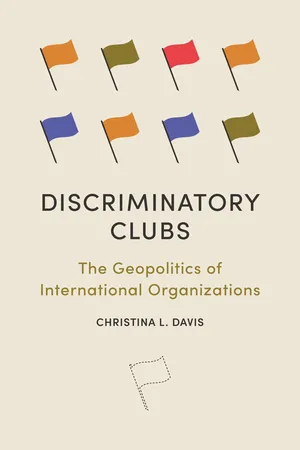
Member selection is one of the defining elements of social organization, imposing categories on who we are and what we do. Discriminatory Clubs shows how international organizations are like social clubs, ones in which institutional rules and informal practices enable states to favor friends while excluding rivals.
Where race or socioeconomic status may be a basis for discrimination by social clubs, geopolitical alignment determines who gets into the room to make the rules of global governance. Christina Davis brings together a wealth of data on membership provisions for more than three hundred organizations to reveal the prevalence of club-style selection on the world stage. States join organizations to deepen their association with a particular group of states—most often their allies—and for the gains from policy coordination. Even organizations that claim to be universal, to target narrow issues, or to cover geographic regions use club-style admission criteria. Davis demonstrates that when it comes to the most important decision of cooperation—who belongs to the club and who doesn't—geopolitical alignment can matter more than the merits or policies of potential members.
With illuminating case studies ranging from nineteenth-century Japan to contemporary Palestine and Taiwan, Discriminatory Clubs sheds light on how, for global and regional organizations such as the WTO and the EU, alliance ties and shared foreign-policy positions form the basis of cooperation.
- 473 pages
- English
- PDF
- Available on iOS & Android
eBook - PDF
About this book
Information
Publisher
Princeton University PressYear
2023Print ISBN
9780691247786
9780691247793
eBook ISBN
9780691247809
Table of contents
- Cover
- Contents
- List of Illustrations
- Acknowledgments
- 1. Membership and International Cooperation
- 2. Flexibility by Design: Rules for Accession
- 3. Membership Patterns in Economic Institutions
- 4. Accession to the GATT/WTO
- 5. The OECD: More Than a Rich Country Club
- 6. Japan’s Multilateral Diplomacy
- 7. Club Politics in Regional Organizations
- 8. Exclusion from Universal Organizations
- 9. Revisiting Anarchical Society
- Bibliography
- Index
Trusted by 375,005 students
Access to over 1.5 million titles for a fair monthly price.
Study more efficiently using our study tools.
Frequently asked questions
Yes, you can cancel anytime from the Subscription tab in your account settings on the Perlego website. Your subscription will stay active until the end of your current billing period. Learn how to cancel your subscription
No, books cannot be downloaded as external files, such as PDFs, for use outside of Perlego. However, you can download books within the Perlego app for offline reading on mobile or tablet. Learn how to download books offline
Perlego offers two plans: Essential and Complete
- Essential is ideal for learners and professionals who enjoy exploring a wide range of subjects. Access the Essential Library with 800,000+ trusted titles and best-sellers across business, personal growth, and the humanities. Includes unlimited reading time and Standard Read Aloud voice.
- Complete: Perfect for advanced learners and researchers needing full, unrestricted access. Unlock 1.5M+ books across hundreds of subjects, including academic and specialized titles. The Complete Plan also includes advanced features like Premium Read Aloud and Research Assistant.
We are an online textbook subscription service, where you can get access to an entire online library for less than the price of a single book per month. With over 1.5 million books across 990+ topics, we’ve got you covered! Learn about our mission
Look out for the read-aloud symbol on your next book to see if you can listen to it. The read-aloud tool reads text aloud for you, highlighting the text as it is being read. You can pause it, speed it up and slow it down. Learn more about Read Aloud
Yes! You can use the Perlego app on both iOS and Android devices to read anytime, anywhere — even offline. Perfect for commutes or when you’re on the go.
Please note we cannot support devices running on iOS 13 and Android 7 or earlier. Learn more about using the app
Please note we cannot support devices running on iOS 13 and Android 7 or earlier. Learn more about using the app
Yes, you can access Discriminatory Clubs by Christina L. Davis in PDF and/or ePUB format, as well as other popular books in Politics & International Relations & International Law. We have over 1.5 million books available in our catalogue for you to explore.