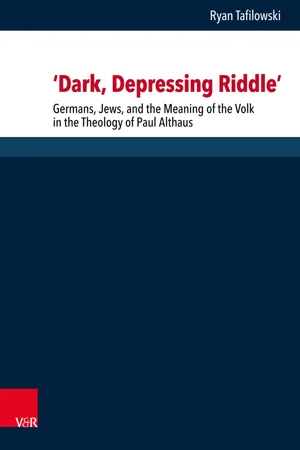
eBook - PDF
'Dark, Depressing Riddle'
Germans, Jews, and the Meaning of the Volk in the Theology of Paul Althaus
- 257 pages
- English
- PDF
- Available on iOS & Android
eBook - PDF
'Dark, Depressing Riddle'
Germans, Jews, and the Meaning of the Volk in the Theology of Paul Althaus
About this book
At the twilight of the Weimar Republic, politicians, scientists, and theologians were engaged in debates surrounding the so-called "Jewish Question." When the Nazi Party came to power in 1933, these discussions took on a new sense of urgency and poignancy. As state measures against Jews unfolded, theological conceptions of the meaning of "Israel" and "Judaism" began to impact living, breathing Jewish persons.
In this study, Ryan Tafilowski traces the thought of the Lutheran theologian Paul Althaus (1888–1966), who once greeted the rise of Hitler as a "gift and miracle of God," as he negotiated the "Jewish Question" and its meaning for his understanding of Germanness across the Weimar Republic, the Nazi years, and the post-war period. In particular, the study uncovers the paradoxical categories Althaus used to interpret the ongoing theological significance of the Jewish people, whom he considered both an imminent threat to German ethnic identity and yet a mysterious cipher by which Germans might decode their own spiritual destiny in world history.
Sketching the peculiar contours of Althaus' theology of Israel, this study offers a fresh interpretation of the Erlangen Opinion on the Aryan Paragraph, which is an important artifact not only of the Kirchenkampf, but also of the complex and ambivalent history of Christian antisemitism. By bringing Althaus into conversation with some of the most influential theologians of the twentieth century—from Karl Barth and Emil Brunner to Rudolf Bultmann and Dietrich Bonhoeffer—Tafilowski broadens the scope of his inquiry to vital questions of political theology, ethnic identity, social ethics, and ecclesiology. As Christian theologians must once again reckon with questions of national self-understanding under the pressures of mass migration and resurgent nationalisms, this investigation into the logic of ethno-nationalist theologies is a timely contribution.
Information
Table of contents
- Title Page
- Copyright
- Table of Contents
- Body
- Chapter I | Introduction
- Movement I: The Volk who belong everywhere and nowhere: Althaus' societal vision for the Jews during the Weimar Republic (1919–1933)
- Chapter II | Invisible others: the “Jewish Question” in the Althausian imagination
- Chapter III | “Open wounds”: the mysterious purpose of Jewish existence
- Movement II: At the church's “German hour”: Germans, Jews, and ecclesial space under National Socialism (1933–1945)
- Chapter IV | Volk before church: the Erlangen Opinion on the Aryan Paragraph and the Ansbach Memorandum
- Chapter V | Inclusive quarantine in microcosm: Jewish pathology and performance in the German churches
- Movement III: The death throes of Judaism: reflection on the “Jewish Question” in the postwar years (1945–1966)
- Chapter VI | Catastrophe and conscience: Jews and Germans as fellow travelers
- Chapter VII | The collapse of the dialectic: dogmatic and exegetical works
- Movement IV: Althaus and the challenge of (pseudo-)Lutheran ethics
- Chapter VIII | self-defeating tendencies in the Althausian theology of Volk
- Chapter IX | The makings of a Lutheran corrective: Bonhoeffer, Bultmann, and Sasse
- Chapter X | Conclusion
- Appendix I | Theologisches Gutachten über die Zulassung von Christen jüdischer Herkunft zu den Ämtern der Deutschen Evangelischen Kirche (Erlanger Gutachten)
- Appendix II | Der “Ansbacher Ratschlag” zu der Barmer “Theologischen Erklärung”
- Bibliography
- Index
Trusted by 375,005 students
Access to over 1.5 million titles for a fair monthly price.
Study more efficiently using our study tools.
Frequently asked questions
Yes, you can cancel anytime from the Subscription tab in your account settings on the Perlego website. Your subscription will stay active until the end of your current billing period. Learn how to cancel your subscription
No, books cannot be downloaded as external files, such as PDFs, for use outside of Perlego. However, you can download books within the Perlego app for offline reading on mobile or tablet. Learn how to download books offline
Perlego offers two plans: Essential and Complete
- Essential is ideal for learners and professionals who enjoy exploring a wide range of subjects. Access the Essential Library with 800,000+ trusted titles and best-sellers across business, personal growth, and the humanities. Includes unlimited reading time and Standard Read Aloud voice.
- Complete: Perfect for advanced learners and researchers needing full, unrestricted access. Unlock 1.5M+ books across hundreds of subjects, including academic and specialized titles. The Complete Plan also includes advanced features like Premium Read Aloud and Research Assistant.
We are an online textbook subscription service, where you can get access to an entire online library for less than the price of a single book per month. With over 1.5 million books across 990+ topics, we’ve got you covered! Learn about our mission
Look out for the read-aloud symbol on your next book to see if you can listen to it. The read-aloud tool reads text aloud for you, highlighting the text as it is being read. You can pause it, speed it up and slow it down. Learn more about Read Aloud
Yes! You can use the Perlego app on both iOS and Android devices to read anytime, anywhere — even offline. Perfect for commutes or when you’re on the go.
Please note we cannot support devices running on iOS 13 and Android 7 or earlier. Learn more about using the app
Please note we cannot support devices running on iOS 13 and Android 7 or earlier. Learn more about using the app
Yes, you can access 'Dark, Depressing Riddle' by Ryan Tafilowski in PDF and/or ePUB format, as well as other popular books in Theology & Religion & Christian Theology. We have over 1.5 million books available in our catalogue for you to explore.