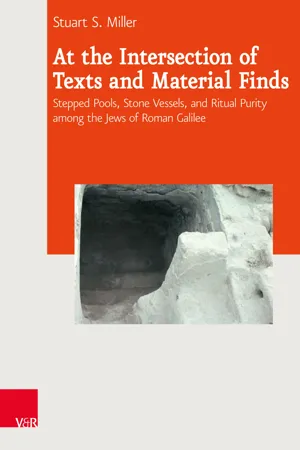
eBook - PDF
At the Intersection of Texts and Material Finds
Stepped Pools, Stone Vessels, and Ritual Purity Among the Jews of Roman Galilee
- 424 pages
- English
- PDF
- Available on iOS & Android
eBook - PDF
At the Intersection of Texts and Material Finds
Stepped Pools, Stone Vessels, and Ritual Purity Among the Jews of Roman Galilee
About this book
Stuart Miller examines the hermeneutical challenges posed by the material and literary evidence pertaining to ritual purity practices in Graeco-Roman Palestine and, especially, the Galilee. He contends that "stepped pools," which we now know were in use well beyond the Destruction of the Temple, and, as indicated by the large collection on the western acropolis of Sepphoris and elsewhere, into the Middle and Late Roman/Byzantine eras,must be understood in light of biblical and popular perspectives on ritual purity. The interpretation of the finds is too frequently forced to conform to rabbinic prescriptions, which oftentimes were the result of the sages' unique and creative, nominalist approach to ritual purity. Special attention is given to the role ritual purity continued to play in the lives of ordinary Jews despite (or because of) the loss of the Temple. Miller argues against the prevailing tendency to type material finds—and Jewish society––according to known groups (pre-70 C.E.: Pharisaic, Sadducaic, Essenic; post 70 C.E.: rabbinic, priestly, etc.). He further counters the perception that ritual purity practices were largely the interest of priests and argues against the recent suggestion that the kohanim resurfaced as an influential group in Late Antiquity. Building upon his earlier work on "sages and commoners," Miller claims that the rabbis emerged out of a context in which a biblically derived "complex common Judaism" thrived. Stepped pools, stone vessels, and other material finds are realia belonging to this "complex common Judaism." A careful reading of the rabbis indicates that they were acutely aware of the extent to which ritual purity rites pertaining to home and family life had "spread," which undoubtedly contributed to their intense interest in regulating them.
Information
Table of contents
- Title Page
- Copyright
- Preface
- Body
- Introduction. Ritual Baths and Ritual Purity, the Last Fifty Years
- Chapter One: Misleading Use of Terminology: The “miqveh,” “bet tevilah,” and other “Ritual Baths”
- Chapter Two: The Evolving, Non-Monolithic “Ritual Bath”
- Chapter Three: Pre-Rabbinic, Non-Rabbinic, and Rabbinic Ritual Immersion Practices in the Making
- Chapter Four: Did the Author of P. Oxyrhynchus 840. Know What a “Miqveh” Was?
- Chapter Five: Further Observations on Stone Vessel Finds and Ritual Purity in Light of Talmudic Sources
- Chapter Six: The Stepped Pools of the Western Acropolis at Sepphoris
- Chapter Seven: Understanding the Pools: Biblical Perceptions of Purity and the Habitus of the Jews of ’Eres Israel
- Chapter Eight: Domestic Judaism and the “Well-Ordered Bayit:” Who Bathed/Immersed in the Stepped Pools at Sepphoris and Why?
- Chapter Nine: Priests, Purities, and the Jews of Roman and Late Antique Galilee — Rethinking the Priests of Sepphoris and the Mishmarot
- Chapter Ten: Non-Rabbinic Ritual Immersion Practices in Post-Talmudic Sources
- Chapter Eleven: From Stepped Pools to Miqva’ot and the Society that Produced Them
- Postscript: From Roman Galilee to Nineteenth-Century Chesterfield, Connecticut
- Bibliography
- Index of Primary Sources
- Index of Places
- Index of Foreign Terms, Phrases, and Expressions
- Index of Subjects
Trusted by 375,005 students
Access to over 1.5 million titles for a fair monthly price.
Study more efficiently using our study tools.
Frequently asked questions
Yes, you can cancel anytime from the Subscription tab in your account settings on the Perlego website. Your subscription will stay active until the end of your current billing period. Learn how to cancel your subscription
No, books cannot be downloaded as external files, such as PDFs, for use outside of Perlego. However, you can download books within the Perlego app for offline reading on mobile or tablet. Learn how to download books offline
We are an online textbook subscription service, where you can get access to an entire online library for less than the price of a single book per month. With over 1.5 million books across 990+ topics, we’ve got you covered! Learn about our mission
Look out for the read-aloud symbol on your next book to see if you can listen to it. The read-aloud tool reads text aloud for you, highlighting the text as it is being read. You can pause it, speed it up and slow it down. Learn more about Read Aloud
Yes! You can use the Perlego app on both iOS and Android devices to read anytime, anywhere — even offline. Perfect for commutes or when you’re on the go.
Please note we cannot support devices running on iOS 13 and Android 7 or earlier. Learn more about using the app
Please note we cannot support devices running on iOS 13 and Android 7 or earlier. Learn more about using the app
Yes, you can access At the Intersection of Texts and Material Finds by Stuart S. Miller in PDF and/or ePUB format, as well as other popular books in Theology & Religion & Jewish Theology. We have over 1.5 million books available in our catalogue for you to explore.