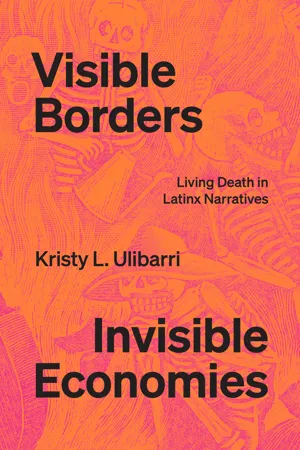
Visible Borders, Invisible Economies
eBook - ePub

Visible Borders, Invisible Economies

Living Death in Latinx Narratives

  1. English
  2. ePUB (mobile friendly)
  3. Available on iOS & Android
eBook - ePub

Visible Borders, Invisible Economies

Living Death in Latinx Narratives

About this book

2023 Outstanding Book Award, National Association for Ethnic Studies

A thorough examination of the political and economic exploitation of Latinx subjects, migrants, and workers through the lens of Latinx literature, photography, and film.


Globalization in the United States can seem paradoxical: free trade coincides with fortification of the southern border, while immigration is reimagined as a national-security threat. US politics turn aggressively against Latinx migrants and subjects even as post-NAFTA markets become thoroughly reliant on migrant and racialized workers. But in fact, there is no incongruity here. Rather, anti-immigrant politics reflect a strategy whereby capital uses specialized forms of violence to create a reserve army of the living, laboring dead.

Visible Borders, Invisible Economies turns to Latinx literature, photography, and films that render this unseen scheme shockingly vivid. Works such as Valeria Luiselli's Tell Me How It Ends and Alex Rivera's Sleep Dealer crystallize the experience of Latinx subjects and migrants subjugated to social death, their political existence erased by disenfranchisement and racist violence while their bodies still toil in behalf of corporate profits. In Kristy L. Ulibarri's telling, art clarifies what power obscures: the national-security state performs anti-immigrant and xenophobic politics that substitute cathartic nationalism for protections from the free market while ensuring maximal corporate profits through the manufacture of disposable migrant labor.

Frequently asked questions

Yes, you can cancel anytime from the Subscription tab in your account settings on the Perlego website. Your subscription will stay active until the end of your current billing period. Learn how to cancel your subscription.
No, books cannot be downloaded as external files, such as PDFs, for use outside of Perlego. However, you can download books within the Perlego app for offline reading on mobile or tablet. Learn more here.
Perlego offers two plans: Essential and Complete
  • Essential is ideal for learners and professionals who enjoy exploring a wide range of subjects. Access the Essential Library with 800,000+ trusted titles and best-sellers across business, personal growth, and the humanities. Includes unlimited reading time and Standard Read Aloud voice.
  • Complete: Perfect for advanced learners and researchers needing full, unrestricted access. Unlock 1.4M+ books across hundreds of subjects, including academic and specialized titles. The Complete Plan also includes advanced features like Premium Read Aloud and Research Assistant.
Both plans are available with monthly, semester, or annual billing cycles.
We are an online textbook subscription service, where you can get access to an entire online library for less than the price of a single book per month. With over 1 million books across 1000+ topics, we’ve got you covered! Learn more here.
Look out for the read-aloud symbol on your next book to see if you can listen to it. The read-aloud tool reads text aloud for you, highlighting the text as it is being read. You can pause it, speed it up and slow it down. Learn more here.
Yes! You can use the Perlego app on both iOS or Android devices to read anytime, anywhere — even offline. Perfect for commutes or when you’re on the go.
Please note we cannot support devices running on iOS 13 and Android 7 or earlier. Learn more about using the app.
Yes, you can access Visible Borders, Invisible Economies by Kristy L. Ulibarri in PDF and/or ePUB format, as well as other popular books in Social Sciences & North American Literary Criticism. We have over one million books available in our catalogue for you to explore.

Table of contents

  1. Cover
  2. Series Page
  3. Title Page
  4. Copyright
  5. Dedication
  6. Contents
  7. List of Illustrations
  8. Acknowledgments
  9. Introduction: Imagination in the Age of National Security and Market Neoliberalization
  10. Part I. Documenting the Living Dead
  11. Part II. Imagining the Living Dead
  12. Notes
  13. Bibliography
  14. Index