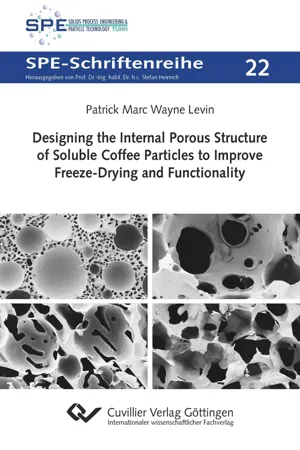
The objective of this work was the understanding of the internal pore structure creation of instant coffee. It includes the question which parameters are influencing the pore structure and mapping the applicable ranges. The influence of these structural parameters on the drying kinetics were investigated in experiment and modeling, finding the optimal approach to increase the drying kinetics. The reconstitution behavior of the dried powder structures was analyzed to link the process optimization to product quality aspects. The instant coffee was structured in a scraped surface heat exchanger and with different freezing methods, where samples were gassed with nitrogen and carbon dioxide. The amount of gassing, the total solids content, the coolant temperature, the scraping speed, temperature cycling and the freezing rate of the slurry during hardening were shown to influence the morphology of the samples, where total solids content, gassing, temperature cycling and freezing rate showed a dominant influence in the investigated range on structure parameters like open porosity, closed porosity and the median pore diameter, obtained after drying. It could be shown that the pore diameter has the biggest potential to improve drying and reconstitution kinetics.
- 153 pages
- English
- PDF
- Available on iOS & Android
eBook - PDF
About this book
Information
Print ISBN
9783736977266
Edition
1Table of contents
- Acknowledgements
- Abstract
- Zusammenfassung
- Symbols
- 1 Introduction
- 1.1 The structure of instant coffee
- 1.2 The process of soluble coffee production
- 1.3 Freezing of concentrated solutions
- 1.4 Foaming of concentrated solutions
- 1.5 Freeze-drying of bulk materials
- 1.6 Reconstitution of food powders
- 2 Methodology
- 2.1 Materials
- 2.2 Crystallization processes
- 2.3 Foaming processes
- 2.4 Freeze-drying
- 2.5 Reconstitution
- 2.6 Characterization and analysis methods
- 3 Results and Discussion
- 3.1 Crystallization process
- 3.2 Foaming process
- 3.3 Crystallization and foam formation in the SSHE
- 3.4 Drying Kinetics
- 3.5 Modeling of freeze-drying as a function of thestructure
- 3.6 Influence of internal structure on product quality
- 4 Conclusion
- 4.1 Structure building of highly concentrated coffeesolutions
- 4.2 Drying kinetics as a function of the internalporous structure
- 4.3 Modeling of freeze-drying kinetics
- 4.4 Reconstitution kinetics as a function of theinternal porous structure
- 4.5 Summary
- Bibliography
- Appendix A
- Appendix B
- Appendix C
Trusted by 375,005 students
Access to over 1.5 million titles for a fair monthly price.
Study more efficiently using our study tools.