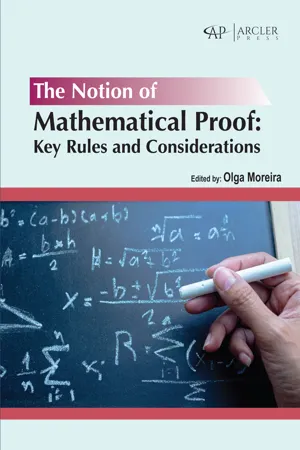
"The Notion Of Mathematical Proof: Key Rules And Considerations" is an edited book consisting of 16 contemporaneous open-access articles that aim to cover the different aspects of learning and teaching mathematical proof. The first part of this book aims at summing up factors that influence the cognitive development required to successfully understand and solve mathematical proofs. The second part of the book aims to overview implementations of learning methods for constructing and evaluating the validity of mathematical proof, as well as to provide strategies for overcoming possible difficulties in mathematical proof processing. It also includes other studies related to mathematical proof and a motion-based program for improving mathematical reasoning through action. This book is intended to reach out to an academic audience ranging from undergraduate students to junior researchers.
- 424 pages
- English
- PDF
- Available on iOS & Android
eBook - PDF
The Notion of mathematical proof: Key rules and considerations
About this book
Information
Subtopic
Logic in MathematicsIndex
MathematicsTable of contents
- Cover
- Title Page
- Copyright
- DECLARATION
- ABOUT THE EDITOR
- TABLE OF CONTENTS
- List of Contributors
- List of Abbreviations
- Preface
- Chapter 1 Venues for Analytical Reasoning Problems: How Children Produce Deductive Reasoning
- Chapter 2 Relations between Generalization, Reasoning and Combinatorial Thinking in Solving Mathematical Open-Ended Problems within Mathematical Contest
- Chapter 3 Counteracting Destructive Student Misconceptions of Mathematics
- Chapter 4 Adversity Quotient and Resilience in Mathematical Proof Problem-Solving Ability
- Chapter 5 Profile of Students’ Errors in Mathematical Proof Process Viewed from Adversity Quotient (AQ)
- Chapter 6 Introducing a Measure of Perceived Self-efficacy for Proof (PSEP): Evidence of Validity
- Chapter 7 Deductive or Inductive? Prospective Teachers’ Preference of Proof Method on an Intermediate Proof Task
- Chapter 8 Flaws in Proof Constructions of Postgraduate Mathematics Education Student Teachers
- Chapter 9 Mathematical Understanding and Proving Abilities: Experiment With Undergraduate Student By Using Modified Moore Learning Approach
- Chapter 10 Understanding on Strategies of Teaching Mathematical Proof for Undergraduate Students
- Chapter 11 Application of Discovery Learning Method in Mathematical Proof of Students in Trigonometry
- Chapter 12 Organizing the Mathematical Proof Process with the Help of Basic Components in Teaching Proof: Abstract Algebra Example
- Chapter 13 The Implementation of Self-explanation Strategy to Develop Understanding Proof in Geometry
- Chapter 14 Mathematical Proof: The Learning Obstacles of Pre-Service Mathematics Teachers on Transformation Geometry
- Chapter 15 Students’ Mathematical Problem-Solving Ability Based on Teaching Models Intervention and Cognitive Style
- Chapter 16 Grounded and Embodied Mathematical Cognition: Promoting Mathematical Insight and Proof using Action and Language
- Index
- Back Cover
Trusted by 375,005 students
Access to over 1.5 million titles for a fair monthly price.
Study more efficiently using our study tools.
Frequently asked questions
Yes, you can cancel anytime from the Subscription tab in your account settings on the Perlego website. Your subscription will stay active until the end of your current billing period. Learn how to cancel your subscription
No, books cannot be downloaded as external files, such as PDFs, for use outside of Perlego. However, you can download books within the Perlego app for offline reading on mobile or tablet. Learn how to download books offline
Perlego offers two plans: Essential and Complete
- Essential is ideal for learners and professionals who enjoy exploring a wide range of subjects. Access the Essential Library with 800,000+ trusted titles and best-sellers across business, personal growth, and the humanities. Includes unlimited reading time and Standard Read Aloud voice.
- Complete: Perfect for advanced learners and researchers needing full, unrestricted access. Unlock 1.5M+ books across hundreds of subjects, including academic and specialized titles. The Complete Plan also includes advanced features like Premium Read Aloud and Research Assistant.
We are an online textbook subscription service, where you can get access to an entire online library for less than the price of a single book per month. With over 1.5 million books across 990+ topics, we’ve got you covered! Learn about our mission
Look out for the read-aloud symbol on your next book to see if you can listen to it. The read-aloud tool reads text aloud for you, highlighting the text as it is being read. You can pause it, speed it up and slow it down. Learn more about Read Aloud
Yes! You can use the Perlego app on both iOS and Android devices to read anytime, anywhere — even offline. Perfect for commutes or when you’re on the go.
Please note we cannot support devices running on iOS 13 and Android 7 or earlier. Learn more about using the app
Please note we cannot support devices running on iOS 13 and Android 7 or earlier. Learn more about using the app
Yes, you can access The Notion of mathematical proof: Key rules and considerations by Olga Moreira in PDF and/or ePUB format, as well as other popular books in Mathematics & Logic in Mathematics. We have over 1.5 million books available in our catalogue for you to explore.