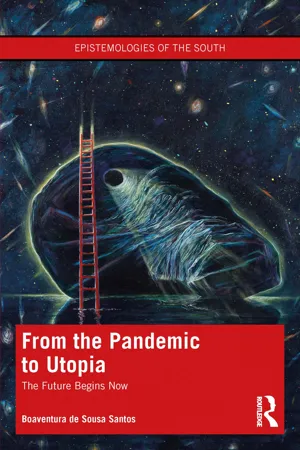
The coronavirus pandemic forces us to rethink our contemporaneity. It has brought to the surface dimensions of human fragility that partially contradict the euphoria and human hubris of the fourth industrial revolution (artificial intelligence). It has also aggravated the social inequality and racial discrimination that characterize our societies. The book argues that the virus, rather than an enemy, must be viewed as a pedagogue. It is trying to teach us that the deep causes of the pandemic lie in our dominant mode of production and consumption. The systemic overload of natural resources creates a metabolic rift between society and nature that destabilizes the habitat of wild animals and the vital cycles of natural regeneration whereby pandemics become an increasingly recurrent phenomenon. In trying to take seriously this lesson the book proposes a paradigmatic shift from the current civilizatory model to a new one guided by a more equitable relationship between nature and society and the priority of life, both human and non-human.
- 248 pages
- English
- ePUB (mobile friendly)
- Available on iOS & Android
eBook - ePub
About this book
Information
Table of contents
- Cover
- Endorsements
- Half Title
- Series Page
- Title Page
- Copyright Page
- Table of Contents
- Preface
- PART ONE
- The 21st century presents itself
- 1 The pandemic and the contradictions of contemporaneity
- The end of presentism
- All that is solid melts into air
- The scale of the planet viewed by the virus
- Metaphors in progress
- The coronavirus, our contemporary
- 2 Abyssal capitalism: The pandemic as business
- Scene 1. Profiting from the pandemic
- Scene 2. Buccaneer capitalism
- Scene 3. Profiting from the post-pandemic: the legal industry and big business
- Scene 4. The value of life and medical and pharmaceutical research: investments, the cost of tests, vaccines, medicines and Big Pharma
- Conclusion
- 3 The open veins of inequality and discrimination
- Introduction
- Economic abyssal lines
- Racist-colonialist abyssal lines
- Sexist abyssal lines
- Religious abyssal lines
- Ableist abyssal lines
- Gray or intermediate exclusion areas
- The degree zero of human tragedy
- 4 Community resistance and self-organization
- Community resistance
- Rural and urban popular organizations in Latin America faced with abandonment by the state
- The indigenous peoples of Latin America
- Best practices of sub-national or autonomous political-administrative units
- Conclusion
- PART TWO
- The future starts now
- 5 Three scenarios: Between hell redux and kairós
- First scenario: everything as before and worse. Abyssal capitalism and the securitarian state of exception
- Second scenario: capitalist skin, socialist mask: the new neo-Keynesianism
- Third scenario: barbarism or civilization – alternatives to capitalism, colonialism and patriarchy
- 6 Towards an insurgent, intercultural and cosmopolitan declaration of human rights and duties
- Introduction
- Rights and duties to be shared in a conversation for humankind: a legal real utopia
- Conclusion
- 7 The paradigmatic transition: A world to accommodate many worlds
- The principles of transition
- Monocultures
- Ecologies
- Conclusion
- 8 First steps in the paradigmatic transition
- Nature does not belong to us: we belong to nature
- Health is a public good, not a business
- Without losing their respective identities, cities must be ruralized and the country must be urbanized
- Culture and art – understood as ecologies of multiple and intercultural artistic and cultural practices – are an essential component of the paradigmatic transition
- We cannot live without demodiversity any more than we can live without biodiversity
- In a time of intermittent pandemic, international relations must be guided by the principle of overriding public interest in the defense of life
- Conclusion
- Epilogue: What if we failed? To be read in 2050
- References
- Index
Trusted by 375,005 students
Access to over 1.5 million titles for a fair monthly price.
Study more efficiently using our study tools.
Frequently asked questions
Yes, you can cancel anytime from the Subscription tab in your account settings on the Perlego website. Your subscription will stay active until the end of your current billing period. Learn how to cancel your subscription
No, books cannot be downloaded as external files, such as PDFs, for use outside of Perlego. However, you can download books within the Perlego app for offline reading on mobile or tablet. Learn how to download books offline
Perlego offers two plans: Essential and Complete
- Essential is ideal for learners and professionals who enjoy exploring a wide range of subjects. Access the Essential Library with 800,000+ trusted titles and best-sellers across business, personal growth, and the humanities. Includes unlimited reading time and Standard Read Aloud voice.
- Complete: Perfect for advanced learners and researchers needing full, unrestricted access. Unlock 1.5M+ books across hundreds of subjects, including academic and specialized titles. The Complete Plan also includes advanced features like Premium Read Aloud and Research Assistant.
We are an online textbook subscription service, where you can get access to an entire online library for less than the price of a single book per month. With over 1.5 million books across 990+ topics, we’ve got you covered! Learn about our mission
Look out for the read-aloud symbol on your next book to see if you can listen to it. The read-aloud tool reads text aloud for you, highlighting the text as it is being read. You can pause it, speed it up and slow it down. Learn more about Read Aloud
Yes! You can use the Perlego app on both iOS and Android devices to read anytime, anywhere — even offline. Perfect for commutes or when you’re on the go.
Please note we cannot support devices running on iOS 13 and Android 7 or earlier. Learn more about using the app
Please note we cannot support devices running on iOS 13 and Android 7 or earlier. Learn more about using the app
Yes, you can access From the Pandemic to Utopia by Boaventura de Sousa Santos in PDF and/or ePUB format, as well as other popular books in Ciencias sociales & Antropología cultural y social. We have over 1.5 million books available in our catalogue for you to explore.