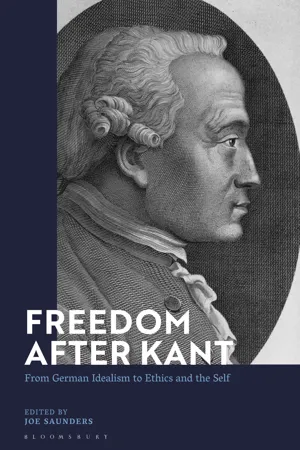
Freedom after Kant situates Kant's concept of freedom in relation to leading philosophers of the period to trace a detailed history of philosophical thinking on freedom from the 18th to the 20th century. Beginning with German Idealism, the volume presents Kant's writings on freedom and their reception by contemporaries, successors, followers and critics.
From exchanges of philosophical ideas on freedom between Kant and his contemporaries, Reinhold and Fichte, through to Kant's ideas on rational self-determination in Hegel and Schelling, we see Kant's original arguments transformed through concepts of autonomy, freedom and absolutes. The political aspect of Kant's freedom finds further articulation in chapters on Marx and Mill who developed their own notions of political freedom after Kant. Revealing how Kant's concept of freedom shaped the history of philosophy in the broadest sense, contributors chart the development of an ethics of freedom in the 20th century which brings Kant into conversation with Heidegger, Beauvoir, Sartre, Levinas and Murdoch.
This line of thinking on freedom signals a new departure for Kantian studies which brings his ideas into the present day and traverses major schools of thought including Idealism, Marxism, existentialism and moral philosophy.
- 232 pages
- English
- ePUB (mobile friendly)
- Available on iOS & Android
eBook - ePub
About this book
Information
Table of contents
- Cover
- Halftitle Page
- Title Page
- Contents
- Acknowledgements
- Notes on contributors
- Introduction
- Part I The eighteenth century: Kant and his contemporaries; freedom and normativity
- Part II The nineteenth century: The post-Kantians, idealists and pragmatists; nature, politics and experience
- Part III The twentieth century: New developments; freedom, the self and others
- Index
- Imprint
Trusted by 375,005 students
Access to over 1.5 million titles for a fair monthly price.
Study more efficiently using our study tools.
Frequently asked questions
Yes, you can cancel anytime from the Subscription tab in your account settings on the Perlego website. Your subscription will stay active until the end of your current billing period. Learn how to cancel your subscription
No, books cannot be downloaded as external files, such as PDFs, for use outside of Perlego. However, you can download books within the Perlego app for offline reading on mobile or tablet. Learn how to download books offline
Perlego offers two plans: Essential and Complete
- Essential is ideal for learners and professionals who enjoy exploring a wide range of subjects. Access the Essential Library with 800,000+ trusted titles and best-sellers across business, personal growth, and the humanities. Includes unlimited reading time and Standard Read Aloud voice.
- Complete: Perfect for advanced learners and researchers needing full, unrestricted access. Unlock 1.5M+ books across hundreds of subjects, including academic and specialized titles. The Complete Plan also includes advanced features like Premium Read Aloud and Research Assistant.
We are an online textbook subscription service, where you can get access to an entire online library for less than the price of a single book per month. With over 1.5 million books across 990+ topics, we’ve got you covered! Learn about our mission
Look out for the read-aloud symbol on your next book to see if you can listen to it. The read-aloud tool reads text aloud for you, highlighting the text as it is being read. You can pause it, speed it up and slow it down. Learn more about Read Aloud
Yes! You can use the Perlego app on both iOS and Android devices to read anytime, anywhere — even offline. Perfect for commutes or when you’re on the go.
Please note we cannot support devices running on iOS 13 and Android 7 or earlier. Learn more about using the app
Please note we cannot support devices running on iOS 13 and Android 7 or earlier. Learn more about using the app
Yes, you can access Freedom After Kant by Joe Saunders in PDF and/or ePUB format, as well as other popular books in Philosophy & Ethics & Moral Philosophy. We have over 1.5 million books available in our catalogue for you to explore.