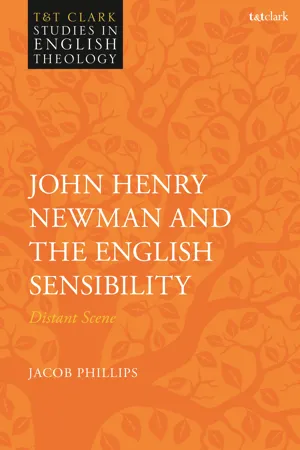
Asides about John Henry Newman being either particularly English or particularly un-English are common. John Henry Newman and the English Sensibility scrutinises Newman's theological writings to establish how his theology can be considered distinctively English or un-English at the different stages of its development.
In his Tractarian period, Newman's theology is shown to be profoundly characterised by common 19th-century tropes of a perceived English sensibility, namely an instinct for compromise, an affection for reserve and a markedly empirical orientation to life. In the period following Newman's conversion to Catholicism in 1845, however, his theology turns against the Englishness of his earlier years as he critiques of the many theological dangers of a self-confident cultural sensibility. In his mature writings, nonetheless, Newman re-incorporates certain elements of his earlier Englishness with a Catholic grounding, yet also maintains an antipathy to certain targets of his post-conversion polemics.
Phillips finds that the English instinct for compromise is not incorporated into Newman's mature theology, which remains unabashedly one-sided in its understanding of God and the Catholic Church, taking precedence over elements of a cultural sensibility pertaining ultimately to the sphere of the natural. The affection for reserve, however, is shown to be capable of gracious elevation when reconfigured on a Catholic grounding. Most importantly, the profoundly empirical orientation to life which was considered typical of Englishness in Newman's day emerges as something exhibiting what Newman might consider a 'antecedent affinity' to Catholic theology.
This book thus concludes by offering a view of the English Catholic sensibility as characterised by a mindset of careful reserve toward knowledge and words about God, arising from a marked concern for the living, embodied present as the site of God's transformative action in the twists and turns of human life.
- 152 pages
- English
- ePUB (mobile friendly)
- Available on iOS & Android
eBook - ePub
About this book
Information
Table of contents
- Cover
- Half-title Page
- Series Page
- Title Page
- Epigraph
- Contents
- Chapter 1 Newman And Englishness
- Chapter 2 The English Sensibility
- Chapter 3 Newman’s Tractarian Compromise
- Chapter 4 Newman’s Tractarian Reserve
- Chapter 5 Newman’s Tractarian Empiricism
- Chapter 6 Compromise in the Second Spring
- Chapter 7 Reserve in the Second Spring
- Chapter 8 Empiricism in the Second Spring
- Chapter 9 Compromise in the Mature Newman
- Chapter 10 Reserve in the Mature Newman
- Chapter 11 Empiricism in the Mature Newman
- Chapter 12 Conclusion: Distant scene
- Bibliography
- Index
- Copyright Page
Trusted by 375,005 students
Access to over 1.5 million titles for a fair monthly price.
Study more efficiently using our study tools.
Frequently asked questions
Yes, you can cancel anytime from the Subscription tab in your account settings on the Perlego website. Your subscription will stay active until the end of your current billing period. Learn how to cancel your subscription
No, books cannot be downloaded as external files, such as PDFs, for use outside of Perlego. However, you can download books within the Perlego app for offline reading on mobile or tablet. Learn how to download books offline
Perlego offers two plans: Essential and Complete
- Essential is ideal for learners and professionals who enjoy exploring a wide range of subjects. Access the Essential Library with 800,000+ trusted titles and best-sellers across business, personal growth, and the humanities. Includes unlimited reading time and Standard Read Aloud voice.
- Complete: Perfect for advanced learners and researchers needing full, unrestricted access. Unlock 1.5M+ books across hundreds of subjects, including academic and specialized titles. The Complete Plan also includes advanced features like Premium Read Aloud and Research Assistant.
We are an online textbook subscription service, where you can get access to an entire online library for less than the price of a single book per month. With over 1.5 million books across 990+ topics, we’ve got you covered! Learn about our mission
Look out for the read-aloud symbol on your next book to see if you can listen to it. The read-aloud tool reads text aloud for you, highlighting the text as it is being read. You can pause it, speed it up and slow it down. Learn more about Read Aloud
Yes! You can use the Perlego app on both iOS and Android devices to read anytime, anywhere — even offline. Perfect for commutes or when you’re on the go.
Please note we cannot support devices running on iOS 13 and Android 7 or earlier. Learn more about using the app
Please note we cannot support devices running on iOS 13 and Android 7 or earlier. Learn more about using the app
Yes, you can access John Henry Newman and the English Sensibility by Jacob Phillips in PDF and/or ePUB format, as well as other popular books in Theology & Religion & Biblical Studies. We have over 1.5 million books available in our catalogue for you to explore.