eBook - PDF
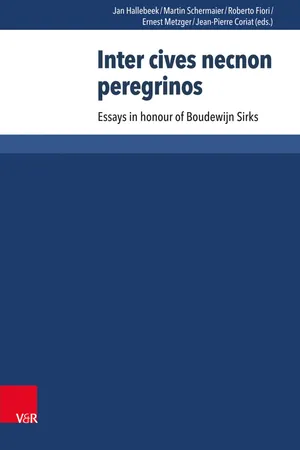
Inter cives necnon peregrinos
- 856 pages
- English
- PDF
- Available on iOS & Android
eBook - PDF
About this book
The contributions to this volume are concerned with the Roman law of antiquity in its broadest sense, covering both private and public law from the Roman Republic to the Byzantine era, including legal papyrology. They also examine the reception of Roman law in Western Europe and its colonies (specifically the Dutch East Indies) from the Middle Ages to the promulgation of the German Bürgerliche Gesetzbuch in 1900. They reflect the wide interests of Professor Boudewijn Sirks, whom the volume honours on the occasion of his retirement and whose work and career have transcended frontiers and nations.
Information
Table of contents
- Title Page
- Copyright
- Table of Contents
- Body
- Praefatio
- Publications
- Ulrike Babusiaux (Zürich): Quod Graeci … vocant – Emblematischer Codewechsel in den Juristenschriften
- Christian Baldus (Heidelberg): Iura in iuribus alienis? Zu D. 20,1,31 (Scaevola 1. resp.)
- Luigi Capogrossi Colognesi (Roma): La villa tra produzione e consumo
- Riccardo Cardilli (Roma): Nexum e damnatio
- Patricio-Ignacio Carvajal (Santiago de Chile): Celso, D. 6,1,38. Una interpretación desde la retórica
- Cosimo Cascione (Napoli): Ianuario Nepoziano, CTh. 1,22,1, Interpretatio: ancora sulla tutela delle donne convenute in giudizio nel tardoantico
- Alessandro Corbino (Catania): Atti formali e rilievo della causa. Considerazioni minime sulla mancipatio del filius familias
- Maria Floriana Cursi (Teramo): La mancipatio decemvirale e il nuovo diritto dei plebei
- Wolfgang Ernst (Zürich): Schiedsrichtermehrheiten im klassischen römischen Recht
- María Victoria Escribano Paño (Zaragoza): Creación y límites del discurso heresiológico imperial: rectificaciones, negociaciones y claudicaciones de Constantino
- Iole Fargnoli (Bern/Mailand): Tückischer Tyrann oder glänzender Herrscher? Zur Gesetzgebung des Kaisers Decius
- Giovanni Finazzi (Roma): Intorno a Pomp. ench. D. 1,2,2,43
- Thomas Finkenauer (Tübingen): „Diversi sint fructus“ – ein vererblicher Nießbrauch in der römischen Spätklassik
- Roberto Fiori (Roma): Proculo e l'agere praescriptis verbis
- Richard Gamauf (Wien): Erro: Suche nach einem verschwundenen Sklaven. Eine Skizze zur Interpretationsgeschichte des ädilizischen Edikts
- Joshua Getzler (Oxford): Citation and the authority of opinions in Roman and Jewish law: The snake oven revisited
- M.H. Hoeflich (Lawrence): Prestige and the value of Roman law books
- Tony Honoré (Oxford): Responsibility for harm to others: conduct and risk
- Eva Jakab (Szeged): Horrea, sûretés et commerce maritime dans les archives des Sulpicii
- Bernd Kannowski (Bayreuth): Landrecht und Lehnrecht nach dem Sachsenspiegel. Für und Wider einen (vermeintlichen?) „uralten Irrtum“
- Soazick Kerneis (Paris/Oxford): Loi et coutumes dans l'Empire romain. A propos du droit vulgaire
- Rolf Knütel (Bonn): Personen und Orte: Zu einigen unklaren Realien in testamentarischen Anordnungen
- Luigi Labruna (Napoli): Francesco Guizzi. Intellettuale poliedrico e accattivante
- Detlef Liebs (Freiburg): Sie liebte ihren Sklaven
- Franciszek Longchamps de Bérier (Krakau): Audiatur et altera pars. Eine fehlende Säuleninschrift am Warschauer Justizpalast und die Bedeutung der Parömie im polnischen Recht
- Luca Loschiavo (Teramo): Verso la costruzione del canone medievale dei testi giustinianei. Il ms. Oxford, Oriel College 22 e la composizione del Volumen parvum.
- Francesco Lucrezi (Salerno): `Ne peccetur', `quia peccatum est': sulle ragioni della pena nel mondo antico
- Mike Macnair (Oxford): Good Faith in English Contract Law before 1850
- Arrigo D. Manfredini (Ferrara): Veturia Coriolani Mater da Livio a Boccaccio alla tapisserie del tardo Seicento
- Carla Masi Doria (Napoli): Uno scandalo del 52 a.C. e la problematica identità di due donne romane (Nota su Val. Max. 9,1,8)
- Yves Mausen (Montpellier): Ne tamen aliquid antiquitatis ignoretur. Zum mittelalterlichen geschichtlichen Verständnis des Codex Iustiniani
- Franz-Stefan Meissel (Wien): Constat enim societas ex societatibus? Zur „Körperschaftlichkeit“ und anderen Besonderheiten der Publikanengesellschaften
- Ernest Metzger (Glasgow): Cum servo agere
- Sigrid Mratschek (Rostock): Augustine, Paulinus, and the question of moving the monastery: Dispute between theologians or between actors of history?
- Martin Pennitz (Innsbruck): D. 4,9,6,1 (Paul. 22 ad ed.): „Sonderfall“ oder „Schlüsseltext“ zur Haftung der Unternehmer (exercitores) für ihre Leute?
- Guido Pfeifer (Frankfurt/Main): Transkulturelle Universale oder juristischer Synkretismus? Zur Abhängigkeit des Eigentumserwerbs von der Zahlung oder Kreditierung des Kaufpreises in Inst. 2,1,41
- Johannes Platschek (Wien): Die Freunde des C. Antonius Hybrida. Versuch über Q. Cicero, Commentariolum petitionis 8
- Salvatore Puliatti (Parma): Tecniche giurisprudenziali e normazione imperiale. Aspetti della legislazione giustinianea
- J. Michael Rainer (Salzburg): Zur Prostitution von Sklavinnen in Rom
- Gianni Santucci (Trento): „Crédit politique“et „crédit commercial“: droit romain et doctrine civiliste française
- Philipp Scheibelreiter (Wien): Zum Wortlaut der Rechtsschutzverheißung des Archon eponymos
- Silvia Schiavo (Ferrara): Sulle tracce della cautio pro expensis in età pregiustinianea
- Andreas Schminck (Frankfurt am Main): Anmerkungen zur Beschreibung des Bildes Andronikosʼ I. an der Kirche der 40 Märtyrer in Konstantinopel
- Helen Scott (Cape Town): Liber homo suo nomine utilem Aquiliae habet actionem: D. 9,2,13 pr. in context
- Konstantin Tanev (Sofia): The perception of stealing in the context of res subrepta and res furtiva within the lex Atinia, the law of XII Tables and a comment of Paul
- Philip Thomas (Pretoria): The intention of the testator: from the causa Curiana to modern South African law
- Gerhard Thür (Wien): Antike Streitfälle im Rechtsunterricht
- Carmen Tort-Martorell (Barcelona): Un caso de alodio en el siglo XXI
- Andreas Wacke (Köln): Proagonaler Euergetismus. Privates „Sport-Sponsoring“ nach römischen Rechtsquellen
- Alain Wijffels (Leiden/Leuven/Louvain-la-Neuve): Alberico Gentili's Oxford lectures on contracts
- Willem Zwalve (Leiden/Groningen): On attornment and assignment. Civil law, German law and common law on transfer of title by a bailor
- Abbreviations
- Index of ancient sources
Trusted by 375,005 students
Access to over 1.5 million titles for a fair monthly price.
Study more efficiently using our study tools.
Frequently asked questions
Yes, you can cancel anytime from the Subscription tab in your account settings on the Perlego website. Your subscription will stay active until the end of your current billing period. Learn how to cancel your subscription
No, books cannot be downloaded as external files, such as PDFs, for use outside of Perlego. However, you can download books within the Perlego app for offline reading on mobile or tablet. Learn how to download books offline
Perlego offers two plans: Essential and Complete
- Essential is ideal for learners and professionals who enjoy exploring a wide range of subjects. Access the Essential Library with 800,000+ trusted titles and best-sellers across business, personal growth, and the humanities. Includes unlimited reading time and Standard Read Aloud voice.
- Complete: Perfect for advanced learners and researchers needing full, unrestricted access. Unlock 1.5M+ books across hundreds of subjects, including academic and specialized titles. The Complete Plan also includes advanced features like Premium Read Aloud and Research Assistant.
We are an online textbook subscription service, where you can get access to an entire online library for less than the price of a single book per month. With over 1.5 million books across 990+ topics, we’ve got you covered! Learn about our mission
Look out for the read-aloud symbol on your next book to see if you can listen to it. The read-aloud tool reads text aloud for you, highlighting the text as it is being read. You can pause it, speed it up and slow it down. Learn more about Read Aloud
Yes! You can use the Perlego app on both iOS and Android devices to read anytime, anywhere — even offline. Perfect for commutes or when you’re on the go.
Please note we cannot support devices running on iOS 13 and Android 7 or earlier. Learn more about using the app
Please note we cannot support devices running on iOS 13 and Android 7 or earlier. Learn more about using the app
Yes, you can access Inter cives necnon peregrinos by Jan Hallebeek, Jan Hallebeek, Martin Schermaier, Roberto Fiori, Jean-Pierre Coriat, Ernest Metzger, Jan Hallebeek,Martin Schermaier,Roberto Fiori,Jean-Pierre Coriat,Ernest Metzger in PDF and/or ePUB format, as well as other popular books in Biological Sciences & Science General. We have over 1.5 million books available in our catalogue for you to explore.