- 613 pages
- English
- PDF
- Available on iOS & Android
eBook - PDF
About this book
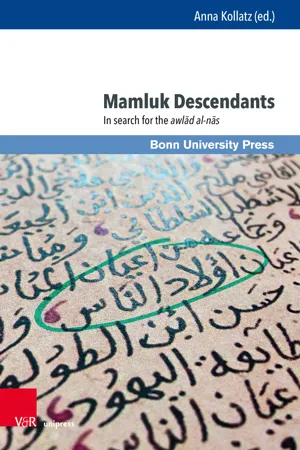
Research on the Mamluk period has so far remained relatively silent about the Mamluk descendants, who are often referred to by the Arabic term awl?d al-n?s (roughly: children of the elite). After Ulrich Haarmann's fundamental theses, research on this group seems to have paused, in comparison to the study dedicated to other social groups of Mamluk society. This volume brings together the results of an international conference and presents the state of the art in approaching the Mamluk descendants, whose emic perception as a group and social roles were far more differentiated and variable than previously assumed. The contributions shed light on the status of the Mamluk descendants from a variety of viewpoints, including historiographies, archival material, and artifacts produced by Mamluk descendants.
Information
Table of contents
- Title Page
- Copyright
- Table of Contents
- Body
- Anna Kollatz: Introduction: On to New Horizons—Tackling the Mamluks' Descendants
- Part I
- Jo Van Steenbergen: Where are the Awlād al-Nās? Arabic Historiography, Mamlūkization, and the Semantics and Discursive Politics of a Polysemous Concept
- Stephan Conermann: Mamluk Descendants in Military Service: The Ḥalqa
- Mustafa Banister: “Sulṭān Awlād al-Nās” or “Amīr ibn Mamlūk”? Re-framing Khalīl ibn Shāhīn’s Zubdat Kashf al-Mamālik wa-Bayān al-Ṭuruq wa-l-Masālik
- Noha Abou-Khatwa: The Muḥsinī Brothers: A Case Study in the Contribution of Mamluks’ Descendants to Cairo’s Material Culture i the Fourteenth Century
- Daisuke Igarashi: ˋWho should benefit from my Waqf?' Mamluks' Views on Progeny, Lineage, and Family based on their Waqf Stipulations
- Takao Ito: Awlād al-Nās during and after the Reign of al-Nāṣir Ḥasan
- Yehoshua Frenkel: Awlād al-Nās in Mamlūk Jerusalem: An Inquiry into several Ḥaram documents
- Part II
- Koby Yosef: The Rise of Mamlūks’ Descendants in the Turkish Period (648–784/1250–1382): The Status and Identity of Mamlūks’ Descendants who were Amirs in Cairo according to the Jarīda Iqṭāʿiyya of the Year 778/1377
- Appendix II: Categories of land and beneficiaries—The Tax yield of Egypt's land in 778/1377
- B. Beneficiary not mentioned (at all, or in 778/1377)—Total: 213,060 DJ + 1,617 feddans X 2.64 DJ 217,329 DJ~
- C. Beneficiary (or category of land) mentioned, but the relevant date is not mentioned—Total: 334,314 DJ + 60,567 feddans X 2.64 DJ 494,211 DJ~
- Bibliography
- Koby Yosef: The Term Awlād al-Nās and “the Rise of a New Class”
- Biographies
Trusted by 375,005 students
Access to over 1.5 million titles for a fair monthly price.
Study more efficiently using our study tools.
Frequently asked questions
Yes, you can cancel anytime from the Subscription tab in your account settings on the Perlego website. Your subscription will stay active until the end of your current billing period. Learn how to cancel your subscription
No, books cannot be downloaded as external files, such as PDFs, for use outside of Perlego. However, you can download books within the Perlego app for offline reading on mobile or tablet. Learn how to download books offline
Perlego offers two plans: Essential and Complete
- Essential is ideal for learners and professionals who enjoy exploring a wide range of subjects. Access the Essential Library with 800,000+ trusted titles and best-sellers across business, personal growth, and the humanities. Includes unlimited reading time and Standard Read Aloud voice.
- Complete: Perfect for advanced learners and researchers needing full, unrestricted access. Unlock 1.5M+ books across hundreds of subjects, including academic and specialized titles. The Complete Plan also includes advanced features like Premium Read Aloud and Research Assistant.
We are an online textbook subscription service, where you can get access to an entire online library for less than the price of a single book per month. With over 1.5 million books across 990+ topics, we’ve got you covered! Learn about our mission
Look out for the read-aloud symbol on your next book to see if you can listen to it. The read-aloud tool reads text aloud for you, highlighting the text as it is being read. You can pause it, speed it up and slow it down. Learn more about Read Aloud
Yes! You can use the Perlego app on both iOS and Android devices to read anytime, anywhere — even offline. Perfect for commutes or when you’re on the go.
Please note we cannot support devices running on iOS 13 and Android 7 or earlier. Learn more about using the app
Please note we cannot support devices running on iOS 13 and Android 7 or earlier. Learn more about using the app
Yes, you can access Mamluk Descendants by Anna Kollatz in PDF and/or ePUB format, as well as other popular books in History & European Medieval History. We have over 1.5 million books available in our catalogue for you to explore.