eBook - PDF
Representing Poverty in the Anglophone Postcolonial World
- 263 pages
- English
- PDF
- Available on iOS & Android
eBook - PDF
Representing Poverty in the Anglophone Postcolonial World
About this book
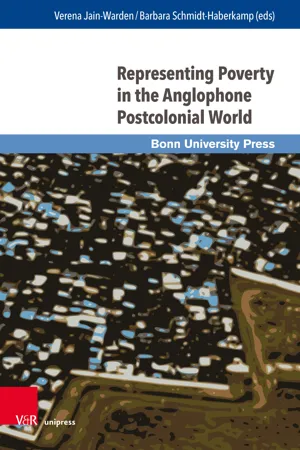
Originally a concern primarily of social studies and economics, poverty has emerged as a significant thematic focus and analytical tool in literary and cultural studies in the last two decades. The "new poverty studies" are dedicated to analyzing representations of poverty and the poor in literature and the visual arts, in the news media and in social practices. They aim at exploring the frameworks of representation that impact the affective and ethical responses of audiences to disenfranchised groups such as the poor. The contributions to this volume focus on representations of poverty in the Anglophone postcolonial world, exploring, for example, contemporary discourses on poverty in the UK, filmic representations of Nairobi slums or the agency of the poor in literature from India.
Information
Table of contents
- Title Page
- Copyright
- Table of Contents
- Barbara Schmidt-Haberkamp: Introduction
- Body
- 1. The Ethics of Representing Poverty
- Barbara Korte: Mumbai's Slums on London's South Bank: Ethics and Aesthetics of Staging Poverty ˋGlobally'
- Katharina Engel: ˋPoverty Porn' in Spoken Word Poetry? Kate Tempest's Brand New Ancients
- Rainer Hillrichs: Slum Affirmation and Magic Neorealism in One Fine Day Films' Soul Boy
- 2. Intersecting Aspects of Poverty and Agency
- Devindra Kohli: The Relevance of the Transforming Image of Self-volitional Deprivation: R. K. Narayan's The Guide
- Verena Jain-Warden: Facing Loss – Downward Social Mobility in Lauren Beukes's Zoo City
- 3. Transforming Stereotypes, Rewriting Poverty Discourse
- Miriam Nandi: “Idle Poor and Lazy Natives?” – Re-Writing Stereotypes about the Global Poor
- Jan Alber: The Humorous Negotiation of Aboriginal Poverty: Busted out Laughing by Dot Collard and Alexis Wright's Carpentaria
- Vijaya John Kohli: Ignoring Poverty in Sociolinguistic Discourse: The Curious Case of “Indian English” as a Linguistic Concept
- 4. Spatial Representations of Poverty
- Miriam Gertzen: Space-situatedness and Localised Poverties in Recent Young Adult Dystopian Novels
- Ellen Grünkemeier: South African Townships – Narrating Poverty in Spatial Terms in Sindiwe Magona's Writing
- 5. Global and Local Displacements
- Katrin Berndt: Paradise Lost: Intersections of Material, Cultural, and Emotional Poverty in NoViolet Bulawayo's We Need New Names
- Katrin Althans: Representations of Australian Refugee Experiences: Poverty or Bare Life?
- Marion Gymnich: Two Representations of Homelessness on British Television – Cathy Come Home and Call the Midwife
- Contributors
Trusted by 375,005 students
Access to over 1.5 million titles for a fair monthly price.
Study more efficiently using our study tools.
Frequently asked questions
Yes, you can cancel anytime from the Subscription tab in your account settings on the Perlego website. Your subscription will stay active until the end of your current billing period. Learn how to cancel your subscription
No, books cannot be downloaded as external files, such as PDFs, for use outside of Perlego. However, you can download books within the Perlego app for offline reading on mobile or tablet. Learn how to download books offline
Perlego offers two plans: Essential and Complete
- Essential is ideal for learners and professionals who enjoy exploring a wide range of subjects. Access the Essential Library with 800,000+ trusted titles and best-sellers across business, personal growth, and the humanities. Includes unlimited reading time and Standard Read Aloud voice.
- Complete: Perfect for advanced learners and researchers needing full, unrestricted access. Unlock 1.5M+ books across hundreds of subjects, including academic and specialized titles. The Complete Plan also includes advanced features like Premium Read Aloud and Research Assistant.
We are an online textbook subscription service, where you can get access to an entire online library for less than the price of a single book per month. With over 1.5 million books across 990+ topics, we’ve got you covered! Learn about our mission
Look out for the read-aloud symbol on your next book to see if you can listen to it. The read-aloud tool reads text aloud for you, highlighting the text as it is being read. You can pause it, speed it up and slow it down. Learn more about Read Aloud
Yes! You can use the Perlego app on both iOS and Android devices to read anytime, anywhere — even offline. Perfect for commutes or when you’re on the go.
Please note we cannot support devices running on iOS 13 and Android 7 or earlier. Learn more about using the app
Please note we cannot support devices running on iOS 13 and Android 7 or earlier. Learn more about using the app
Yes, you can access Representing Poverty in the Anglophone Postcolonial World by Verena Jain-Warden, Barbara Schmidt-Haberkamp, Verena Jain-Warden,Barbara Schmidt-Haberkamp in PDF and/or ePUB format, as well as other popular books in Literature & English Literary Criticism. We have over 1.5 million books available in our catalogue for you to explore.