eBook - PDF
Diz vliegende bîspel
Ambiguity in Medieval and Early Modern Literature. Essays in Honor of Arthur Groos
- 255 pages
- English
- PDF
- Available on iOS & Android
eBook - PDF
Diz vliegende bîspel
Ambiguity in Medieval and Early Modern Literature. Essays in Honor of Arthur Groos
About this book
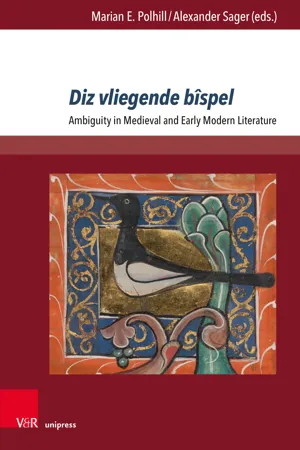
The volume explores the theme of ambiguity in medieval and early modern literature in essays honoring the life and work of Arthur Groos, Avalon Foundation Professor in the Humanities at Cornell University, USA, emeritus. The famous expression diz vliegende bîspel from Wolfram von Eschenbach's Parzival is its watchword. In the poem the black and white plumage of the magpie represents the characteristic complexity, ambiguity, and ambivalence of the romance. Removed from its historical context the expression is also a figure of Arthur Groos's wide-ranging intellectual flight. In addition to his work on medieval German verse narrative, he has made important contributions to courtly love poetry, medieval and early modern scientific literature, early modern German literature in general, and especially to opera.
Information
Table of contents
- Title Page
- Copyright
- Table of Contents
- Body
- Introduction
- Andrea Schindler: Mediale Mehrstimmigkeit. Der ‚Wigaloisˋ in Handschrift, Buchdruck und Comic
- Markus Stock: Cunneware de Lalant and Her Brothers. The Other Family in Wolfram's ˋParzival'
- Bonnie Buettner: rede unde tât. Gawan, Gramoflanz, and the Arthurian Court
- John Greenfield: gan mir got so vil der tage. On the Perception of Time and Space in Wolfram's ˋWillehalm'
- Matthias Meyer: The Prophesying Damsel in Heinrich von dem Türlin's ˋDiu Crône'. A case of intentional ambiguity?
- Marian E. Polhill: gewisser wân. Lovesickness in ˋMauritius von Craûn'
- Christoph Huber: Der zwiespältige Gelehrte. Zur Ambiguität der Aristoteles-Figur in mittelalterlichen Darstellungen (Artes-Repräsentant, Fürstenerzieher, Liebhaber)
- Alexander Sager: Stant ûf, ritter! Otto von Botenlouben's ˋWie sol ich den ritter nu gescheiden' as challenge to Wolfram's radical dawnsong ideology
- Volker Mertens: Minnesang – A Performative Approach
- David H. Price: The Uncertain Place of Love in Martin Opitz's ˋTeutsche Poemata' (1624 and 1625)
- Maria Dobozy: German Single-leaf Prints as Multi-media Objects. Texts, Images, and Performance Potential, 1529–1530
- Helmut Puff: sodomia und ironia um 1500. Versuch einer Annäherung
- Ingrid Bennewitz: Die Eigenthümlichkeit einer alten Geschichte. Hartmanns ‚Erecˋ als Sonderfall von Überlieferung und Rezeptio mit einem Ausblick auf Richard Wagners ‚Erecˋ-Lektüre
- Danielle Buschinger: Produktive ‚Nibelungenliedˋ-Rezeption in Opern des 19. Jahrhunderts. Ernst Raupach, Eduard Gerber/Heinrich Dorn und Louise Otto-Peters
- Publications of Arthur Groos
- Contributors
Trusted by 375,005 students
Access to over 1.5 million titles for a fair monthly price.
Study more efficiently using our study tools.
Frequently asked questions
Yes, you can cancel anytime from the Subscription tab in your account settings on the Perlego website. Your subscription will stay active until the end of your current billing period. Learn how to cancel your subscription
No, books cannot be downloaded as external files, such as PDFs, for use outside of Perlego. However, you can download books within the Perlego app for offline reading on mobile or tablet. Learn how to download books offline
Perlego offers two plans: Essential and Complete
- Essential is ideal for learners and professionals who enjoy exploring a wide range of subjects. Access the Essential Library with 800,000+ trusted titles and best-sellers across business, personal growth, and the humanities. Includes unlimited reading time and Standard Read Aloud voice.
- Complete: Perfect for advanced learners and researchers needing full, unrestricted access. Unlock 1.5M+ books across hundreds of subjects, including academic and specialized titles. The Complete Plan also includes advanced features like Premium Read Aloud and Research Assistant.
We are an online textbook subscription service, where you can get access to an entire online library for less than the price of a single book per month. With over 1.5 million books across 990+ topics, we’ve got you covered! Learn about our mission
Look out for the read-aloud symbol on your next book to see if you can listen to it. The read-aloud tool reads text aloud for you, highlighting the text as it is being read. You can pause it, speed it up and slow it down. Learn more about Read Aloud
Yes! You can use the Perlego app on both iOS and Android devices to read anytime, anywhere — even offline. Perfect for commutes or when you’re on the go.
Please note we cannot support devices running on iOS 13 and Android 7 or earlier. Learn more about using the app
Please note we cannot support devices running on iOS 13 and Android 7 or earlier. Learn more about using the app
Yes, you can access Diz vliegende bîspel by Marian Polhill, Alexander Sager, Marian E. Polhill,Alexander Sager, Marian E. Polhill, Alexander Sager in PDF and/or ePUB format, as well as other popular books in Literature & German Literary Criticism. We have over 1.5 million books available in our catalogue for you to explore.