eBook - PDF
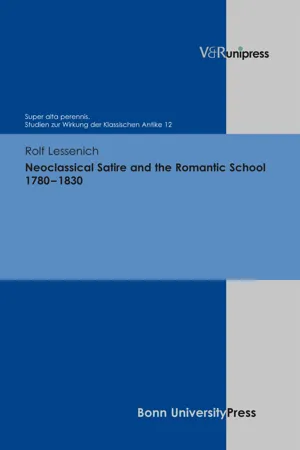
Neoclassical Satire and the Romantic School 1780–1830
- 438 pages
- English
- PDF
- Available on iOS & Android
eBook - PDF
Neoclassical Satire and the Romantic School 1780–1830
About this book
Romanticism was not only heterogeneous and disunited. It also had to face the counter-movements of the Enlightenment and Augustan Neoclassicism, which were still gaining momentum in the decades around the French Revolution. Neoclassicists regarded Romanticism as a heretical amalgam of dissenting "new schools" threatening the monopoly of the Classical Tradition. Acrimonious debates in aesthetics and politics were conducted with the traditional strategies of the classical "ars disputandi" on both sides. Under the duress of the heaviest satirical attacks, Romanticism began to gradually see itself as one movement, giving rise to the problematic opposition of "Classical" with "Romantic". This construction, however, was indispensable for the clarification of different positions among the hubbub of conflicting voices. It has also proved critical in literary and cultural studies. The Classical Tradition emerges as an ongoing event from Greek and Latin antiquity via Neoclassicism and Romanticism to our time.
Information
Table of contents
- Title Page
- Copyright
- Table of Contents
- Body
- Preliminary
- Introduction
- I. The Classical Tradition and the Poetics of Satire
- II. Tory Periodicals and Anti-Jacobin Satire
- III. William Gifford against the Della-Cruscan Poets and the Non-Classical Stage
- IV. Lord Byron in Defence of the Classical Tradition
- V. The Function of Criticism
- VI. Arguments in the Debate against the Romantic School
- VII. The Romantic School
- VIII. Neoclassicism, Romantic Disillusionism, Victorianism, and after
- Select Bibliography
Trusted by 375,005 students
Access to over 1.5 million titles for a fair monthly price.
Study more efficiently using our study tools.
Frequently asked questions
Yes, you can cancel anytime from the Subscription tab in your account settings on the Perlego website. Your subscription will stay active until the end of your current billing period. Learn how to cancel your subscription
No, books cannot be downloaded as external files, such as PDFs, for use outside of Perlego. However, you can download books within the Perlego app for offline reading on mobile or tablet. Learn how to download books offline
Perlego offers two plans: Essential and Complete
- Essential is ideal for learners and professionals who enjoy exploring a wide range of subjects. Access the Essential Library with 800,000+ trusted titles and best-sellers across business, personal growth, and the humanities. Includes unlimited reading time and Standard Read Aloud voice.
- Complete: Perfect for advanced learners and researchers needing full, unrestricted access. Unlock 1.5M+ books across hundreds of subjects, including academic and specialized titles. The Complete Plan also includes advanced features like Premium Read Aloud and Research Assistant.
We are an online textbook subscription service, where you can get access to an entire online library for less than the price of a single book per month. With over 1.5 million books across 990+ topics, we’ve got you covered! Learn about our mission
Look out for the read-aloud symbol on your next book to see if you can listen to it. The read-aloud tool reads text aloud for you, highlighting the text as it is being read. You can pause it, speed it up and slow it down. Learn more about Read Aloud
Yes! You can use the Perlego app on both iOS and Android devices to read anytime, anywhere — even offline. Perfect for commutes or when you’re on the go.
Please note we cannot support devices running on iOS 13 and Android 7 or earlier. Learn more about using the app
Please note we cannot support devices running on iOS 13 and Android 7 or earlier. Learn more about using the app
Yes, you can access Neoclassical Satire and the Romantic School 1780–1830 by Rolf P. Lessenich, Uwe Baumann, Marc Laureys, Winfried Schmitz, Uwe Baumann,Marc Laureys,Winfried Schmitz in PDF and/or ePUB format, as well as other popular books in Storia & Riferimenti storici. We have over 1.5 million books available in our catalogue for you to explore.