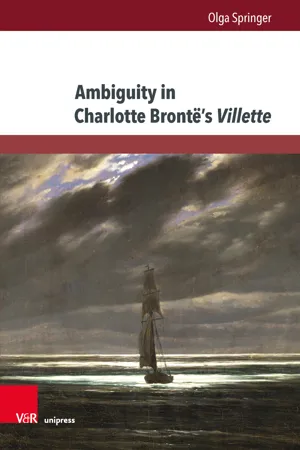
Charlotte Brontë's final novel Villette (1853) is associated with ambiguity because of its open ending: Does M. Paul return to narrator-protagonist Lucy Snowe or is he killed in a storm raging on the Atlantic? Taking its famous ending as a starting point, this study explores Villette as a text in which ambiguity is all-pervasive in various ways. Among these is the narrator's ambivalent attitude toward herself and others, epitomised in her stylistic idiosyncrasies. The links between ambiguity and doubt are explored through an analysis of Lucy's signature phrase, "I know not, " expressive of her existential doubts and questioning attitude toward the world. The analysis moreover focuses on the motif of the oracle as a traditionally ambiguous utterance, and explores its relevance in the context of the generic tradition of Villette as a fictional autobiography. Another focus is the interplay of figurative and literal levels of meaning in the allegorical episodes, creating ambiguity.
- 285 pages
- English
- PDF
- Available on iOS & Android
eBook - PDF
Ambiguity in Charlotte Brontë's Villette
About this book
Information
Table of contents
- Title Page
- Copyright
- Table of Contents
- Body
- Acknowledgements
- I. Introduction
- II. The Signature of Ambiguity: “I know not”
- III. Who Is Lucy Snowe?
- IV. “ˋBad or good?'” – Endeavours at Oracular Prediction
- V. “[C]overed with a cloud”: Allegory
- VI. Conclusion: The Treasure of Letters and the Ambiguity of Hope
- VII. Works Cited
Trusted by 375,005 students
Access to over 1.5 million titles for a fair monthly price.
Study more efficiently using our study tools.
Frequently asked questions
Yes, you can cancel anytime from the Subscription tab in your account settings on the Perlego website. Your subscription will stay active until the end of your current billing period. Learn how to cancel your subscription
No, books cannot be downloaded as external files, such as PDFs, for use outside of Perlego. However, you can download books within the Perlego app for offline reading on mobile or tablet. Learn how to download books offline
Perlego offers two plans: Essential and Complete
- Essential is ideal for learners and professionals who enjoy exploring a wide range of subjects. Access the Essential Library with 800,000+ trusted titles and best-sellers across business, personal growth, and the humanities. Includes unlimited reading time and Standard Read Aloud voice.
- Complete: Perfect for advanced learners and researchers needing full, unrestricted access. Unlock 1.5M+ books across hundreds of subjects, including academic and specialized titles. The Complete Plan also includes advanced features like Premium Read Aloud and Research Assistant.
We are an online textbook subscription service, where you can get access to an entire online library for less than the price of a single book per month. With over 1.5 million books across 990+ topics, we’ve got you covered! Learn about our mission
Look out for the read-aloud symbol on your next book to see if you can listen to it. The read-aloud tool reads text aloud for you, highlighting the text as it is being read. You can pause it, speed it up and slow it down. Learn more about Read Aloud
Yes! You can use the Perlego app on both iOS and Android devices to read anytime, anywhere — even offline. Perfect for commutes or when you’re on the go.
Please note we cannot support devices running on iOS 13 and Android 7 or earlier. Learn more about using the app
Please note we cannot support devices running on iOS 13 and Android 7 or earlier. Learn more about using the app
Yes, you can access Ambiguity in Charlotte Brontë's Villette by Olga Springer in PDF and/or ePUB format, as well as other popular books in Literature & Comics & Graphic Novels Literary Criticism. We have over 1.5 million books available in our catalogue for you to explore.