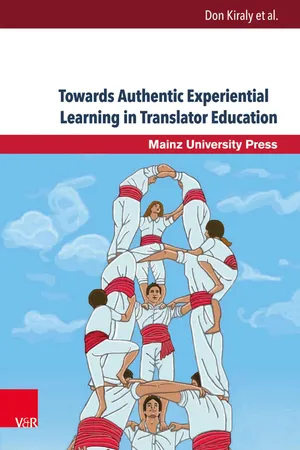
This volume deals with the theory and practice of incorporating authentic experiential work into curricula for the education of professional translators and interpreters. The contributions deal with a wide variety of topics in this domain, extending from the foundations of experiential learning in pedagogical epistemology to discussions of exemplary experiments with the use of authentic project work at leading translator and interpreter education institutions in Germany, Spain and Switzerland. Matters of educational philosophy, curriculum design as well as instructional design are dealt with, and the wide range of focal points and perspectives of the various authors provides a multi-facetted view of authentic project work that has so far been lacking in translation pedagogy literature.
- 208 pages
- English
- PDF
- Available on iOS & Android
eBook - PDF
Towards Authentic Experiential Learning in Translator Education
About this book
Information
Table of contents
- Title Page
- Copyright
- Table of Contents
- Body
- Acknowledgements
- Preface
- Raquel Pacheco Aguilar (University of Mainz/Germersheim): Chapter 1: The Question of Authenticity in Translator Education from the Perspective of Educational Philosophy
- Susanne Hagemann (University of Mainz/Germersheim): Chapter 2: (Non-)Professional, Authentic Projects? Why Terminology Matters
- Don Kiraly (University of Mainz/Germersheim): Chapter 3: Authentic Project Work and Pedagogical Epistemologies: A Question of Competing or Complementary Worldviews?
- Don Kiraly and Sascha Hofmann (University of Mainz/Germersheim): Chapter 4: Towards a Postpositivist Curriculum Development Model for Translator Education
- Don Kiraly, Lisa Rüth, Marcus Wiedmann (University of Mainz/Germersheim): Chapter 5: Enhancing Translation Course Design and Didactic Interventions with E-Learning
- Maren Dingfelder Stone (University of Mainz/Germersheim): Chapter 6: Authenticity, Autonomy, and Automation: Training Conference Interpreters
- Andrea Cnyrim (Karlsruhe University of Applied Sciences): Chapter 7: Developing Intercultural Competence through Authentic Projects in the Classroom
- Catherine Way (University of Granada): Chapter 8: Intra-University Projects as a Solution to the Simulated/Authentic Dilemma
- Carmen Canfora (University of Mainz/Germersheim): Chapter 9: Assessing Learning in Heterogeneous Learning Groups in Translator Training – A Role for Portfolios
- Gary Massey and Barbara Brändli (Zurich University of Applied Sciences/Winterthur): Chapter 10: Collaborative feedback flows and how we can learn from them: investigating a synergetic learning experience in translator education
- Epilogue
- Contributors
Trusted by 375,005 students
Access to over 1.5 million titles for a fair monthly price.
Study more efficiently using our study tools.
Frequently asked questions
Yes, you can cancel anytime from the Subscription tab in your account settings on the Perlego website. Your subscription will stay active until the end of your current billing period. Learn how to cancel your subscription
No, books cannot be downloaded as external files, such as PDFs, for use outside of Perlego. However, you can download books within the Perlego app for offline reading on mobile or tablet. Learn how to download books offline
Perlego offers two plans: Essential and Complete
- Essential is ideal for learners and professionals who enjoy exploring a wide range of subjects. Access the Essential Library with 800,000+ trusted titles and best-sellers across business, personal growth, and the humanities. Includes unlimited reading time and Standard Read Aloud voice.
- Complete: Perfect for advanced learners and researchers needing full, unrestricted access. Unlock 1.5M+ books across hundreds of subjects, including academic and specialized titles. The Complete Plan also includes advanced features like Premium Read Aloud and Research Assistant.
We are an online textbook subscription service, where you can get access to an entire online library for less than the price of a single book per month. With over 1.5 million books across 990+ topics, we’ve got you covered! Learn about our mission
Look out for the read-aloud symbol on your next book to see if you can listen to it. The read-aloud tool reads text aloud for you, highlighting the text as it is being read. You can pause it, speed it up and slow it down. Learn more about Read Aloud
Yes! You can use the Perlego app on both iOS and Android devices to read anytime, anywhere — even offline. Perfect for commutes or when you’re on the go.
Please note we cannot support devices running on iOS 13 and Android 7 or earlier. Learn more about using the app
Please note we cannot support devices running on iOS 13 and Android 7 or earlier. Learn more about using the app
Yes, you can access Towards Authentic Experiential Learning in Translator Education by Don Kiraly in PDF and/or ePUB format, as well as other popular books in Literature & Literary Criticism History & Theory. We have over 1.5 million books available in our catalogue for you to explore.