eBook - PDF
Caring and Killing
Nursing and Psychiatric Practice in Germany, 1931–1943
- 280 pages
- English
- PDF
- Available on iOS & Android
eBook - PDF
Caring and Killing
Nursing and Psychiatric Practice in Germany, 1931–1943
About this book
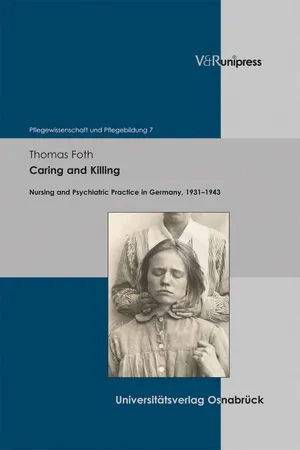
Under the Nazi regime in Germany a calculated killing of chronic "mentally ill" patients took place. Nurses executed this program in their everyday practice. However, suspicions have been raised that psychiatric patients were also assassinated before and after the Nazi regime, suggesting that the motives for these killings must be investigated within psychiatric practice itself. This book highlights the mechanisms and scientific discourses in place that allowed nurses to perceive patients as unworthy of life. This study analyzes patient records as "inscriptions" that actively intervene in interactions in institutions and that create a specific reality on their own accord. The question is not whether the reality represented within the documents is true, but rather how documents worked in institutions and what their effects were. It is shown how nurses were actively involved in the construction of patients' identities and how these "documentary identities" led to the death of thousands of humans.
Information
Table of contents
- Title Page
- Copyright
- Table of Contents
- Body
- Preface
- Foreword
- Abstract
- List of tables
- List of figures
- Acknowledgements
- Chapter 1: Introduction
- Chapter 2: Historical Background of the Killing of Sick Persons
- Chapter 3: The History of the Langenhorn Asylum from 1893 to 1945
- Chapter 4: Anna Maria Buller's First Admission in 1931: Analysis of the Record
- Chapter 5: Transfer to House 16 (March 1931)
- Chapter 6: The Intensification of the War against the Madness: Buller's Subsequent Admissions (1932–1943)
- Chapter 7: Conclusion
- Appendix
- Bibliography
Trusted by 375,005 students
Access to over 1.5 million titles for a fair monthly price.
Study more efficiently using our study tools.
Frequently asked questions
Yes, you can cancel anytime from the Subscription tab in your account settings on the Perlego website. Your subscription will stay active until the end of your current billing period. Learn how to cancel your subscription
No, books cannot be downloaded as external files, such as PDFs, for use outside of Perlego. However, you can download books within the Perlego app for offline reading on mobile or tablet. Learn how to download books offline
Perlego offers two plans: Essential and Complete
- Essential is ideal for learners and professionals who enjoy exploring a wide range of subjects. Access the Essential Library with 800,000+ trusted titles and best-sellers across business, personal growth, and the humanities. Includes unlimited reading time and Standard Read Aloud voice.
- Complete: Perfect for advanced learners and researchers needing full, unrestricted access. Unlock 1.5M+ books across hundreds of subjects, including academic and specialized titles. The Complete Plan also includes advanced features like Premium Read Aloud and Research Assistant.
We are an online textbook subscription service, where you can get access to an entire online library for less than the price of a single book per month. With over 1.5 million books across 990+ topics, we’ve got you covered! Learn about our mission
Look out for the read-aloud symbol on your next book to see if you can listen to it. The read-aloud tool reads text aloud for you, highlighting the text as it is being read. You can pause it, speed it up and slow it down. Learn more about Read Aloud
Yes! You can use the Perlego app on both iOS and Android devices to read anytime, anywhere — even offline. Perfect for commutes or when you’re on the go.
Please note we cannot support devices running on iOS 13 and Android 7 or earlier. Learn more about using the app
Please note we cannot support devices running on iOS 13 and Android 7 or earlier. Learn more about using the app
Yes, you can access Caring and Killing by Thomas Foth, Hartmut Remmers in PDF and/or ePUB format, as well as other popular books in Medicine & Medical Theory, Practice & Reference. We have over 1.5 million books available in our catalogue for you to explore.