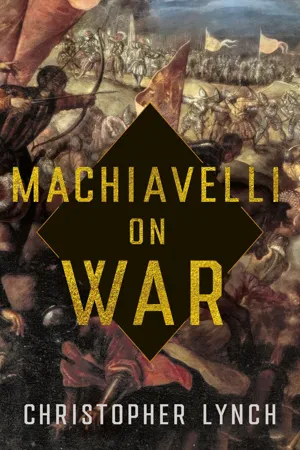
Machiavelli on War
eBook - ePub

Machiavelli on War

  1. 372 pages
  2. English
  3. ePUB (mobile friendly)
  4. Available on iOS & Android
eBook - ePub

Machiavelli on War

About this book

Machiavelli on War offers a comprehensive interpretation of the philosopher-historian's treatment of war throughout his writings, from poems and memoranda drafted while he was Florence's top official for military matters to his posthumous works, The Prince and Discourses on Livy. Christopher Lynch argues that the issue of war permeates the form and content of each of Machiavelli's works, the substance of his thoughts, and his own activity as a writer, concluding that he was the first great modern philosopher because he was the first modern philosopher of war.

Lynch details Machiavelli's understanding of warfare in terms of both actual armed conflict and at the intellectual level of thinkers competing on the field of knowledge and belief. Throughout Machiavelli's works, he focuses on how military commanders' knowledge of human necessities, beginning with their own, enables and requires them to mold soldiers, organizationally and politically, to best deploy them in operations attuned to political context and changing circumstances. Intellectually, leaders must shape minds, their own and others', to reject beliefs that would weaken their purpose; for Machiavelli, this meant overcoming the classical and Christian traditions in favor of a new teaching of human freedom and excellence.

As Machiavelli on War makes clear, prevailing both on the battlefield and in the war of ideas demands a single-minded engagement in "reasoning about everything," beginning with oneself. For Machiavelli, Lynch shows, the successful military commander is not just an excellent leader but also an excellent human being in constant pursuit of the truth about themselves and the world.

Frequently asked questions

Yes, you can cancel anytime from the Subscription tab in your account settings on the Perlego website. Your subscription will stay active until the end of your current billing period. Learn how to cancel your subscription.
No, books cannot be downloaded as external files, such as PDFs, for use outside of Perlego. However, you can download books within the Perlego app for offline reading on mobile or tablet. Learn more here.
Perlego offers two plans: Essential and Complete
  • Essential is ideal for learners and professionals who enjoy exploring a wide range of subjects. Access the Essential Library with 800,000+ trusted titles and best-sellers across business, personal growth, and the humanities. Includes unlimited reading time and Standard Read Aloud voice.
  • Complete: Perfect for advanced learners and researchers needing full, unrestricted access. Unlock 1.4M+ books across hundreds of subjects, including academic and specialized titles. The Complete Plan also includes advanced features like Premium Read Aloud and Research Assistant.
Both plans are available with monthly, semester, or annual billing cycles.
We are an online textbook subscription service, where you can get access to an entire online library for less than the price of a single book per month. With over 1 million books across 1000+ topics, we’ve got you covered! Learn more here.
Look out for the read-aloud symbol on your next book to see if you can listen to it. The read-aloud tool reads text aloud for you, highlighting the text as it is being read. You can pause it, speed it up and slow it down. Learn more here.
Yes! You can use the Perlego app on both iOS or Android devices to read anytime, anywhere — even offline. Perfect for commutes or when you’re on the go.
Please note we cannot support devices running on iOS 13 and Android 7 or earlier. Learn more about using the app.
Yes, you can access Machiavelli on War by Christopher Lynch in PDF and/or ePUB format, as well as other popular books in History & Military & Maritime History. We have over one million books available in our catalogue for you to explore.

Table of contents

  1. Acknowledgments
  2. Abbreviations and Citations
  3. Introduction
  4. Part I. Secretary of War 9
  5. Part II. War and Politics 57
  6. Part III. Politics and War 117
  7. Part IV. Philosopher of War 229
  8. Conclusion
  9. Notes
  10. Bibliography
  11. Index